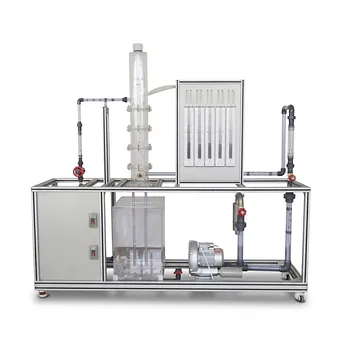
Integrating dividing wall columns (DWC) and side-stream columns into unit operations pilot plants directly answers the call for process intensification. These configurations allow a single column shell to cleanly separate a ternary mixture into three pure product streams—a task that conventionally requires two full distillation columns in series. The immediate advantage is a dramatic, simultaneous reduction in capital equipment, plant footprint, and energy consumption, while creating an unmatched training ground for future engineers to master the complex control puzzles these smart systems demand.
Complex column pilot plants condense a two-column separation into one thermally integrated unit, slashing hardware cost and energy use by roughly 30–50% compared to a simple column sequence. Their real power, however, lies in teaching the advanced multivariable control strategies that directly translate to the modern, energy-conscious process industry.
The Capital and Energy Efficiency Leap
Single-Shell, Triple-Product Separation
A traditional separation of a ternary mixture requires two separate distillation towers, each with its own reboiler, condenser, and associated infrastructure.
A DWC or a side-stream column with an integrated stripper performs the same task inside a single vertical shell, partitioned by a wall or cleverly arranged side draws.
This architectural consolidation eliminates an entire column, condenser, reboiler, and large-bore interconnecting piping, directly cutting the purchased equipment cost and halving the physical footprint.
Thermal Coupling and Heat Integration
The true genius of these designs is the thermally coupled internal flows. Heat removed at one section becomes the vapour traffic for another, eliminating wasteful remixing of separated components that occurs in a standard sequence.
The result is a fundamental thermodynamic efficiency gain. Pilot‑scale studies routinely demonstrate that a DWC can deliver the same product purities with 30% less total energy input compared to a conventional two‑column train.
For universities, this means the same separation goal is achieved while consuming dramatically less steam and cooling water—immediately positioning research projects within the sustainability and carbon‑reduction agenda.
Quantifying Real-World Savings
Industrial case studies and pilot‑scale data show that the switch to DWC can reduce operating costs by 25–50% and lower the overall life‑cycle cost of a separation system.
When these numbers are demonstrated on a tangible pilot plant, they stop being abstract textbook figures and become a powerful convener for industry‑funded research and collaborative grants.
The cost‑saving narrative is not just about economics; it becomes an objective, measurable entry point into deeper conversations about resource efficiency and decarbonisation.
Hands-On Mastery of Advanced Process Control
Managing Multiple Degrees of Freedom
A simple binary column has only two main handles: reflux and boil‑up. A dividing wall column introduces a web of interconnected control loops—liquid split to each side of the wall, vapour split, side‑stream flow rates, and multiple temperature profiles.
Operating these systems in a pilot plant forces students and researchers to move beyond single‑loop thinking and tackle true multivariable control, the kind that is now essential in any modern refinery or chemical complex.
They learn to diagnose interactions, tune cascade loops, and appreciate how a small change in the liquid split ratio can simultaneously disturb product purity on both sides of the wall.
Bridging Theory and Industrial Reality
Most graduates encounter advanced distillation only through steady‑state simulations. A pilot DWC exposes them to the non‑linear dynamics, time delays, and real‑world noise that simulators often sanitise.
They witness firsthand the “bow‑tie” temperature profiles that form around the dividing wall, and they must devise inferential control strategies when on‑line composition analysers are unavailable—skills that are directly transferable to operating industrial DWC installations.
This practical fluency transforms a student from a theoretical thinker into a plant‑ready engineer who can hit the ground running during a start‑up or debottlenecking project.
From Simple to Complex: A Controlled Learning Curve
A side‑stream column with a simple stripper is an ideal stepping stone. It introduces the concept of extracting a third product from a single shell without the full complexity of a vertical partition wall.
Pilot plants can be designed with removable walls or configurable side‑draw stations, allowing a progressive curriculum: start with a conventional configuration, advance to side‑stream operation, and finally tackle a complete DWC.
This staged exposure ensures that the learning curve is never overwhelming, yet it yields deep, transferable insights into process intensification and complex control architecture.
Pioneering Process Intensification Research
Enabling Sustainability and Decarbonization Studies
When a pilot DWC achieves the same separation with 30% less energy, it directly contributes to the United Nations Sustainable Development Goals and aligns with global net‑zero targets.
Researchers can use the pilot unit to benchmark novel heat‑pump‑assisted DWC configurations, evaluate solvents for extractive dividing wall columns (EDWC), or test advanced model‑predictive control algorithms that push efficiency even further.
The plant becomes a living laboratory where the link between process design decisions and real‑time carbon footprint can be measured, reported, and optimised.
Exploring Extractive Dividing Wall Columns (EDWC) and Hybrid Configurations
The same pilot‑scale flexibility enables the study of Extractive Dividing Wall Columns (EDWC), where a heavy solvent is injected to break azeotropes — all within a single shell.
This fuses the capital‑footprint reduction of a DWC with the high‑efficiency separation of extractive distillation, a combination that is rapidly gaining traction in biofuel and specialty chemical industries.
By running such configurations, the research group generates unique data sets on solvent distribution, wall‑side pressure balance, and long‑term fouling behaviour that are rarely available in public literature, directly strengthening publication output and IP creation.
Understanding the Trade-offs
Increased Operational Complexity
A DWC is fundamentally more complicated to operate than a simple binary column. The liquid and vapour split ratios are not independent—adjusting one loop can disturb several others, making manual operation demanding and error‑prone.
Without proper training and automated safeguards, the column can drift into a state where all three product streams go off‑spec simultaneously, requiring a lengthy and costly recovery.
This complexity is precisely why a pilot plant is essential: it provides a safe, low‑stakes environment to experience these interactions and develop robust operating procedures before any attempt at industrial scale‑up.
Demanding Instrumentation and Control Requirements
To extract the full benefit, a DWC pilot plant needs higher‑resolution temperature sensors along the entire column length, reliable flow control for the divided sections, and often an online composition analyser or soft sensor.
The initial investment in instrumentation can be 20–40% higher than that of a conventional distillation skid, and the maintenance burden is non‑trivial.
However, this instrumentation is the very toolkit that enables advanced control research; it becomes a platform for training in Industry 4.0 concepts, such as real‑time optimisation and digital twin development, which far outweigh the incremental upfront cost.
The Risk of Operational Inflexibility
A DWC is designed for a specific separation task. If the feed composition changes drastically or a new product slate is required, the fixed internal wall becomes a liability rather than an asset.
In contrast, a conventional two‑column sequence offers more flexibility to reroute streams. Pilot‑scale research must therefore investigate turndown capabilities and the economic limits of feed variability, which are critical data points for industrial decision‑making.
A well‑designed pilot plant with configurable internals can mitigate this by allowing the wall position or side‑draw location to be changed between experimental campaigns, turning a potential weakness into a research strength.
Making the Right Choice for Your Goal
The integration of dividing wall and side‑stream columns into a unit operations pilot plant is not a one‑size‑fits‑all decision. Prioritise your objectives to shape the design.
- If your primary focus is undergraduate and vocational training: Start with a side‑stream configuration to introduce the concept of multi‑product separation, then add a physical dividing wall module that can be inserted for advanced coursework. This staged approach controls cost while maximising pedagogical impact.
- If your primary focus is groundbreaking research in energy efficiency and decarbonisation: Invest immediately in a fully instrumented DWC with the flexibility to operate in extractive mode (EDWC). The data sets on internal flow distribution and dynamic control will fuel high‑impact publications and attract sustainable‑chemistry grants.
- If your primary focus is industrial collaboration and technology transfer: Equip the pilot plant with industry‑standard DCS, advanced process control software, and remote access capabilities. Position the unit as a test bed where industrial partners can trial new control algorithms, solvent systems, or feedstocks at minimal risk before committing to capital‑intensive plant trials.
By selecting the right complexity level and instrumentation, you transform a distillation pilot plant from a simple teaching tool into a strategic asset that drives educational excellence, research leadership, and real‑world process innovation.
Summary Table:
| Feature / Metric | Conventional Distillation | DWC & Side-Stream Columns | Pilot Plant Advantage |
|---|---|---|---|
| Equipment & Footprint | Two columns in series | Single vertical shell | Cuts capital costs and halves physical footprint |
| Energy Efficiency | Standard thermal load | 30% to 50% energy reduction | Aligns academic research with decarbonization goals |
| Process Control | Simple loops (reflux/boil-up) | Complex multivariable loops | Offers hands-on training for advanced industrial control |
| System Flexibility | High (easy to reroute streams) | Low (designed for specific tasks) | Safe environment to study turndown and feed variability |
Elevate Your Chemical Engineering Lab with LABPARK
Are you looking to integrate advanced process intensification technologies like dividing wall columns into your curriculum or research?
LABPARK provides premium Educational and Vocational Unit Operations Pilot Plants in chemical engineering, bioprocess & biotech, and environmental & water treatment. Designed specifically for universities, research institutes, and enterprises, our plants offer the high-end instrumentation and flexible configurations required to bridge the gap between theory and industrial reality.
Contact LABPARK today to discuss your pilot plant requirements and get a customized solution!
Related Products
- Dual-Mode Rectification Pilot Plant for Practical Training Unit Operations
- Bench Scale Dual Column Gas Separation and Capture Educational Pilot Plant
- Absorption and Desorption Educational Unit Operations Pilot Plant
- Multi-Modal Distillation Unit Operations Training Pilot Plant
- Plate Column Hydrodynamics Tray Demonstration Educational Pilot Plant
People Also Ask
- How does polyphosphate hydrolysis affect scale and corrosion in pilot plants? Essential Monitoring Guide
- How do predictive thermodynamic models integrate into pilot plants? Bridging Theory and Practice
- How do utility requirements influence pilot plant selection? Avoid Costly Lab Integration Mistakes
- Why are Phase Equilibria & Enthalpy Vital in Separation Pilot Plants? Optimize Your Research
- Why Unit Operations Pilot Plants Are Critical for Nanotech Integration: Scale-Up Secrets