Knowledge Chemical Engineering Education Why is EDC cracking conversion limited to 50%-60%? Essential pilot plant insights.
Author avatar

Tech Team · LABPARK

Updated 1 month ago

Why is EDC cracking conversion limited to 50%-60%? Essential pilot plant insights.


The single-pass conversion limit is not a shortcoming—it’s a deliberately engineered throttle that keeps the entire plant running.
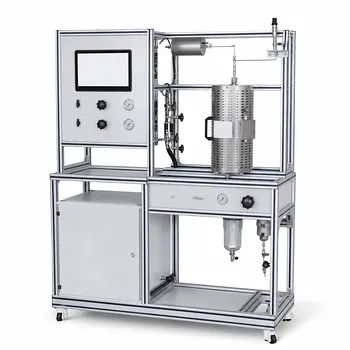
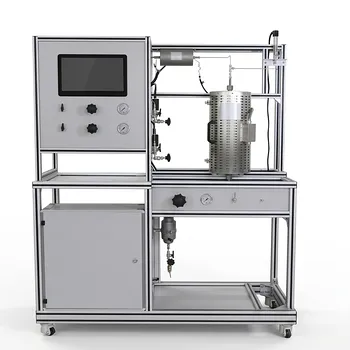
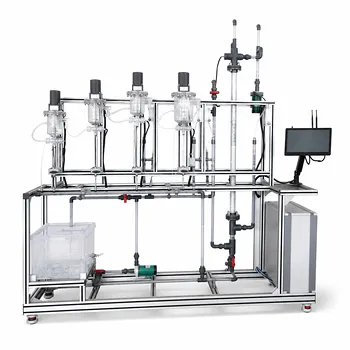
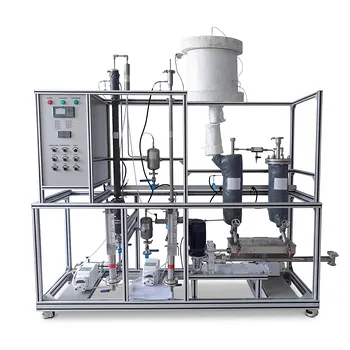
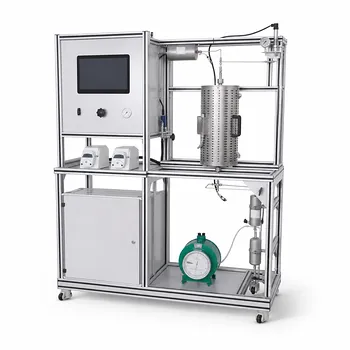
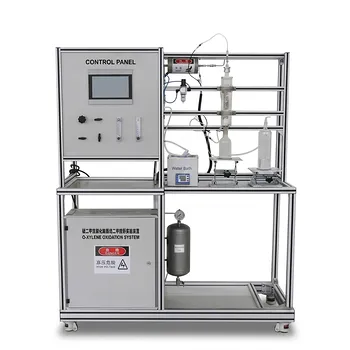
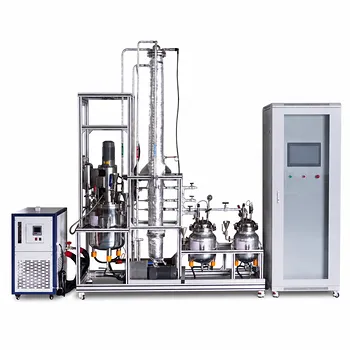
The thermal cracking of 1,2‑dichloroethane (EDC) into vinyl chloride monomer (VCM) deliberately caps conversion at 50–60 % per pass. Pushing the reaction beyond that window accelerates coke formation on the tube walls to a point where the reactor pressure drop skyrockets, side impurities multiply, and the economic balance collapses. A reactor pilot plant brings this control concept to life: students systematically vary furnace heat input and watch how pressure drop evolves, directly demonstrating the real‑world trade‑off between single‑pass yield and plant availability.

Thermal cracking of EDC operates inside a narrow, deliberate conversion window because beyond 50–60 %, the rate of carbon deposition and impurity generation outweighs any small gain in vinyl chloride output. The pilot plant translates that industrial truth into a teachable moment—manipulating furnace duty and monitoring the resulting pressure drop makes the balance between yield, downtime, and energy costs tangible.

The Science Behind the 50–60 % Conversion Ceiling

The limit is not arbitrary; it is written into the thermodynamics and kinetics of the system.

The Chemical Pathway to Vinyl Chloride

1,2‑dichloroethane decomposes at high temperatures (430–530 °C) through a free‑radical chain mechanism.
The main cracking step strips a molecule of HCl, producing vinyl chloride.
This reaction is highly endothermic—you must keep supplying intense heat to sustain it.

Why Higher Conversion Spells Disaster

Raising the furnace temperature or the residence time pushes more EDC to crack, but it also fuels two hostile side paths.
First, the vinyl chloride itself can further dehydrogenate, forming acetylene and leading to oligomerization that leaves solid carbon deposits (coke) on the tube walls.
Second, trace reactions with chlorinated intermediates generate impurities such as methyl chloride, which are costly to separate downstream.
The coke layer acts as an insulator, forcing tube metal temperatures even higher, which in turn accelerates coke formation in a runaway feedback loop.

The Economics of Yield vs. Downtime

A higher single‑pass conversion would seem to improve raw material utilisation.
In practice, the reactor must be shut down for decoking far more frequently when coking rates soar beyond the 50–60 % zone.
The capital and energy cost of cleaning, plus the lost production hours, quickly erases any modest gain in per‑pass VCM output.
Industrial plants therefore recycle the unreacted EDC back to the reactor inlet, accepting a lower per‑pass conversion to keep the entire train running reliably.

Illustrating the Control Concept in a Reactor Pilot Plant

A pilot‑scale cracking furnace gives chemical engineering students a direct, hands‑on window into this balancing act.

How Students Replicate Industrial Behaviour

In a teaching pilot plant, the operator deliberately increases the heat input to the cracking furnace.
As the reactor wall temperature climbs, the single‑pass conversion edges upward.
Almost immediately, the pressure drop across the reactor tube begins to rise—a tell‑tale sign of accumulating coke deposits that narrow the flow cross‑section.
When the furnace duty is reduced back to the range that yields 50–60 % conversion, the pressure drop stabilises, confirming that the coking rate has returned to an acceptable baseline.

Learning Through Parameters: Temperature, Time, and Coke

Students monitor not just the downstream VCM concentration but also the rate of pressure‑drop increase over a fixed interval.
By plotting conversion versus delta‑P per hour, they see a distinct inflection point where coking accelerates sharply.
This inflection aligns with the 50–60 % conversion threshold found in full‑scale plants, vividly teaching that optimum conversion is found not at the maximum, but at the sweet spot where yield, coking, and energy costs intersect.

Understanding the Trade‑offs

No process variable lives in isolation. The conversion limit imposes real constraints.

  • Throughput vs. purity. Pushing beyond 55 % conversion elevates acetylene and methyl chloride concentrations, raising purification costs in the downstream distillation train.
  • Capital vs. operational expense. A larger furnace can handle the heat duty for higher conversion, but the resulting decoking frequency often makes the overall economics worse.
  • Energy recycling realism. Recirculating unreacted EDC consumes energy in separation and preheating, yet that energy is far cheaper than the cost of reactor outages and tube replacements caused by excessive coking.
  • Pilot plant limitations. Small‑scale units may respond differently than industrial furnaces due to wall‑to‑volume ratio effects; the pilot plant demonstrates the principle of the trade‑off, but exact numbers must be scaled carefully.

Making the Right Choice for Your Process Goal

Whether you are designing a new plant or running a teaching experiment, the conversion ceiling guides every decision.

  • If your primary focus is maximising daily VCM output: Accept the 50–60 % conversion range and invest in an efficient EDC recycle loop; the decoking schedule will be predictable, and purity stays manageable.
  • If your primary focus is minimising maintenance downtime: Operate at the lower end of the window (50–53 % conversion) to suppress coking even further, trading a little more recycle energy for longer run‑lengths.
  • If your primary focus is demonstrating the concept in a pilot plant: Deliberately vary heat input while logging pressure drop in real time; the observed sharp rise in coking rate above 60 % conversion is the single most convincing data point for students and stakeholders alike.

The 50–60 % conversion limit is not a barrier—it’s the engineering compromise that keeps a vinyl chloride plant profitable, safe, and operable. Understanding it transforms a simple constraint into a masterclass in process integration.

Summary Table:

Conversion Level Coke Formation Rate Downstream Impurities Plant Availability & Economy
50% – 60% (Optimal) Low & stable Low (minimal side reactions) High (stable run lengths, lower maintenance)
> 60% (Excessive) Rapid (runaway tube insulation) High (costly acetylene & methyl chloride) Low (frequent shutdown/decoking required)

Bring Real-World Process Dynamics to Your Lab

Teaching complex thermodynamic trade-offs requires hands-on, reliable hardware. LABPARK provides premium Educational and Vocational Unit Operations Pilot Plants in chemical engineering, bioprocess & biotech, and environmental & water treatment for universities, research institutes, and enterprises.

Empower your students and researchers to master industrial control concepts safely and effectively. Contact us today to find the perfect pilot plant solution for your institution!

Related Products

People Also Ask

Related Products

Methane Cracking Educational Unit Operations Pilot Plant

Methane Cracking Educational Unit Operations Pilot Plant

This bench-scale methane cracking educational pilot plant provides hands-on catalytic conversion training with a 1000°C furnace, seven mass flow controllers, and real-time automation for safe, curriculum-aligned experiments. Designed for university teaching of unit operations and reaction engineering.

Methanol Synthesis and Catalyst Performance Evaluation Educational Unit Operations Pilot Plant

Methanol Synthesis and Catalyst Performance Evaluation Educational Unit Operations Pilot Plant

Bench-scale methanol synthesis and catalyst evaluation educational pilot plant for chemical engineering labs to study catalytic kinetics, high-pressure operations, process control, and unit operations under realistic conditions with industrial safety features, precision gas delivery, data acquisition, and intelligent monitoring.

Carbon Dioxide Hydrogenation Methanol Synthesis Educational Unit Operations Pilot Plant

Carbon Dioxide Hydrogenation Methanol Synthesis Educational Unit Operations Pilot Plant

Pilot-scale educational system for carbon dioxide hydrogenation to methanol. Designed for unit operations teaching, it features a fixed-bed reactor, three-stage heating, dual mass flow controllers, and a 15.6-inch touchscreen with data acquisition. Perfect for chemical engineering and sustainable energy courses.

Carbon Dioxide Hydrogen Methanol Synthesis Educational Unit Operations Pilot Plant

Carbon Dioxide Hydrogen Methanol Synthesis Educational Unit Operations Pilot Plant

Hands-on educational pilot plant for methanol synthesis from carbon dioxide and hydrogen. Enables practical study of high-pressure catalysis, unit operations, and process control. Features real-time data acquisition, safety systems, and customizable experiment modules for undergraduate and graduate chemical engineering laboratories.

Thermal Desorption Exhaust Gas and Tail Water Treatment Educational Pilot Plant

Thermal Desorption Exhaust Gas and Tail Water Treatment Educational Pilot Plant

Bench-scale educational pilot plant for treating thermal desorption exhaust gas and tail water integrates condensation, Fenton oxidation, precipitation, filtration, and carbon adsorption. Ideal for chemical engineering and environmental labs, teaching unit operations, process control, and real-time data analysis.

Multi-Stage Stirred Tanks in Series Residence Time Distribution and Mixing Performance Determination Educational Pilot Plant

Multi-Stage Stirred Tanks in Series Residence Time Distribution and Mixing Performance Determination Educational Pilot Plant

Explore residence time distribution and mixing performance in series stirred tanks with this educational pilot plant. Real-time conductivity sensors, interactive 3D simulation, and industrial-grade PC for chemical engineering lab training. Customizable to curricula.

Ethyl Acetate Synthesis Unit Operations Pilot Plant for Practical Training

Ethyl Acetate Synthesis Unit Operations Pilot Plant for Practical Training

Modular and customizable pilot plant for ethyl acetate synthesis practical training. Integrates esterification reaction, liquid-liquid extraction, neutralization, and sieve-plate distillation unit operations. Bridging theory and real-world industrial processes. Designed for university chemical engineering labs

Residence Time Distribution and Reactor Flow Characteristics Determination Educational Pilot Plant

Residence Time Distribution and Reactor Flow Characteristics Determination Educational Pilot Plant

This versatile educational pilot plant is designed for comprehensive study of residence time distribution and reactor flow characteristics, featuring multiple CSTRs in series, a tubular reactor, variable recycle loop, and automated real-time data acquisition, perfect for hands-on chemical engineering education.

Crude Benzene Hydrogenation Educational Unit Operations Pilot Plant

Crude Benzene Hydrogenation Educational Unit Operations Pilot Plant

Advanced pilot plant for higher education, enabling hands-on study of crude benzene hydrogenation and gas-liquid catalytic reactions. Triple-stage reactor system with precision flow and temperature control, AI-driven PID, remote monitoring, and comprehensive safety interlocks. Customizable for curriculum integration.

Steam Methane Reforming Hydrogen Production and Purification Educational Pilot Plant

Steam Methane Reforming Hydrogen Production and Purification Educational Pilot Plant

This bench-scale educational pilot plant combines steam methane reforming with hydrogen purification, offering safe, hands-on unit operations training for university engineering laboratories. Its customizable design and high-precision monitoring enable real-time study of catalysis, phase separation, and process dynamics.

Multi-Reactor Educational Pilot Plant for Reaction Engineering Unit Operations

Multi-Reactor Educational Pilot Plant for Reaction Engineering Unit Operations

Integrated bench-scale educational pilot plant for chemical engineering teaching featuring fixed bed fluidized bed and stirred tank reactors with web-based digital twin controls and safety interlocks for hands-on unit operations and reaction engineering comparative studies in one compact system.

Bio-fermentation Ethanol Production Practical Training Unit Operations Pilot Plant

Bio-fermentation Ethanol Production Practical Training Unit Operations Pilot Plant

Bio-fermentation ethanol production pilot plant for hands-on training in unit operations: fermentation, solid-liquid filtration, membrane separation, and distillation. Bridges theory with industrial practice using industrial-grade components, customizable for university labs. Hybrid automated and manual control for comprehensive learning.

Ethylbenzene Dehydrogenation Educational Unit Operations Pilot Plant

Ethylbenzene Dehydrogenation Educational Unit Operations Pilot Plant

Ethylbenzene dehydrogenation educational pilot plant replicates industrial styrene production, offering hands-on experience with fixed-bed reactors, catalyst activation, regeneration, automated process control. Designed for university chemical engineering labs, it enables study of gas-solid catalysis, catalyst deactivation, steam regeneration, and safety interlocks.

Fixed-Bed Chemical Reaction and Gas Dust Tar Removal Unit Operations Pilot Plant

Fixed-Bed Chemical Reaction and Gas Dust Tar Removal Unit Operations Pilot Plant

Integrated educational pilot plant for studying catalytic gas-solid reactions and downstream gas purification. Features dual fixed-bed reactor, three-stage heating, and touchscreen control for hands-on engineering training. Ideal for chemical and environmental engineering curricula.

O-Xylene Oxidation to Phthalic Anhydride Educational Unit Operations Pilot Plant

O-Xylene Oxidation to Phthalic Anhydride Educational Unit Operations Pilot Plant

Explore our bench-scale educational pilot plant for o-xylene oxidation to phthalic anhydride, featuring a fixed-bed tubular reactor with visual observation, precise temperature control, and safety systems, ideal for chemical engineering hands-on training and industrial simulation, designed for university unit operations.

Multi Functional Membrane Crystallization Educational Unit Operations Pilot Plant

Multi Functional Membrane Crystallization Educational Unit Operations Pilot Plant

Integrated bench-scale membrane crystallization pilot plant for engineering education. Provides hands-on training in advanced separation technologies, combining membrane distillation crystallization and process intensification. Features variable scaling vessels, industrial-grade flow control, and interactive digital data acquisition. Customizable for university labs.

Green Anhydrous Ethanol Refining Practical Training Pilot Plant

Green Anhydrous Ethanol Refining Practical Training Pilot Plant

Advanced integrated pilot plant for university labs demonstrating extractive distillation to produce high-purity absolute ethanol from crude feedstock, featuring multi-column continuous operation, closed-loop solvent recycling, and customizable controls for hands-on engineering education, ideal for chemical engineering training and research.

Multi Functional Catalytic Reaction and Reactor Evaluation Educational Unit Operations Pilot Plant

Multi Functional Catalytic Reaction and Reactor Evaluation Educational Unit Operations Pilot Plant

Bench-scale educational pilot plant for catalytic reaction and reactor evaluation, integrating fixed bed, fluidized bed, and stirred tank reactors. Students compare reactor designs, evaluate catalysts, and study reaction kinetics and hydrodynamics. Perfect for unit operations labs in chemical engineering curricula.

Multi-Functional Special Distillation Educational Pilot Plant

Multi-Functional Special Distillation Educational Pilot Plant

Versatile multi-functional special distillation pilot plant for chemical engineering education. Supports continuous, vacuum, azeotropic, reactive, extractive distillation. Transparent glass columns enable real-time visual observation of hydrodynamics and separation processes.

Carbon Material Thermal Pretreatment Multiphase Separation Educational Pilot Plant

Carbon Material Thermal Pretreatment Multiphase Separation Educational Pilot Plant

Educational pilot plant for carbon material thermal pretreatment and multiphase separation. Features jacketed agitated reactor, separation column, and modern controls for hands-on unit operations training in heat transfer, fluid flow, and process safety with industrial-grade materials and wireless data acquisition.


Leave Your Message