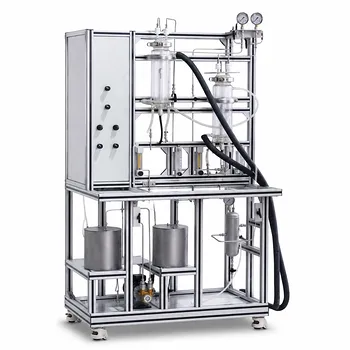
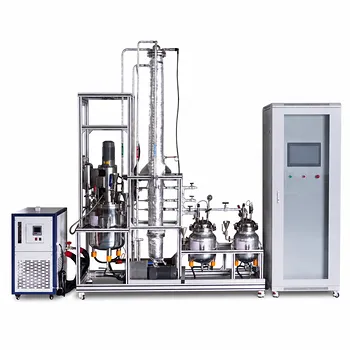
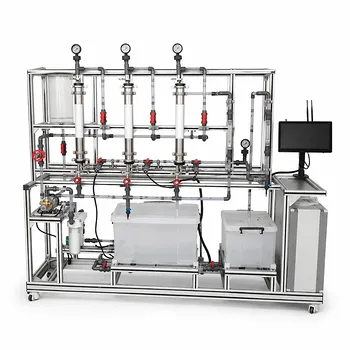
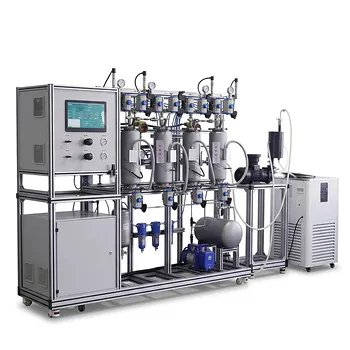
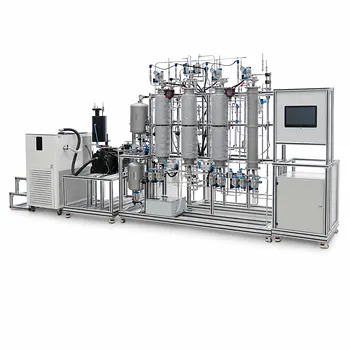
The most direct way to demonstrate monomer separation after pyrolysis is to let students operate a chemical engineering unit‑operations pilot plant that mimics industrial purification. A fractional distillation column fed with a simplified pyrolysis oil stream allows them to monitor vapor‑liquid equilibrium, vary reflux ratios, and sample product cuts for purity analysis. Pairing this with liquid‑liquid extraction or absorption units shows how complementary operations polish the monomer to polymer‑grade quality. These hands‑on experiments turn abstract circular‑economy ideas into measurable, real‑world separation problems.
Separating pyrolysis‑derived monomers is never a single‑step distillation; it is a multi‑operation purification challenge where reflux strategy, solvent choice, and integrated reaction steps determine final purity and energy cost. Pilot‑plant experiments make those trade‑offs tangible, giving students the engineering judgment needed to design viable chemical recycling loops.
Turning Pyrolysis Oil into Monomers: The Unit Operations Blueprint
The Distillation Column: The Core Separation Tool
An industrial pyrolysis oil is a complex mixture of hydrocarbons, but for teaching purposes a synthetic blend of styrene, toluene, ethylbenzene, and light olefins works perfectly. Students feed this blend into a pilot‑scale distillation column, directly observing how boiling‑point differences allow fractional separation.
They see that raising the reflux ratio improves separation but increases energy consumption — a key economic tension. By sampling liquid from multiple trays, they measure composition and construct a real McCabe‑Thiele diagram, moving beyond textbook sketches.
Liquid‑Liquid Extraction for Complex Monomer Pools
Not all monomers separate easily by distillation. Pyrolyzed polystyrene, for example, yields styrene mixed with aromatic and aliphatic impurities that form azeotropes. Here, a pilot liquid‑liquid extraction column becomes invaluable.
By introducing a solvent such as ethylene glycol or a sulfolane‑water mixture, students can selectively pull polar or aromatic components into the extract phase. They adjust solvent‑to‑feed ratio and temperature, directly witnessing the phase rule in action and validating the thermodynamics of monomer‑solvent miscibility. This visible phase separation reinforces why extraction often replaces energy‑intensive distillation for close‑boiling mixtures.
Integrated Purification: From Crude Cuts to Polymer‑Grade
Polymerisation demands monomer purities above 99.9 mol% with impurities like acetylene kept below 1 ppm. A single distillation cannot achieve this; a train of operations is required. Pilot plants that combine an absorption column, a drying unit, and a cryogenic distillation section let students experience the full purification sequence.
For an ethylene‑rich pyrolysis gas, the stream first passes through an amine absorber to remove CO₂ and H₂S, then a molecular sieve dryer, and finally a cryogenic distillation column that separates ethylene from ethane at temperatures below 273 K. Optionally, they can insert a selective hydrogenation reactor to convert trace acetylene into ethylene, demonstrating how a chemical reaction step reduces the burden on the distillation column — a classic process‑intensification lesson.
Closing the Mass Balance: Recycle and Purge Essentials
Monomer recovery processes rarely extract all of the valuable product in a single pass. Pilot plants with a reactor‑separator‑recycle loop (even if the reactor simulates pyrolysis) teach students to perform component balances around the whole system.
They measure fresh feed, recycle, purge, and product streams, then calculate conversion, separator efficiency, and buildup of inerts. The necessity of a purge stream becomes obvious when nitrogen or methane accumulates in the loop and threatens to stall the compressor. This insight directly translates to designing a credible circular economy where non‑recyclable by‑products must leave the loop.
Understanding the Trade‑offs in Pilot‑Plant Demonstrations
No pilot‑scale setup perfectly mirrors a commercial plant. Pyrolysis oils are corrosive and thermally sensitive; feeding real post‑consumer waste may foul column internals faster than a clean synthetic mixture. This forces instructors to either simplify the chemistry or invest in advanced metallurgy and cleaning protocols.
Cryogenic separations demand heavy insulation and safety interlocks, making them more complex to maintain than a room‑temperature extraction unit. Yet the learning value is immense — students grasp why energy‑intensive cryogenic distillation still dominates ethylene production, a concept no textbook can fully convey.
Time constraints also matter. A batch distillation run may take several hours, and getting stable liquid‑liquid extraction requires patience. Curriculum designers must balance depth of understanding against available lab time.
Making the Right Choice for Your Curriculum
The pilot‑plant configuration you choose should match the specific learning outcomes you value most.
- If your primary focus is fundamental thermodynamics: Start with a simple batch distillation column using a binary styrene‑toluene mixture. Students can construct McCabe‑Thiele diagrams and measure tray efficiency directly.
- If your primary focus is process integration: Combine a continuous distillation column with a liquid‑liquid extraction unit and a recycle loop. This mirrors a real monomer‑recovery flowsheet and forces students to think about stream routing and impurity accumulation.
- If your primary focus is sustainability and economics: Require students to log steam, electricity, and cooling water use across all operations. Then have them calculate the energy cost per kilogram of purified monomer and compare it to fossil‑based virgin monomer production — turning circular‑economy aspirations into measurable engineering reality.
By thoughtfully pairing unit‑operations pilot plants with your teaching goals, you transform monomer separation from an abstract textbook topic into a concrete, memorable skill set that future process engineers can carry directly into industry.
Summary Table:
| Unit Operation | Role in Monomer Separation | Key Learning Outcome |
|---|---|---|
| Fractional Distillation | Separates monomers based on boiling point differences (e.g., styrene/toluene). | Understand reflux ratios and construct McCabe-Thiele diagrams. |
| Liquid-Liquid Extraction | Purifies close-boiling or azeotropic mixtures using selective solvents. | Witness phase rule in action and evaluate solvent-to-feed ratios. |
| Absorption & Drying | Removes impurities (CO₂, moisture) from pyrolysis gas streams. | Learn gas purification sequences and molecular sieve operation. |
| Recycle & Purge Loop | Simulates continuous processes and manages inert accumulation. | Calculate system mass balances, conversion, and separator efficiency. |
Elevate Your Engineering Curriculum with LABPARK
Bridge the gap between circular economy theory and industrial reality. LABPARK provides premium Educational and Vocational Unit Operations Pilot Plants in chemical engineering, bioprocess & biotech, and environmental & water treatment for universities, research institutes, and enterprises. Our robust systems empower students to master complex separation processes, mass balances, and energy optimization hands-on.
Ready to bring advanced monomer purification training to your lab? Contact LABPARK today to explore our customizable pilot plant solutions!
Related Products
- Solid Waste Pyrolysis and Refining Educational Pilot Plant for Unit Operations
- Polymerization Granulation and Pellet Processing Educational Unit Operations Pilot Plant
- Photocatalytic Membrane Separation and Degradation Unit Operations Pilot Plant
- Bio-fermentation Ethanol Production Practical Training Unit Operations Pilot Plant
- Multi-Functional Membrane Separation Educational Pilot Plant for Unit Operations Lab
People Also Ask
- How do educational unit operations pilot plants bridge theory and design? Bridge the Engineering Gap
- How do educational unit operations pilot plants address safety and waste management when scaling up?
- When to transition from PID to adaptive control in pilot plants? Key process indicators.
- Why is the chemical plant startup schedule crucial? De-risk scale-up with pilot plants.
- Why Compare Predicted and Experimental Excess Enthalpy? Key to Accurate Pilot Plant Scale-up