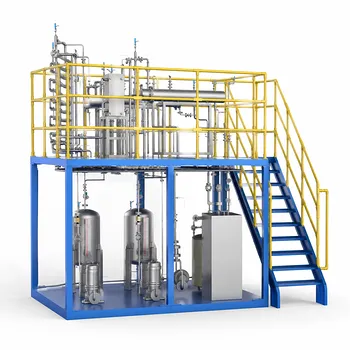
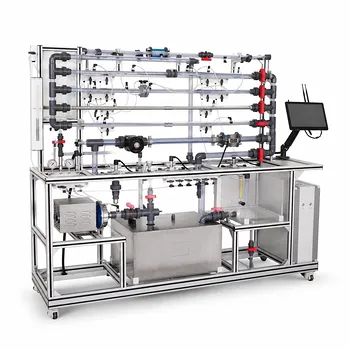
Parallel expansion often fails due to flow maldistribution. When retrofitting existing processes with new, parallel equipment, the most immediate challenge is ensuring that incoming streams split evenly between the old and new units. The assumption that a simple tee or manual balancing valve will suffice is almost always incorrect once the plant is running. Pilot plants designed with parallel process lines, flow meters, and automated control valves provide a critical training ground to practice the balancing techniques that prevent this failure.
Adding equipment in parallel creates a hidden hydraulic competition: even identical vessels will experience different pressure drops over time due to fouling, leading to flow maldistribution and a significant loss of overall efficiency. Pilot plants let engineers and operators learn to tame this problem through hands-on control loop tuning before they touch the real process.
Understanding the Flow Distribution Problem in Retrofitting
Why Simple Piping Solutions Fail
A new branch line teed off an existing header seems straightforward. In reality, fluid will always follow the path of least resistance. The existing heat exchanger, reactor, or filter may already be partially fouled, raising its pressure drop well above the clean, new unit placed beside it. Without active compensation, the clean unit will hog the flow, leaving the older unit starved and underperforming. A manual bypass or throttling valve set once during commissioning cannot adapt to these drifting conditions.
The Real Cost of Maldistribution
Uneven flow immediately destroys the capacity gains you expected from the expansion. One unit overflows while the other sits idle, reducing heat transfer, conversion, or separation efficiency across the entire bank. This often forces operators to reduce total throughput or run the process in a sub-optimal state, erasing the return on investment. The deeper cost is a loss of process control, where inconsistent residence times in parallel reactors or crystallizers degrade product quality in ways that are difficult to diagnose.
The Standard Engineering Solution
Automated Control Valves as the Linchpin
The established fix is to install an automated control valve on each parallel branch. These valves, paired with flow meters, allow a control system to continuously measure the flow through each leg and adjust the valve position to maintain a defined split. This compensates in real time for the changing pressure drop as equipment fouls, maintaining balanced loading without operator intervention. It transforms a passive, failure-prone pipe network into an actively managed hydraulic system.
The Importance of Instrumentation
You cannot control what you cannot measure. Reliable flow meters on each branch are non-negotiable for this strategy to work. A differential pressure transmitter across each piece of equipment also provides direct insight into its fouling condition, enabling predictive maintenance. This combination of flow measurement and valve actuation forms a closed loop that keeps parallel trains operating as a single, cohesive unit.
How Pilot Plants Bridge the Theory-Practice Gap
Replicating Real-World Maldistribution for Training
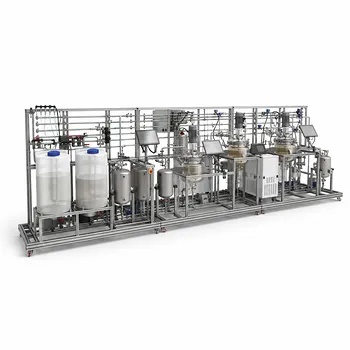
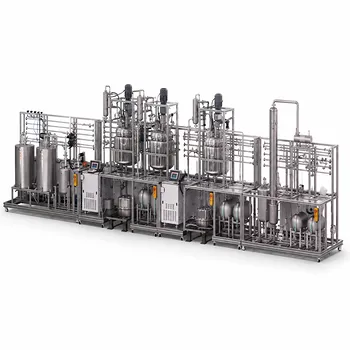
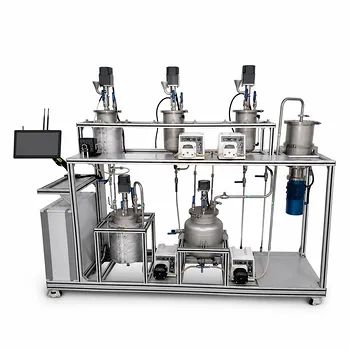
Vocational unit operations pilot plants can be configured with two or more parallel lines, a shared feed, control valves, and independent flow meters. Instructors can deliberately introduce a blockage or partially close a valve to simulate the effect of a fouled heat exchanger. The student then sees the flow immediately swing toward the less-restricted line, directly observing the maldistribution that a static piping design would cause. This visceral demonstration replaces abstract theory with an unforgettable lesson.
Hands-On Experience with Control Loop Tuning
Beyond simply observing the problem, learners can practice the solution. They tune the PID controller that manipulates the control valve to hold a set flow ratio between the two legs. They learn what happens when loop tuning is too aggressive or too sluggish in a safe, low-consequence environment. Tracking how the flow stabilizes—or oscillates—teaches the stability and response time requirements long before any product is put at risk.
Building Intuition for Scale-Up and Steady-State Operation
In continuous processes, pilot plants eliminate a separate scale-up risk because they run at the same flow rate as planned for commercial production; only the run duration changes. When these pilot lines are set up in parallel, learners can also practice maintaining balanced steady-state conditions over time. Automated Design of Experiments (DoE) on such a system deepens process understanding, proving that the distribution strategy will hold as the unit runs for hours or days.
Recognizing the Limits: What Pilot Plants Can't Fully Simulate
The Difference Between Clean Pilot Lines and Fouled Production Units
A pilot plant’s small tubing and clean fluids can approximate a pressure-drop imbalance, but they rarely replicate the unpredictable, sticky fouling layers found in real plants. The dynamics of a slowly blocking catalyst bed or a polymerizing reboiler may be absent. Training must therefore be paired with discussions of how industrial fouling rates change the time constant of the balancing control system.
The Challenge of Transient Behavior in Large-Scale Systems
A compact pilot plant has minimal piping volume, so flow changes propagate almost instantly. In a full-scale plant, long pipe runs introduce significant time delays that can destabilize a control loop. While the fundamental tuning principles remain the same, graduates must be aware that the same controller settings may need to be detuned for a real, larger system to avoid oscillation.
Making the Right Choice for Your Training or Project Goal
Based on the objectives behind your question, here is how to prioritize the use of pilot plants for flow distribution training.
- If your primary focus is de-risking a specific parallel expansion project: Build a pilot-scale mockup that physically mirrors your planned pipe diameters and valve types. Use it to verify the control strategy and flow meter placement before cutting into the existing header.
- If your primary focus is developing workforce competency: Invest in a unit operations pilot plant with flexible parallel lines and programmable disturbances. The goal is not an exact replica of your plant, but repeated practice in recognizing maldistribution and tuning the response.
- If your primary focus is understanding long-term operational drift: Supplement pilot plant training with operator training simulators that incorporate real plant fouling data. This bridges the gap between the clean pilot experience and the slow degradation of a production unit.
A well-designed pilot plant turns the hydraulic chaos of parallel expansion from a project risk into a mastered, predictable skill.
Summary Table:
| Challenge | Root Cause | Pilot Plant Training Solution |
|---|---|---|
| Flow Maldistribution | Uneven equipment fouling and pressure drops | Parallel lines with automated control valves and flow meters |
| Capacity & Quality Loss | Fluid choosing the path of least resistance | Hands-on PID loop tuning & flow-split ratio control |
| Scale-Up Risks | Transient behaviors and piping delays | Steady-state operation & Design of Experiments (DoE) |
Master Process Flow & Control with LABPARK
Prevent flow maldistribution from compromising your scale-up projects and workforce readiness. LABPARK provides state-of-the-art Educational and Vocational Unit Operations Pilot Plants in chemical engineering, bioprocess & biotech, and environmental & water treatment. Designed specifically for universities, research institutes, and enterprises, our systems offer the hands-on control loop tuning experience engineers and operators need to manage complex industrial hydraulics.
Contact LABPARK today to find the perfect pilot plant solution for your training or research goals!
Related Products
- Natural Product Extraction Unit Operations Training Pilot Plant
- Fixed-Bed Chemical Reaction and Gas Dust Tar Removal Unit Operations Pilot Plant
- Ethyl Acetate Synthesis Unit Operations Pilot Plant for Practical Training
- Methanol Synthesis and Catalyst Performance Evaluation Educational Unit Operations Pilot Plant
- Electrolytic Hydrogen Production Educational Unit Operations Pilot Plant
People Also Ask
- How to Demo Solubility Sensitivity in SFE Pilot Plants? Practical Thermodynamics
- How do pilot plants differentiate physical vs chemical extraction? Enhance Chemical Engineering Training
- How are HTU and NTU applied to determine extraction column height? Guide to Pilot Plant Scaling
- How do fluid transport principles apply to pilot plant configuration? Optimize your unit operations.
- What are the limitations of acentric factor models? Avoid pilot plant errors with polar fluids.