Knowledge Chemical Engineering Education How do reaction rates & contact times impact nonisothermal absorption flux? Critical Scaling Effects Explained
Author avatar

Tech Team · LABPARK

Updated 1 month ago

How do reaction rates & contact times impact nonisothermal absorption flux? Critical Scaling Effects Explained


At high reaction rates or extended contact times, the absorption flux in a nonisothermal pilot plant falls sharply below what is predicted by isothermal models. The rapid release of absorption and reaction heat at the gas-liquid interface raises the local temperature, which reduces the interfacial solubility of the gaseous reactant. This solubility drop, coupled with solvent evaporation and gas‑phase heat effects, can cause a 25% or greater overprediction of the mass transfer rate when temperature is assumed constant.

Nonisothermal conditions are not a minor correction—they fundamentally alter the driving force for absorption. At low reaction speeds or brief contact, the thermal penalty is negligible. But once the reaction accelerates or the contact time lengthens, the interfacial temperature surge suppresses the absorption flux dramatically, making isothermal assumptions dangerously optimistic.

How Heat Disrupts the Interface Equilibrium

The Heat of Absorption at the Interface

Every absorption process that involves a chemical reaction or physical dissolution releases heat. In a nonisothermal pilot plant, this heat concentrates at the gas-liquid interface. The local temperature rises because the heat cannot dissipate instantly into the bulk phases.

The Feedback Loop of Reduced Solubility

As the interfacial temperature climbs, Henry’s law becomes less favorable. The solubility of the gas in the liquid decreases, lowering the interfacial concentration (c_{Ai}) that drives mass transfer. This creates a self-reinforcing cycle: a faster reaction generates more heat, which cuts solubility, which in turn chokes the absorption rate.

How Reaction Rate and Contact Time Amplify the Effect

Low Reaction Rates and Short Contact Times

When the chemical reaction is sluggish, or when the gas and liquid are in contact only briefly, the temperature rise at the interface is minimal. The heat generated has little time to accumulate, so the decrease in absorption flux is insignificant. The system behaves almost isothermally.

The Critical Transition: When Heat Effects Dominate

As the reaction rate increases—entering the fast or instantaneous regime—the heat release per unit time intensifies. Likewise, longer contact times allow more heat to build up before the fluid parcels are refreshed. These two factors push the system into a state where the interfacial temperature spike significantly suppresses the effective solubility.

The Role of Solvent Evaporation and Gas‑Phase Heat

In high‑rate or long‑contact scenarios, solvent evaporation accelerates from the hot interface. This evaporation consumes heat but also dilutes and complicates the gas‑side mass transfer. Simultaneously, the gas phase itself heats up, altering its diffusivity and further reducing the available concentration gradient. Ignoring these coupled effects in models leads to the severe overprediction observed in practice.

Quantifying the Deviation from Isothermal Predictions

Case Study: Chlorine Absorption in Toluene

A classic example is the absorption of chlorine gas into toluene with a strong chemical reaction. When researchers excluded gas‑phase heat and solvent evaporation from their calculations, the predicted mass flux was 25% higher than the experimentally measured value. This gap directly quantifies the combined penalty of nonisothermal behavior.

Linking to Fast Reaction Regimes in Pilot Plants

In the fast reaction regime ((M \gg 1)), the enhancement factor simplifies to (\sqrt{M}), and the absorption rate becomes (N_A = c_{Ai}\sqrt{k_1^* D_{Al}}). Here, the process depends solely on the interfacial concentration—exactly the parameter that temperature rise degrades. Unlike physical mass transfer, this regime is insensitive to mechanical agitation; increasing liquid turbulence or flow rate in the pilot plant will not recover the lost flux. The damage is purely due to the solubility drop at the hotter interface.

Understanding the Trade‑offs

Nonisothermal realities force difficult compromises. While lowering the bulk liquid temperature improves solubility, it may also decelerate the reaction kinetics, pushing the system out of the fast regime where conversion is highest. Likewise, pilot plants used for education or research must balance the desire for clean isothermal data against the need to teach real‑world process behaviour.

Another pitfall is that operators often try to counteract a flux decrease by increasing gas flow or mechanical agitation. In fast reactions, that effort is wasted—and the real culprit, the localized temperature spike, remains unaddressed. Acknowledging these limitations builds a more realistic foundation for scale‑up.

Actionable Guidance for Pilot Plant Operations

After a short introduction, the specific recommendations based on your primary goal are:

  • If your primary focus is generating design‑grade data: Always augment your mass‑transfer model with a coupled energy balance. Neglecting interfacial heating can lead to an overoptimistic column height by 25% or more.
  • If your primary focus is educational demonstration of mass transfer limits: Deliberately vary the contact time (e.g., by changing liquid head or column packing) to observe the clear shift from isothermal to nonisothermal control, reinforcing the heat‑mass coupling principles.
  • If your primary focus is optimizing an exothermic absorption process: Shift your tuning efforts from mechanical changes (pump speed, agitator RPM) to chemical parameters—increase the reactant concentration in the liquid phase and, if possible, manage the interfacial temperature through precooling or evaporative cooling of the gas stream.

Embrace the nonisothermal reality early in your pilot‑plant studies. It transforms a textbook assumption into a measurable, actionable variable that sharpens both your experimental insight and your scale‑up accuracy.

Summary Table:

Parameter Low Reaction Rate / Short Contact Time High Reaction Rate / Long Contact Time
Interfacial Temp. Rise Minimal / Negligible Significant (Severe localized heating)
Gas Solubility ($c_{Ai}$) Normal (Matches bulk conditions) Greatly reduced (Suppressed mass transfer driving force)
Isothermal Model Accuracy Highly accurate Overpredicts mass flux by 25% or more
Impact of Turbulence High (Mechanical agitation recovers flux) Low (Flux is limited by interfacial temperature, not mixing)
Design Focus Standard flow and mixing optimizations Energy balance coupling, pre-cooling, & chemical parameter tuning

Scale Up with Precision Using LABPARK Pilot Plants

Bridge the gap between theoretical isothermal models and real-world nonisothermal realities. LABPARK provides advanced Educational and Vocational Unit Operations Pilot Plants in chemical engineering, bioprocess & biotech, and environmental & water treatment. Specifically designed for universities, research institutes, and enterprises, our pilot plants deliver the reliable, design-grade data you need to master complex heat and mass transfer coupling.

Ready to elevate your research and training capabilities? Contact us today to find the perfect pilot plant solution for your lab!

Related Products

People Also Ask

Related Products

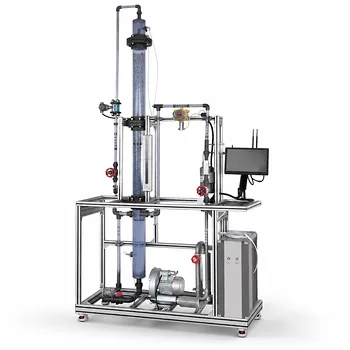
Packed Bed Absorption Educational Unit Operations Pilot Plant

Packed Bed Absorption Educational Unit Operations Pilot Plant

Study gas-liquid absorption, pressure drop, flooding, and mass transfer coefficients with this pilot plant. Transparent packed column, industrial touchscreen, real-time sensor data, automated analysis. Investigate two-phase flow, loading points, column efficiency. Comprehensive data logging and assessment software included.

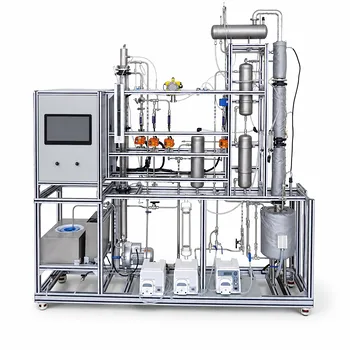
Dual-Mode Gas Absorption and Desorption Unit Operations Training Pilot Plant

Dual-Mode Gas Absorption and Desorption Unit Operations Training Pilot Plant

Industrial-scale pilot plant for gas absorption and desorption training in chemical engineering. Features dual-mode operation with real and simulated materials, transparent columns for flow visualization, and customizable design. Supports independent or combined loops for hands-on unit operations experiments.

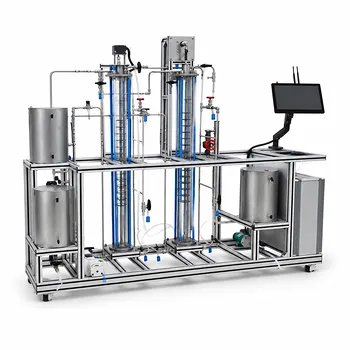
Absorption and Desorption Educational Unit Operations Pilot Plant

Absorption and Desorption Educational Unit Operations Pilot Plant

Dual packed column absorption and desorption pilot plant for chemical engineering education, offering real-time mass transfer coefficient measurement, durable mobile frame, industrial touch-screen interface, and customizable design for varied laboratory curricula, enabling hands-on study of gas absorption and stripping.

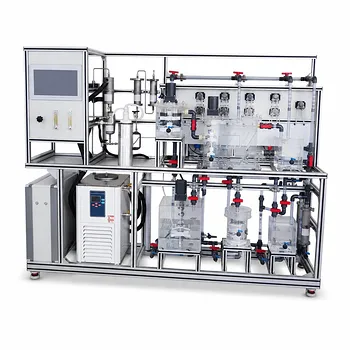
Carbon Dioxide Absorption and Desorption Educational Pilot Plant for Carbon Capture Studies

Carbon Dioxide Absorption and Desorption Educational Pilot Plant for Carbon Capture Studies

Explore carbon dioxide absorption and desorption with this educational pilot plant. Transparent columns visualize mass transfer; electric heating simulates industrial solvent regeneration; touchscreen interface enables data monitoring. Ideal for chemical engineering, bridging theory and practice.

Comprehensive Liquid-Liquid Extraction Pilot Plant for Engineering Education

Comprehensive Liquid-Liquid Extraction Pilot Plant for Engineering Education

Comprehensive liquid-liquid extraction pilot plant for engineering education, integrating rotary and vibratory columns for hands-on observation of phase behavior, flooding limits, and mass transfer efficiency, enabling precise HTU and mass transfer coefficient calculations.

Multimodal Absorption and Desorption Pilot Plant for Unit Operations Training

Multimodal Absorption and Desorption Pilot Plant for Unit Operations Training

Multimodal absorption and desorption pilot plant for higher education labs. Bridges theory and industrial practice with transparent packed columns, three operational modes (real-material, simulated, semi-physical), and SCADA control. Students explore mass transfer, column hydraulics, and process control. Customizable.

Thermal Desorption Exhaust Gas and Tail Water Treatment Educational Pilot Plant

Thermal Desorption Exhaust Gas and Tail Water Treatment Educational Pilot Plant

Bench-scale educational pilot plant for treating thermal desorption exhaust gas and tail water integrates condensation, Fenton oxidation, precipitation, filtration, and carbon adsorption. Ideal for chemical engineering and environmental labs, teaching unit operations, process control, and real-time data analysis.

Bench Scale Carbon Dioxide Capture Educational Unit Operations Pilot Plant

Bench Scale Carbon Dioxide Capture Educational Unit Operations Pilot Plant

This bench-scale educational pilot plant simulates industrial CO₂ separation using a multi-tower adsorption system for hands-on engineering training. Students achieve ≥90% CO₂ purity while studying pressure swing adsorption, desorption kinetics, and process control in gas purification experiments.

Gallium and Indium Selective Extraction Educational Pilot Plant

Gallium and Indium Selective Extraction Educational Pilot Plant

Integrated pilot-scale laboratory system for engineering education bridging theoretical concepts with industrial practice enabling hands-on study of liquid liquid extraction reaction kinetics and mass transfer for selective gallium and indium separation featuring real-time IoT connectivity with integrated safety

Bench Scale Dual Column Gas Separation and Capture Educational Pilot Plant

Bench Scale Dual Column Gas Separation and Capture Educational Pilot Plant

This dual-column educational pilot plant provides hands-on teaching of gas adsorption, separation, and capture processes. It features stainless steel columns, regeneration up to 400°C, and a 15.6-inch touchscreen PLC for TSA and PSA studies in chemical engineering curricula, process simulation.

Multi-Component Gas Pressure Swing Adsorption Pilot Plant for Unit Operations Education

Multi-Component Gas Pressure Swing Adsorption Pilot Plant for Unit Operations Education

Multi-component gas pressure swing adsorption pilot plant designed for unit operations education. Features four-tower configuration, IoT touchscreen control, dual regeneration, and real-time breakthrough curve analysis for engineering training with safety interlocks and mobile frame simulates industrial PSA processes.

Low Concentration Carbon Dioxide Capture Pressure Swing Adsorption Educational Pilot Plant

Low Concentration Carbon Dioxide Capture Pressure Swing Adsorption Educational Pilot Plant

Low-concentration CO2 capture pilot plant using Pressure Swing Adsorption for engineering education. Students gain practical experience in breakthrough curve measurement, adsorption dynamics, and variable analysis in a hands-on lab setting. Ideal for unit operations, mass transfer, and chemical engineering labs.

Pressure Swing Adsorption Educational Unit Operations Pilot Plant

Pressure Swing Adsorption Educational Unit Operations Pilot Plant

Integrated bench-scale pressure swing adsorption pilot plant for hands-on teaching of gas-solid separation, mass transfer, and process optimization using nitrogen-oxygen model, featuring dual-column design, industrial touchscreen control, digital assessment suite, and customizable hardware and software configurations for educational laboratories.

Two Phase Flow Pattern Velocity Resistance Measurement Educational Pilot Plant

Two Phase Flow Pattern Velocity Resistance Measurement Educational Pilot Plant

Benchtop educational pilot plant for university labs studying gas-liquid two-phase flow patterns, velocity, and resistance across circular, square, and rectangular conduits. Features 15.6-inch touchscreen, 5G connectivity, differential pressure sensors, safe water-air operation. Supports chemical engineering curricula.

Educational Pressure Swing Adsorption Ethylene Capture Unit Operations Pilot Plant

Educational Pressure Swing Adsorption Ethylene Capture Unit Operations Pilot Plant

Advanced educational pilot plant for pressure swing adsorption ethylene capture provides comprehensive hands-on training in industrial gas separation processes, featuring an eight-column PSA system, real-time data acquisition, and fully customizable design for chemical engineering unit operations laboratories and research.

Fixed-Bed Chemical Reaction and Gas Dust Tar Removal Unit Operations Pilot Plant

Fixed-Bed Chemical Reaction and Gas Dust Tar Removal Unit Operations Pilot Plant

Integrated educational pilot plant for studying catalytic gas-solid reactions and downstream gas purification. Features dual fixed-bed reactor, three-stage heating, and touchscreen control for hands-on engineering training. Ideal for chemical and environmental engineering curricula.

Gas-Solid Heterogeneous Separation Demonstration Educational Unit Operations Pilot Plant

Gas-Solid Heterogeneous Separation Demonstration Educational Unit Operations Pilot Plant

Comprehensive visual transparent gas-solid separation pilot plant for chemical engineering labs. Demonstrates gravity settling inertial settling cyclone and bag filter technologies. Enables real-time analysis of fluid-particle mechanics pressure drop and collection efficiency. Ideal for undergraduate unit operations courses.

Natural Product Extraction Unit Operations Training Pilot Plant

Natural Product Extraction Unit Operations Training Pilot Plant

Integrated natural product extraction pilot plant for chemical engineering training bridges theory and industrial practice with modular extraction and evaporation/concentration units, hybrid touchscreen and manual control, realistic process simulation, and self-contained softened water and vacuum utilities.

Multi-Functional Special Distillation Educational Pilot Plant

Multi-Functional Special Distillation Educational Pilot Plant

Versatile multi-functional special distillation pilot plant for chemical engineering education. Supports continuous, vacuum, azeotropic, reactive, extractive distillation. Transparent glass columns enable real-time visual observation of hydrodynamics and separation processes.

Fluidized Bed Gas Solid Catalytic Reaction Educational Pilot Plant

Fluidized Bed Gas Solid Catalytic Reaction Educational Pilot Plant

Our educational fluidized bed gas-solid catalytic reaction pilot plant is ideal for chemical engineering labs. Students study fluidization dynamics, catalyst evaluation, and process control hands-on. Features include a customizable reactor, touchscreen HMI, and safety interlocks for safe, curriculum-aligned experiments.


Leave Your Message