The selection of a column sequencing scheme is not a trivial plumbing decision—it is the primary lever that determines the total vapor load your pilot plant must handle. In multi-component distillation, a direct sequence (removing components in order of decreasing volatility) subjects the mixture to far fewer repeated vaporizations and condensations than an indirect sequence. This directly reduces the reboiler and condenser duties—often by 20–40%—and shrinks the required heat exchanger surface areas, making both utility consumption and equipment sizing highly sequence-dependent.
In distillation pilot plants, the battle over utility bills and equipment footprint is won or lost by how you sequence your columns. A direct sequence typically minimizes the aggregate vapor load by preventing light and intermediate components from being boiled and condensed multiple times. This cuts both heating and cooling demands and leads to smaller, less expensive heat exchangers and column shells.
Why Sequencing Dictates Utility Consumption and Equipment Size
Every time a component is vaporized and condensed again in another column, you pay for it twice: once in the reboiler, once in the condenser. The column sequencing scheme determines how many times each component undergoes this phase change.
Direct vs. Indirect Sequences: A Tale of Two Paths
Consider a three-component mixture of A (lightest), B, and C (heaviest). In a direct sequence, the first column separates A from the B/C mixture. The second column then separates B from C. Component A is boiled and condensed only in the first column. B is processed only in the second column. C never vaporizes.
An indirect sequence flips this logic. The first column separates A and B together from C. The distillate, containing both A and B, then enters a second column to split them. Now A and B are vaporized and condensed in both columns. This doubling of thermal duty for the lighter components is the root cause of higher utility consumption.
Vapor Load and the Domino Effect on Utilities
Total vapor load is the sum of all vapor generated in all reboilers. Because the indirect sequence re-vaporizes streams that were already distilled, the aggregate flow of vapor inside the columns increases. Higher vapor rates directly translate into higher steam or hot oil usage in the reboilers and increased cooling water or refrigerant demand in the condensers.
In pilot-plant training, students can measure this difference experimentally. For example, a simple heat balance on a two-column system often shows a 30–50% increase in combined reboiler duty for the indirect route, depending on the feed composition. These numbers make the thermodynamic cost of poor sequencing immediately tangible.
Equipment Sizing: Why Bigger Isn’t Always Better
The size of a distillation column’s shell and its internal heat exchangers scales with the vapor and liquid traffic. When sequencing raises the vapor load, the required reboiler and condenser surface areas grow almost linearly with the extra duty. You end up with physically larger exchangers, larger-diameter columns to handle higher vapor velocities without flooding, and heavier supporting structures.
For a pilot plant designed to be moved between laboratories or for vocational training, this footprint penalty matters. A sequence that keeps vapor loads low produces a leaner, more manageable installation without sacrificing the learning experience.
The Deeper Principles: Heuristics That Protect Your Utilities
Beyond the simple direct-vs.-indirect comparison, a few distillation heuristics capture the deeper relationship between sequencing, energy, and equipment.
Heuristic 1: Minimize Repeated Phase Changes
Every time you re-vaporize a component that was already condensed, you waste exergy. Aim to settle the fate of each component in as few columns as possible. This principle favors sequences that remove high-volatility materials early, leaving the bottoms stream with fewer components that still need processing.
Heuristic 2: Remove Difficult Components First
If a component is corrosive, thermally sensitive, or carries solids, it should be separated in the first column. This protects all downstream columns and sensors, avoiding the need to fabricate multiple columns from exotic alloys or to install anti-fouling internals throughout the entire train. While this may occasionally increase utility use, the equipment and maintenance savings often dominate the economic picture.
Heuristic 3: Favor Equimolar Splits
Sequences that split the feed into roughly equal distillate and bottoms mass flows tend to be more thermodynamically efficient. They avoid imposing extreme reflux ratios on a single column. In pilot plants, this translates into balanced column diameters and predictable hydraulic behavior, which simplifies both educational observation and design.
Understanding the Trade-offs
No heuristic tells the whole story. A sequencing strategy must be evaluated against the real constraints of your operation.
The Tray Count vs. Energy Consumption Dilemma
Reducing the number of physical trays forces the column to run at a higher reflux ratio to achieve the same separation. A decrease of just two theoretical stages can increase reboiler duty by around 30%. When sizing equipment for a pilot plant, adding a few extra trays is almost always cheaper than accepting the lifetime utility penalty and larger heat exchangers demanded by a short column.
When the “Energy-Efficient” Sequence Is Not the Right Choice
If a feed stream contains a thermally sensitive monomer that polymerizes when held too long at elevated temperatures, the direct sequence—though energy-optimal—might cause on-stream degradation. In that case, removing the sensitive component quickly in an earlier column, even at the cost of extra vaporization, protects product quality and plant operability. The best sequence is the one that meets all process constraints, not just the one with the lowest calculated duty.
Making the Right Choice for Your Training or Pilot-Plant Goal
The sequencing decision becomes a powerful teaching moment, connecting thermodynamic theory to real hardware. Prioritize based on what you need the pilot plant to demonstrate.
- If your primary focus is minimizing operating cost and teaching energy efficiency: Choose the direct sequence. It keeps vapor loads low, reduces utility consumption, and shrinks heat exchanger surface areas—giving you a compact, economical plant that clearly shows the value of thermodynamic optimization.
- If your primary focus is studying operability with aggressive or fouling chemicals: Select a sequence that isolates the problematic component in the first column. Accept the higher utility bill in exchange for much lower capital and maintenance costs across the rest of the unit.
- If your primary focus is demonstrating the full spectrum of distillation trade-offs to students: Operate both sequences back-to-back. Let learners measure reboiler and condenser duties, calculate the resulting equipment sizes, and debate the real-world constraints that sometimes force the “less efficient” path.
Understanding how column sequencing shapes both the energy bill and the equipment drawing is what transforms a simple distillation experiment into an exercise in real process engineering judgment.
Summary Table:
| Sequencing Scheme | Vapor Load & Utility Duty | Equipment Sizing (Columns & Exchangers) | Primary Application / Benefit |
|---|---|---|---|
| Direct Sequence | 20–40% Lower; prevents repeated vaporization of light components. | Smaller footprint; smaller diameter columns and heat exchange areas. | Minimizing utility costs and teaching energy efficiency. |
| Indirect Sequence | Higher; re-vaporizes intermediate components in downstream columns. | Larger footprint; requires larger exchangers and column shells. | Separating corrosive, fouling, or heat-sensitive components first. |
Enhance Your Engineering Curriculum and Research with LABPARK
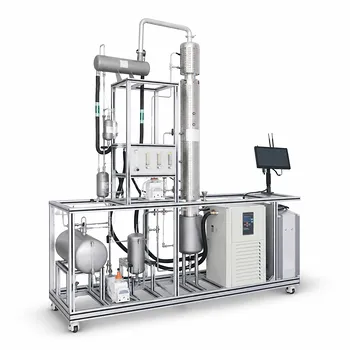
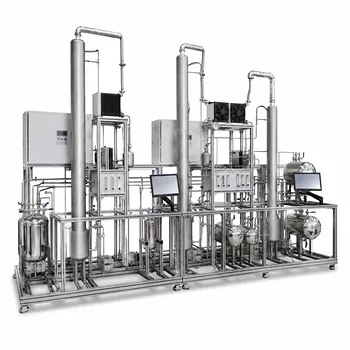
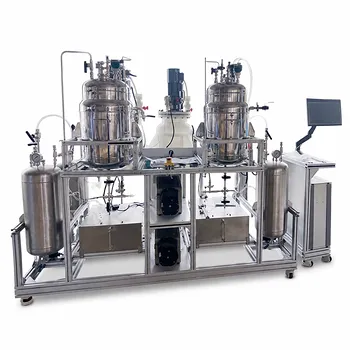
Are you looking to provide hands-on, real-world experience in process optimization? LABPARK designs and manufactures premium Educational and Vocational Unit Operations Pilot Plants in chemical engineering, bioprocess & biotech, and environmental & water treatment for universities, research institutes, and enterprises.
Our custom-built distillation pilot plants allow students and researchers to easily compare column sequencing schemes, measure real-time utility consumption, and study thermal efficiency on industrial-grade equipment.
Ready to elevate your lab's capabilities? Contact our technical team today to discuss your custom pilot plant requirements!
Related Products
- Continuous Sieve-Plate Distillation Pilot Plant for Unit Operations Laboratory Education
- Multi-Functional Special Distillation Educational Pilot Plant
- Continuous Batch Extractive Distillation Educational Pilot Plant
- Multi-Modal Distillation Unit Operations Training Pilot Plant
- Electrolyte Distillation Purification and Formulation Educational Pilot Plant
People Also Ask
- How can real-time carbon number prediction improve distillation pilot plants? Optimize control.
- How does catalyst water concentration affect distillation pilot plant design? Key separation train choices.
- What are the primary reflux ratio control strategies? Master Distillation Unit Operations
- Why is vacuum operation capability an essential feature for a distillation unit operations pilot plant? Unlock Efficiency
- How to select the right activity coefficient model (Wilson, NRTL, UNIQUAC) for distillation pilot plants?