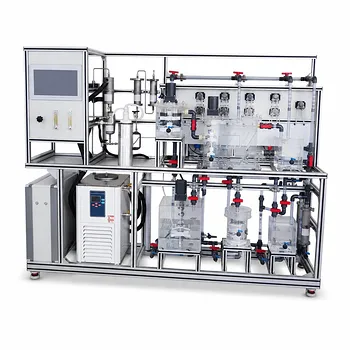
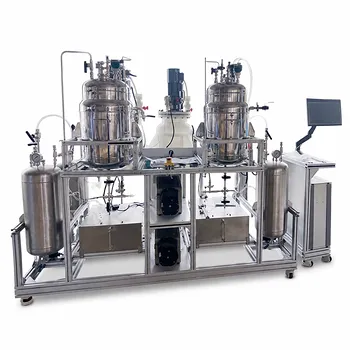
Supercritical water rewrites the rules of oxidation. In an SCWO pilot plant, water is heated and pressurized above its critical point (374 °C and 22.1 MPa), where it transforms from a polar liquid into a dense, non‑polar solvent. This single-phase environment dissolves organic pollutants and oxygen completely, eliminating the mass‑transfer barriers that slow conventional oxidation. The result is a near-instantaneous reaction that destroys hazardous organics in seconds, leaving only clean gases and separable salts.
Core Takeaway: Above its critical point, water acts as a universal solvent for organics and oxygen, creating a homogeneous reaction medium. An SCWO pilot plant exploits this to achieve ultra‑fast, complete pollutant destruction—while letting you safely test extreme operating conditions, identify corrosion‑resistant materials, and gather the data needed for industrial scale‑up.
The Unique Chemistry of Water Above Its Critical Point
From Polar Liquid to Non‑Polar Solvent
Below the critical point, water’s high dielectric constant makes it a great polar solvent, but a poor solvent for non‑polar organics and gases like oxygen. Once temperature and pressure exceed 374 °C and 22.1 MPa, the dielectric constant collapses dramatically. Water molecules lose much of their hydrogen‑bonded structure, effectively becoming a dense, non‑polar fluid. In this state, supercritical water behaves like an organic solvent, able to dissolve hydrophobic compounds that would otherwise form a separate phase.
The Single‑Phase Advantage
The critical point marks the end of a distinct liquid‑gas boundary. Above it, water exists as a single supercritical phase with gas‑like diffusivity and liquid‑like density. Because both the organic waste and the oxidant (usually air or oxygen) now dissolve entirely in this single phase, there are no bubbles, droplets, or interfaces. This creates an ideal, intimate contact between fuel and oxidizer, enabling chemistry that would be impossible in a two‑phase reactor.
How SCWO Eliminates Mass Transfer Barriers
Instant Miscibility
In conventional wet oxidation or incineration, oxygen must cross a phase boundary to reach the organic molecules—a slow, rate‑limiting step. In supercritical water, that boundary vanishes. Organics and oxygen are completely miscible with the water, mixing at the molecular level. Because there is no interfacial resistance, the oxidation reaction is governed purely by chemical kinetics, not by how fast gases can dissolve or disperse.
Homogeneous Reaction Kinetics
With everything dissolved in one phase, the oxidation of phenols, pesticides, paper‑making effluents, and other recalcitrant pollutants proceeds at extraordinarily high rates. Reaction times shrink from minutes or hours to mere seconds, pushing total organic carbon (TOC) removal above 97 %. The effluent is a clean stream of CO₂, H₂O, and N₂, while heteroatoms like chlorine or sulfur are converted to mineral acids and can be neutralized.
Why Pilot Plants Are Essential for SCWO Process Design
Testing Real‑World Wastes
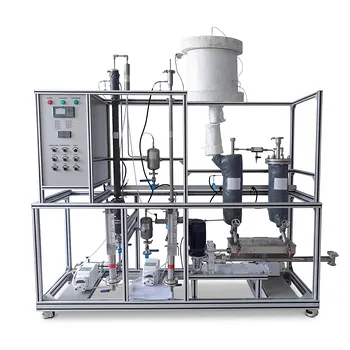
A pilot plant is a scaled‑down but highly instrumented version of a full‑size system. It allows operators to run actual industrial wastewater streams—pharmaceutical residues, pesticide rinse waters, explosive‑contaminated leachates—under precisely controlled temperature and pressure profiles. Researchers can map destruction efficiency versus residence time, screen for the best oxidant‑to‑fuel ratios, and verify that no toxic intermediates survive the process.
Materials and Corrosion Studies
The harsh, high‑temperature, high‑pressure, and often acidic environment of SCWO aggressively attacks most common metals. A pilot plant is the proving ground where you can evaluate exotic nickel‑base alloys, ceramics, or innovative reactor linings. By monitoring in‑situ corrosion coupons and downstream salt‑precipitation behaviour, you develop the materials science backbone needed to build durable, full‑scale units.
Understanding the Trade‑offs
While SCWO offers unmatched destruction efficiency, it comes with real‑world challenges that must be managed:
- Extreme operating conditions demand high‑pressure pumps, thick‑walled reactors, and robust heat exchangers, which escalate capital cost and energy consumption.
- Salt management is critical. Inorganic salts that are soluble in subcritical water become insoluble in the supercritical phase and can quickly plug reactors or heat exchangers if not precipitated and removed strategically.
- Corrosion from halide‑rich wastes or formed acids can severely limit reactor lifespan. Without proper material selection and pH control, maintenance can become prohibitive.
- Scale‑up complexity is non‑trivial. What works in a litre‑per‑hour pilot rig may require major engineering rework to handle tens of cubic metres per day commercially.
Making the Right Choice for Your Goal
How you implement an SCWO pilot plant should match your specific development stage and treatment target.
- If your primary focus is rapid, complete destruction of persistent organics: Use supercritical conditions to leverage the single‑phase advantage. Focus on residence‑time‑distribution studies and TOC monitoring to confirm >99 % conversion.
- If your primary focus is salt‑laden industrial streams: Design the pilot plant with a salt‑separation step (e.g., a reverse‑flow or cooled‑wall reactor). Iterate on precipitation zones to avoid plugging.
- If your primary focus is evaluating long‑term reactor durability: Run extended campaigns with aggressive model wastes. Systematically test different alloys, coatings, and start‑up/shutdown procedures to map corrosion rates and failure modes.
- If your primary focus is energy recovery and cost reduction: Integrate the pilot plant with heat‑recovery exchangers and investigate autothermal operation. Measure net energy consumption to validate economic models before scaling up.
The supercritical state gives you an unfair kinetic advantage—but it’s the pilot‑plant data that turns that advantage into a reliable, scalable treatment technology.
Summary Table:
| Parameter / Feature | Subcritical Water | Supercritical Water (>374°C, >22.1 MPa) |
|---|---|---|
| Phase State | Two-phase (liquid & gas) | Single-phase dense fluid |
| Polarity & Solubility | Polar; poor organic solubility | Non-polar; fully miscible with organics & O2 |
| Mass Transfer | Limited by phase boundaries | Zero boundary resistance (molecular mixing) |
| Reaction Speed | Slow (minutes to hours) | Ultra-fast (seconds; >97% TOC removal) |
Bring Advanced Unit Operations to Your Lab
Ready to scale up your environmental processes? LABPARK provides state-of-the-art Educational and Vocational Unit Operations Pilot Plants in chemical engineering, bioprocess & biotech, and environmental & water treatment designed specifically for universities, research institutes, and enterprises.
Accelerate your research in supercritical water oxidation and wastewater treatment. Contact LABPARK today to customize a pilot plant solution that meets your exact research and training goals.
Related Products
- Supercritical High-Gravity Flash Evaporation Educational Unit Operations Pilot Plant
- 100L Continuous Loop Hydrogenation Educational Unit Operations Pilot Plant
- Solid Waste Pyrolysis and Refining Educational Pilot Plant for Unit Operations
- Steam Methane Reforming Hydrogen Production and Purification Educational Pilot Plant
- Constant Pressure Filtration Educational Unit Operations Pilot Plant
People Also Ask
- How is the heat transfer area calculated for an evaporation unit operations pilot plant during experimental design? Guide
- How to select educational evaporator pilot plants for thermal & scaling solutions? Complete Guide
- What is the practical significance of Kb in pilot plant evaporation? Master process design.
- How do flash calculations relate to flash evaporation pilot plants? Bridge Theory and Practice
- Vacuum vs. Atmospheric Evaporation: Key Pilot Plant Trade-Offs to Evaluate