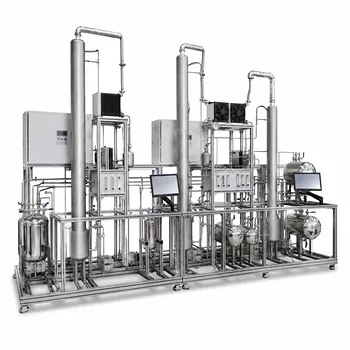
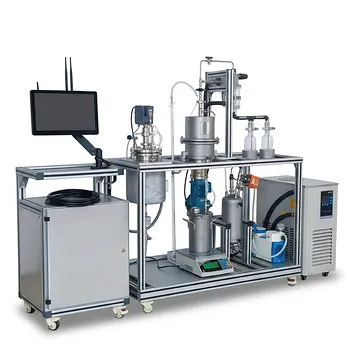
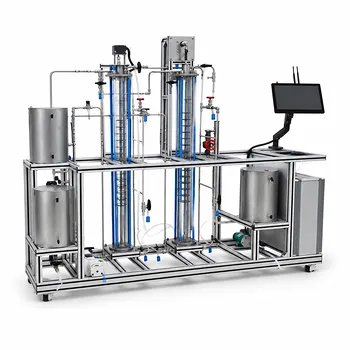
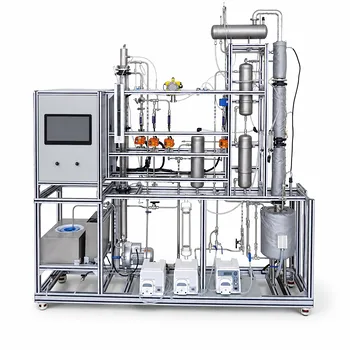
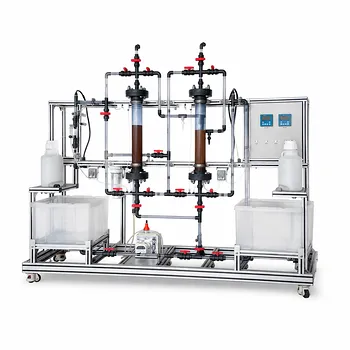
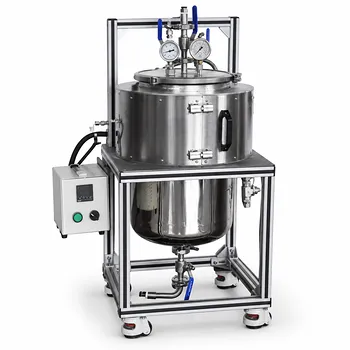
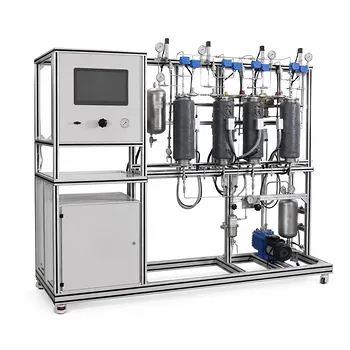
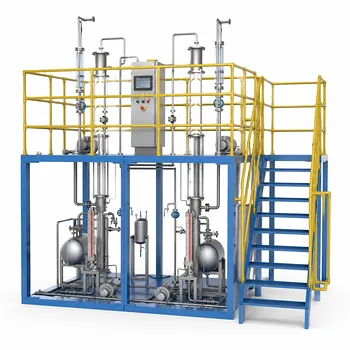
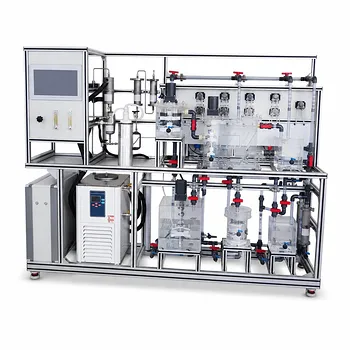
The answer isn't just about using bigger glassware—it's about replacing glass with a fully engineered system. In an educational pilot plant, manual techniques like preparative TLC and benchtop rotary evaporators are scaled up to continuous or semi-batch unit operations. This involves transitioning to falling film evaporators, fractional distillation columns, and preparative liquid chromatography systems. The "how" centers on shifting from a batch, artisanal process to a dynamic engineering process where students control and measure heat transfer, mass balance, and fluid dynamics in real-time.
The fundamental challenge of scaling up solvent evaporation and purification is overcoming the drastic decrease in surface area-to-volume ratio. The core takeaway is that pilot plants solve this not by simply making glassware larger, but by fundamentally changing the physics of the separation using thin-film technology, active vacuum control, and continuous column dynamics to replicate industrial conditions safely.
From Lab Glassware to Pilot-Plant Unit Operations
The first step in scaling up is a complete equipment swap. You are no longer limited by the physics of a static pool of boiling liquid in a round-bottom flask.
The Thin-Film Principle for Evaporation
A benchtop rotary evaporator creates a thin film manually. In a pilot plant, this function is taken over by falling film or rising film evaporators. Instead of a rotating flask, the liquid mixture flows under gravity down a heated tube bundle. This creates a highly efficient, gravity-driven thin film with a massive heat transfer area, allowing for continuous processing and dramatically faster solvent recovery rates than any batch glassware could achieve.
Dynamic Separation in Distillation
Simple fractional distillation in glass becomes a pilot-scale fractional distillation column. The scaling mechanism here is not just about larger volume; it's about advanced process control. The plant is packed with industrial materials (like structured packing or sieve trays). Students study the reflux ratio—the portion of condensed vapor returned to the column—which is the critical parameter for achieving high-purity separations that a manual apparatus could never sustain consistently.
Chromatography at Scale
The laborious process of manual preparative TLC is replaced by a preparative liquid chromatography (LC) column. The scaling principle is automated injection and gradient control. Instead of manually scraping a plate, the product mixture is injected into a packed column under high flow rates generated by a pump system. Separation occurs based on controlled solvent gradients and is monitored by in-line detectors, making the purification reproducible.
The Deep Need: Mastering Hidden Engineering Parameters
The true educational value is not just seeing the machine, but understanding the invisible parameters that govern its success. A glass flask can be watched; a pilot plant must be instrumented and calculated.
Controlling the Thermodynamic Environment
The most critical difference is the heat transfer coefficient. In a glass flask, heat passes almost instantly through a thin wall. In a stainless-steel pilot evaporator, the vessel wall itself becomes a resistance. This requires a higher jacket temperature to achieve the same evaporation rate, which introduces a major risk: thermal degradation of solids deposited on the hot vessel walls. Students must learn to balance vapor velocity against product stability, a calculation never required when simply monitoring a heating bath's temperature.
Managing the Hidden Risk of Vacuum and Time
A rotary evaporator reaches a stable vacuum instantly. A pilot-plant distillation can take hours, creating a new failure mode: prolonged thermal stress. A process that was safe for 30 minutes in a lab might degrade completely when held at boiling temperatures for an extended period. Furthermore, vacuum level in a pilot unit can fluctuate wildly, especially below 50 mmHg. These fluctuations cause the liquid's boiling point to shift unpredictably, leading to violent bumping or massive foaming that a level sensor cannot interpret. This is why operational sequences—like starting rotation before vacuum—are paramount to prevent accidents like the evaporation flask slipping off.
The Inaccuracy of Measurement at Scale
In glass, you visually see the volume. In a pilot plant, you rely on radar level sensors or in-process analytics. Foaming can cause these sensors to have a significant error margin, often ±5% to 10%. This forces a radical shift in procedure. A pilot vessel also has a much higher minimum agitatable volume, meaning you can never distill to complete dryness. The product recovery process must be designed to an endpoint based on compositional analysis, not visual emptiness.
Understanding the Trade-offs: Purity vs. Stability
Scaling up is a deliberate compromise between separation efficiency and product integrity.
The Capacity-to-Heat Transfer Conflict
The primary trade-off is throughput versus heat exposure. A falling film evaporator provides a high heat transfer coefficient and a short residence time, protecting the product but requiring a precise and controlled feed flow. A simpler batch distillation in a large stirred vessel is easier to operate but has a terrible area-to-volume ratio, forcing the product to be held at elevated temperatures for hours. The educational goal is to model this economic and quality-critical choice.
Open-Loop vs. Closed-Loop Operation
Simple lab evaporation is an open concept where you smell the solvents. Industrial-scale recovery demands a closed-loop vacuum system for safety and economics. The trade-off here is capital complexity versus operational sustainability. Teaching students how to manage steam economy and condensation efficiency in a closed system transforms the pilot plant from a simple "big experiment" into a true analog for a pharmaceutical manufacturing facility. The complexity of managing a closed-loop system is the price of achieving an economically viable solvent recovery rate.
Making the Right Choice for Your Educational Goal
Your approach to teaching these scaled-up steps depends entirely on the learning objective.
- If your primary focus is distillation science: Emphasize the fractional distillation column, centering your curriculum on how adjusting the reflux ratio and characterizing column packing dynamics directly dictate separation efficiency.
- If your primary focus is heat transfer and product stability: Focus on the falling film evaporator, designing experiments to map the relationship between jacket temperature, flow rate, and the resulting heat transfer coefficients to demonstrate how to avoid thermal degradation.
- If your primary focus is process safety and control: Use the pilot-scale vacuum system to demonstrate how fluctuations cause boiling point shifts and foaming, and teach the critical procedural logic of managing unstable mixtures that lab glassware does not simulate.
The transition is complete when a student stops seeing a boiling liquid and starts seeing a set of interdependent, controllable dynamic variables.
Summary Table:
| Laboratory Method | Pilot Plant Unit Operation | Key Scaling Parameter |
|---|---|---|
| Rotary Evaporator | Falling/Rising Film Evaporator | Gravity-driven thin film (high heat transfer area) |
| Fractional Distillation (Glass) | Fractional Distillation Column | Reflux ratio and structured packing dynamics |
| Preparative TLC | Preparative LC Column | Automated gradient control and pump flow rates |
Bring Industrial-Scale Learning to Your Lab with LABPARK
Bridging the gap between laboratory glassware and industrial processing requires robust, well-engineered systems. LABPARK designs and manufactures high-quality Educational and Vocational Unit Operations Pilot Plants in:
- Chemical Engineering (Distillation, Evaporation, Extraction)
- Bioprocess & Biotech (Fermentation, Purification)
- Environmental & Water Treatment (Filtration, Wastewater Processing)
We empower universities, research institutes, and enterprises to train the next generation of engineers on real-world scale-up and process control challenges. Ready to upgrade your educational laboratory?
Contact LABPARK Today to Request a Custom Solution
Related Products
- Natural Product Extraction Unit Operations Training Pilot Plant
- Green Anhydrous Ethanol Purification Extractive Distillation Unit Operations Training Pilot Plant
- Electrolyte Distillation Purification and Formulation Educational Pilot Plant
- Supercritical High-Gravity Flash Evaporation Educational Unit Operations Pilot Plant
- Comprehensive Liquid-Liquid Extraction Pilot Plant for Engineering Education
People Also Ask
- How to Demo Solubility Sensitivity in SFE Pilot Plants? Practical Thermodynamics
- How do pilot plants differentiate physical vs chemical extraction? Enhance Chemical Engineering Training
- How are HTU and NTU applied to determine extraction column height? Guide to Pilot Plant Scaling
- How do fluid transport principles apply to pilot plant configuration? Optimize your unit operations.
- What are the limitations of acentric factor models? Avoid pilot plant errors with polar fluids.