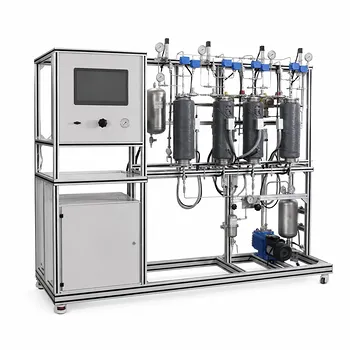
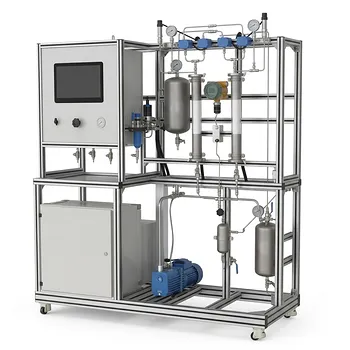
Fine particle management is the make-or-break skill in fluidized bed gasification. The primary operational challenge in coal-fired pilot plants is the uncontrolled disintegration of partially converted coal into fines. These fines are entrained by the gas stream, stick stubbornly to cyclone walls, and slash carbon conversion efficiency. In vocational training pilots, this is managed by two core strategies: adjusting the fluidizing gas velocity to keep the cyclone load within a workable window, and injecting secondary oxygen near the bed surface to combust the troublesome fines before they can escape.
The real struggle isn’t just fines formation—it’s the cascade of knock-on effects: lost carbon, fouled cyclones, and a destabilized bed. Training pilots turn this into a controlled learning laboratory where students see, diagnose, and correct these interconnected problems themselves.
The Hidden Operational Challenge of Coal Fines
How Fines Form and Why They Matter for Conversion
Coal particles in a fluidized bed are not simply converted in place. Partial reaction causes the parent particles to break down into much smaller fragments. These fines have a low terminal velocity and are easily swept upward by the gas flow.
Once airborne, they travel straight toward the product gas outlet. Because fines are difficult to fully convert in the dilute freeboard region, a significant fraction of the coal’s carbon content simply leaves the reactor unreacted. In pilot plants, this commonly limits carbon conversion to 85–90% unless deliberate corrective action is taken.
The Cascade of Operational Problems
The trouble starts the moment fines reach the cyclone. Coal fines show a strong tendency to adhere to cyclone walls, building up into layers that restrict flow, reduce separation efficiency, and eventually demand a shutdown.
If a fines recycle loop is used, returning that collected material to the bed introduces a new danger. The stream of lighter, harder-to-fluidize powder lowers the overall bed density and changes the fluidization regime—often pushing the bed into a poorer mixing state that further drops conversion.
Even in systems without a recycle, the continuous loss of fines steals the “interstitial fines” that are essential for a healthy Group A powder. Without these small particles, interstitial gas flow decreases and reactor performance progressively degrades over an operating shift.
Proven Management Techniques in Pilot Plants
Velocity Optimization and Cyclone Load Balancing
The most direct lever is the fluidizing gas velocity. Running at the minimum fluidization velocity (Umf) keeps the bed just suspended, minimizing particle carryover. However, going too low risks ash agglomeration and defluidization, especially with high‑ash coals.
Vocational pilots force students to find the sweet spot. Operators measure pressure drop versus velocity, calculate theoretical Umf using correlations like Broadhurst and Becker, then compare those predictions to live sensor data. The goal is to maintain bubbling fluidization while keeping the cyclone inlet loading within the separator’s design envelope—a balancing act that reveals how closely fluidization theory and real‑world operability are linked.
Secondary Oxygen Injection for Fines Combustion
When simple velocity tweaking is not enough, the most elegant solution is to introduce a stream of oxygen near the top of the bed. This deliberately creates a high‑temperature zone in the dilute phase where entrained fines ignite and burn before they can reach the cyclone.
The reactor operates as a partial combustor, trading some syngas output for greatly reduced cyclone fouling and a higher effective carbon conversion. Students learn to control the secondary oxygen flowrate while watching temperature profiles and gas composition, directly linking their action to changes in fines carryover.
Understanding the Trade-offs and Pitfalls
No single fix works without downsides. Velocity adjustments that protect the cyclone can starve the bed of mixing energy, causing localized hot spots or ash melting. Secondary oxygen injection, while powerful, consumes some of the desirable syngas components and raises the freeboard temperature beyond the design limits of simpler pilot hardware.
Recycling fines may seem like the obvious answer, but the returned material is qualitatively different from fresh feed. It is finer, more reactive only on its surface, and often sticky from partial tars. This changes bed behaviour in ways that cannot be predicted from clean‑sand fluidization experiments, making it a rich source of training scenarios where students must diagnose changing pressure‑drop profiles and adjust feed rates on the fly.
Bridging Theory and Practice in Vocational Training
Making the Invisible Visible
The real value of a pilot plant for training is that phenomena normally hidden in industrial reactors become observable. Students can open sampling ports to physically see the fines load in the cyclone catch pot, record the time‑evolution of bed pressure drop, and correlate those readings with gas‑phase carbon dioxide spikes from secondary oxygen injection.
This turns the Ergun equation and two‑phase flow models from abstract formulas into a tactile decision‑making tool. When a student sees that a 10% rise in gas velocity pushes the bed just past the slugging threshold and doubles the fines loss, the principle of terminal velocity becomes unforgettable.
Learning to Balance Fines Recovery and Carbon Conversion
The central skill a vocational pilot teaches is the ability to manage multiple competing objectives at once. Operators must maintain fluidization quality, control cyclone fouling, safeguard carbon conversion, and stay below ash fusion temperatures—all while handling a feedstock that is constantly disintegrating.
The pilot plant compresses weeks of industrial experience into a single day’s shift. By the end, students can decode pressure‑drop noise as early warnings of cyclone plugging, calculate the oxygen demand to just burn the fines without wasting expensive reactants, and explain why selecting a slightly coarser coal feed can sometimes be the simplest solution.
Making the Right Choice for Your Training Goals
Every management strategy has a distinct personality. Your choice depends on what you need the pilot plant to teach.
- If your primary focus is maximizing carbon conversion: Prioritize secondary oxygen injection and teach students to control freeboard combustion. This forces them to interpret temperature profiles and gas composition in real time.
- If your primary focus is mechanical reliability and cyclone life: Emphasize velocity optimization and cyclic return‑loop operation. Students learn the discipline of slowly ramping gas flow while monitoring cyclone pressure drop.
- If your primary focus is demonstrating the link between fluidization theory and practice: Start with Umf experiments using the Broadhurst and Becker correlation, then deliberately vary the fines content to show how bed expansion and performance shift.
The best training pilot does not avoid the fines problem—it puts it centre stage, so every learner walks away with the instinct to balance the bed, manage the cyclone, and know when to burn rather than recycle.
Summary Table:
| Challenge | Operational Impact | Management Strategy |
|---|---|---|
| Fines Entrainment | Reduced carbon conversion (85–90%) | Inject secondary oxygen for freeboard combustion |
| Cyclone Fouling | Flow restriction and unscheduled shutdown | Optimize fluidizing gas velocity near minimum fluidization ($U_{mf}$) |
| Bed Destabilization | Lower bed density and poor fluidization | Balance the recycle loop and monitor pressure-drop profiles |
Equip Your Laboratory with Industry-Grade Training Systems
Translating complex chemical processes like fluidized bed gasification into hands-on lessons requires robust, real-world simulation. LABPARK designs and manufactures advanced Educational and Vocational Unit Operations Pilot Plants in chemical engineering, bioprocess & biotech, and environmental & water treatment.
We empower universities, research institutes, and enterprises to train the next generation of operators and engineers with high-fidelity, safe, and instrument-rich systems. Enhance your vocational curriculum and research capabilities today—contact our engineering experts to discuss your lab requirements.
Related Products
- Fluidized Bed Gas Solid Catalytic Reaction Educational Pilot Plant
- Two-Dimensional Fluidization Hydrodynamics Educational Pilot Plant for Unit Operations Training
- Multi-Reactor Educational Pilot Plant for Reaction Engineering Unit Operations
- Multi Functional Catalytic Reaction and Reactor Evaluation Educational Unit Operations Pilot Plant
- Fixed Bed Gas Solid Catalytic Reaction Educational Pilot Plant
People Also Ask
- Why is the bed height-to-diameter ratio (L/dt) critical? Fluidized bed pilot plant selection guide.
- How do dimensionless numbers guide heat transfer in pilot plants? Optimize Scale-Up
- How is the minimum fluidization velocity (U_mf) determined and utilized? A Unit Operations Guide
- Fixed-Bed vs. Fluidized-Bed Reactor: How to Choose the Right Pilot Plant for Gas-Solid Catalytic Reactions
- How to determine catalyst pore radius & porosity? Optimize your chemical engineering pilot plant.