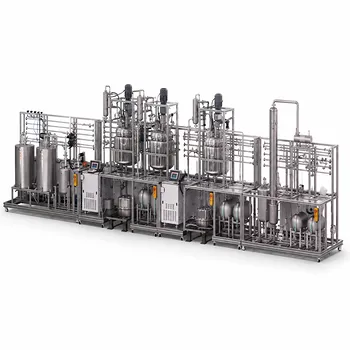
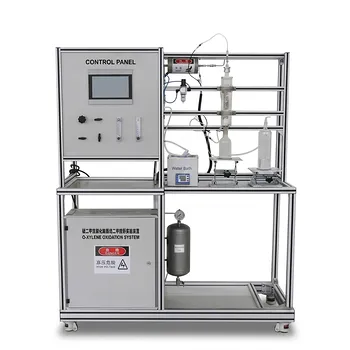
The catalyst particle size is a master lever in ammonia synthesis pilot plants, directly controlling the balance between reaction rate and reactor pressure drop. In a gas-solid packed bed, smaller catalyst particles shorten the diffusion path inside the pores, drastically reducing internal mass transfer resistance. This makes the entire catalyst volume more effective, enabling high conversion efficiency in a compact pilot-scale setup—exactly what you need to demonstrate performance. However, the price for that enhanced activity is a steeper pressure drop, a compromise that shapes every design decision from laboratory rigs to full-scale production.
Pilot-scale ammonia reactors typically use catalyst particles of 2.2–3.3 mm to achieve high catalyst utilization and overcome internal diffusion limitations, whereas industrial units sacrifice some effectiveness by adopting 6–13 mm particles to keep pressure drop and compression costs acceptably low. The choice is always a tug-of-war between catalytic efficiency and hydraulic practicality.
How Internal Diffusion Governs the Reaction Rate
At the heart of ammonia synthesis lies a rapid surface reaction that quickly consumes reactants inside the catalyst. When the chemical kinetics are fast—especially above 380°C—the overall rate becomes limited not by the intrinsic activity of the catalyst, but by how fast molecules can diffuse into the pore network.
The Thiele Modulus and Effectiveness Factor
The internal effectiveness factor ($\eta$) quantifies what fraction of the catalyst’s internal surface is actually participating in the reaction.
For diffusion-limited systems, $\eta$ can drop well below 1, meaning the inner core of a particle sits idle.
Smaller particles reduce the characteristic diffusion length, lowering the Thiele modulus and pushing $\eta$ closer to 1.0.
Why 380°C Is the Tipping Point
In ammonia synthesis, the reaction rate becomes extremely sensitive to temperature.
Above 380°C, the intrinsic kinetics accelerate so much that pore diffusion is unable to keep up, creating steep concentration gradients inside the particle.
At this point, shrinking particle size delivers the most dramatic improvements in utilization, effectively “unlocking” active sites that would otherwise be starved.
How Particle Size Directly Shapes Reactor Performance
Performance in a pilot plant is not just about conversion; it’s about achieving that conversion in a controlled, measurable, and scalable manner. Changing the catalyst particle size touches nearly every metric you track.
Conversion and Space Velocity Interplay
Smaller particles boost the observed reaction rate per unit volume, meaning you can reach target ammonia concentrations at lower temperatures or higher space velocities.
Operating at varying space velocities with a fixed particle size reveals whether the reactor is still under kinetic control or has entered the diffusion-limited regime.
A classic pilot-plant experiment involves testing two particle sizes at identical conditions; if conversion increases significantly with the smaller size, you’ve identified a diffusion limitation.
Catalyst Inventory and Bed Height Constraints
Smaller particles pack more tightly, often raising the bulk density and total active surface area in a given bed volume.
This can shorten the required bed height for a given conversion, a key advantage in a pilot plant with limited vertical space.
However, the same tight packing is what drives up the pressure drop, so you must consider the whole hydraulic system.
Radial Flow and Alternative Geometries as Solutions
In some pilot-plant designs, you can offset the pressure-drop penalty by switching from axial to radial flow.
Radial flow beds expose the gas to a much larger cross-sectional area, reducing the linear velocity through the catalyst.
This allows the use of small, highly effective particles without an unacceptable pressure penalty—a direct demonstration of how industrial reactors manage the trade-off.
Understanding the Trade‑offs: Pressure Drop and Beyond
While smaller particles clearly improve mass transfer and utilization, they introduce practical hurdles that can distort your data or limit operational flexibility.
The Pressure Drop Penalty
For a fixed bed, pressure drop scales inversely with particle diameter squared (in the Ergun equation domain).
Switching from a 6 mm particle to a 3 mm particle can increase pressure drop by a factor of four or more at the same mass flux.
In a research pilot plant with long, narrow reactor tubes, an excessive pressure drop can require oversized feed compressors and generate unwanted mechanical stress on catalyst pellets.
Potential for Channeling and Fluid Maldistribution
When particles are too small relative to the reactor diameter, the bed becomes more prone to poor gas distribution.
Axial dispersion can rise, and wall effects can create bypass channels that reduce the effective contact time.
This defeats the purpose of using small particles—the apparent performance may drop not because of kinetics but because of hydraulics.
Particle Attrition and Fines Generation
Smaller, irregularly shaped particles may break down more easily under thermal cycling and gas flow.
Fines can plug pores, increase pressure drop further, or even escape into downstream instrumentation.
In pilot plants where long-term stability is paramount, mechanical integrity can sometimes steer the choice back toward slightly larger particles.
Making the Right Choice for Your Pilot Plant Goal
The “right” particle size is always a function of what you intend to learn or prove. Use these goal-driven guidelines to narrow your selection.
- If your primary focus is determining intrinsic reaction kinetics: Start with very small particles (e.g., a powder diluted with inert material) to eliminate internal diffusion entirely, then validate by testing a slightly larger size to ensure there is no conversion drop-off.
- If your primary focus is simulating a commercial‑scale reactor in a small bed: Choose a particle size in the 2.2–3.3 mm range that delivers high effectiveness, and complement your runs with pressure drop measurements to feed into your scale‑up model.
- If your primary focus is demonstrating process stability over hundreds of hours: Select a pellet size and shape with proven mechanical strength (often spherical) to minimize attrition, even if it means a slightly lower effectiveness factor.
Ultimately, catalyst particle size is the dial you turn to navigate between the perfect kinetics experiment, a manageable pressure drop, and a representative industrial simulation—informed by the delicate interplay of diffusion length, reactor hydraulics, and your pilot plant’s specific mission.
Summary Table:
| Particle Size | Mass Transfer Resistance | Effectiveness Factor ($\eta$) | Pressure Drop Penalty | Best Suited For |
|---|---|---|---|---|
| Small (2.2–3.3 mm) | Low (Short diffusion path) | High (Approaching 1.0) | High (Proportional to $1/d_p^2$) | Kinetic studies & compact pilot simulations |
| Large (6–13 mm) | High (Pore diffusion limitations) | Low (Inner core inactive) | Low (Minimal compression costs) | Commercial-scale operations & long-term stability |
Scale Up with Confidence using LABPARK Pilot Plants
Optimizing catalyst efficiency and managing pressure drops requires precise, reliable experimental equipment. LABPARK provides state-of-the-art Educational and Vocational Unit Operations Pilot Plants in chemical engineering, bioprocess & biotech, and environmental & water treatment.
Designed specifically for universities, research institutes, and enterprises, our pilot plants help you accurately transition from laboratory kinetics to industrial reality.
Ready to elevate your research and engineering training? Contact LABPARK today to find the perfect pilot plant solution for your facility!
Related Products
- Methanol Synthesis and Catalyst Performance Evaluation Educational Unit Operations Pilot Plant
- Educational Unit Operations Pilot Plant for Intraparticle Diffusion Effective Factor Measurement
- Micro-Scale Gas-Solid Catalytic Reaction Educational Pilot Plant
- Fixed Bed Gas Solid Catalytic Reaction Educational Pilot Plant
- Fixed-Bed Chemical Reaction and Gas Dust Tar Removal Unit Operations Pilot Plant
People Also Ask
- Why is a purge system necessary when operating a gas recirculation loop in a methanol synthesis pilot plant? (Guide)
- How do temp & pressure affect methanol synthesis pilot plants? Optimize equilibrium and catalyst performance.
- Why do modern methanol pilot plants operate at lower pressures? Catalyst & Feed Requirements Explained
- What are the operational requirements for catalyst activation? Safe Methanol Pilot Plant Operation
- Why Compare Predicted and Experimental Excess Enthalpy? Key to Accurate Pilot Plant Scale-up