Equilibrium-stage models are the instructional backbone of distillation laboratory training because they prioritize conceptual clarity over computational complexity. They teach students the core principles of vapor-liquid equilibrium and stage-wise separation using an intuitive tray efficiency factor. Rate-based models, conversely, abandon the equilibrium assumption and directly solve mass and heat transfer equations at the vapor-liquid interface, offering higher physical realism at the cost of demanding, hard-to-predict parameters that can obscure the underlying separation science in a teaching environment.
While both models describe the same physical column, they serve fundamentally different pedagogical purposes. In a teaching lab, the equilibrium-stage model’s strength lies in its ability to make abstract thermodynamic concepts tangible through a single, adjustable efficiency knob, whereas the rate-based model is reserved for advanced study where students must confront the unpredictability of interfacial area and mass transfer coefficients.
The Two Philosophical Approaches to Distillation Modeling
The core divide between these models isn't just mathematical—it's a difference in how we believe a tray or packing element behaves. In a teaching laboratory, that philosophical difference directly shapes a student's intuition.
Equilibrium-Stage Models: The Cornerstone of Pedagogy
The equilibrium-stage model makes one monumental simplification: vapor and liquid leaving any theoretical stage are in perfect thermodynamic equilibrium. This assumption immediately unlocks the classic MESH (Material, Equilibrium, Summation, Heat) equation framework. Students can track species balances, phase splits via K-values, and enthalpy balances without ever calculating a diffusion rate.
Because no real tray achieves perfect equilibrium, the model introduces a tray efficiency factor—typically a value below 0.8. This single, tunable parameter bridges theory and experimental data. It gives students a direct, physical feel for non-ideality without forcing them to model the chaotic fluid mechanics and bubble dynamics inside a froth layer.
For the teaching lab, this is a powerful advantage. Students can quickly build a simulation, vary reflux ratio or feed condition, and immediately see a coherent response. The computational simplicity means the focus stays on separation fundamentals, not on debugging convergence failures.
Rate-Based Models: The Reality-Centric Alternative
Rate-based models reject the equilibrium assumption entirely. They treat each stage not as a black box at equilibrium, but as a physical volume where mass and heat transfer occur at finite rates across a specific vapor-liquid interfacial area. The model solves actual transport equations, accounting for bulk-phase resistance on both sides of the interface.
In theory, this yields superior accuracy, especially for columns where transport limitations—not just thermodynamics—dictate separation. In practice, it shifts the bottleneck from conceptual understanding to parameter estimation. Interfacial area, individual mass transfer coefficients, and flow patterns are notoriously difficult to predict, even with modern correlations.
For a student in a unit operations pilot plant, this means they spend less time exploring distillation principles and more time wrestling with the model’s data hunger. Where an equilibrium model needs VLE data and an efficiency guess, a rate-based model demands transport properties, packing/tray dimensions, and often proprietary hydraulic correlations that are not transparent to a learner.
Key Distinctions in a Teaching Laboratory Context
When you’re standing in front of a pilot-scale column, the differences between these models translate into concrete instructional decisions. These aren't just theoretical nuances—they dictate what students learn, measure, and debug.
Assumptions and Simplifications
Equilibrium-stage models treat every tray as a single, well-mixed equilibrium cell. The complexity of the real process is compressed into the tray efficiency. Rate-based models decompose each tray into separate bulk vapor, bulk liquid, and interface regions, requiring assumptions about mixing patterns, flow regimes, and transport path lengths.
In a training environment, the equilibrium model forces students to ask, “Why is my overall efficiency lower than 1?” – a rich prompt for discussing fluid dynamics, weeping, flooding, and channeling. The rate-based model can bury those insights under layers of hard-to-verify input parameters.
Computational Complexity and Accessibility
Solving the MESH equations for a multi-component column is a classic numerical problem, well-supported by accessible textbooks and software. Equilibrium models converge reliably with standard algorithms. Rate-based models introduce a far larger system of non-linear equations, often requiring specialized solvers and more sophisticated initial guesses.
For a laboratory session with limited time, a model that fails to converge teaches frustration, not distillation. Students need to see a successful simulation, perturb it, and interpret results. The equilibrium approach consistently delivers that experience.
Required Input Parameters
An equilibrium model demands phase equilibrium constants (K-values) and a single tray efficiency. Both are conceptually digestible. Students can measure VLE in a companion lab or look up reliable correlations. Efficiency can be estimated from empirical charts like those of O’Connell or Drickamer and Bradford.
A rate-based model requires binary diffusion coefficients, mass transfer coefficients, interfacial area, liquid holdup, and pressure drop correlations. These are often derived from proprietary vendor data or complex empirical regressions. In a teaching lab, asking students to source these values without deep industrial context makes the model feel like a black box, not an educational tool.
Accuracy vs. Practicality
The rate-based model is unquestionably more physically faithful, particularly for columns with significant heat effects, multi-component mass transfer coupling, or reactive separations. However, in the typical teaching laboratory—where columns operate at near-total reflux, with known, ideal or near-ideal mixtures—the gain in accuracy is marginal, while the loss in transparency is substantial.
The equilibrium model's efficiency parameter, though empirical, actually becomes a pedagogical feature. It teaches that models are idealized maps, not the territory itself. It opens a conversation about model validation and the limits of theoretical predictions—a conversation that is far harder to stage with a rate-based model that projects an illusion of first-principles correctness.
Understanding the Trade-offs
Choosing a teaching model means choosing which lessons you want to emphasize and which frustrations you are willing to accept. Ignoring these trade-offs leads to lab exercises that either oversimplify reality or drown students in complexity.
The primary trade-off is conceptual clarity versus physical realism. Equilibrium models deliver immediate intuition about how vapor and liquid compositions evolve along the column. Rate-based models reveal the real internal gradients that drive separation but require students to already have a firm grasp on transport phenomena, numerical methods, and fluid mechanics. Without that foundation, the added realism becomes noise.
Another pitfall is the "efficiency trap." Students taught only with equilibrium models may come to view efficiency as a fixed column property, rather than a dynamic variable dependent on operating conditions. Good instructors counter this by explicitly showing how efficiency shifts with vapor load or liquid viscosity, linking the equilibrium model back to the transport physics it ignores.
Making the Right Choice for Your Instructional Goal
Your selection should be driven not by which model is academically superior, but by what intellectual skills you need your students to develop in a finite amount of laboratory time. Match the model to the learning objective.
- If your primary focus is teaching core separation principles and phase equilibrium thermodynamics: Start with the equilibrium-stage model. Its transparent assumptions and single tuning parameter keep causal relationships visible, allowing students to connect lever movements (reflux, boil-up) to separation outcomes without computational distraction.
- If your primary focus is preparing students for advanced troubleshooting of real, transport-limited columns: Supplement a solid equilibrium foundation with a targeted rate-based case study. Use it only after students can predict ideal behavior, so they can isolate and quantify the "non-equilibrium gap" as a deliberate exercise in model refinement.
- If your primary focus is balancing curriculum time and lab resources with credible results: Use the equilibrium-stage model as your default, and treat the rate-based model conceptually. Walk students through pseudo-code or flowcharts of the rate-based solver, discussing why industrial simulations pay the computational cost, but reserve hands-on rate-based simulation for a capstone design project.
The goal is not to choose one model forever, but to use the equilibrium-stage framework to build an unshakable intuition, then, if time and aptitude allow, to use the rate-based view to show that every real tray is a small, beautiful battlefield of transport phenomena.
Summary Table:
| Feature | Equilibrium-Stage Model | Rate-Based Model |
|---|---|---|
| Core Assumption | Vapor & liquid leave stages in thermodynamic equilibrium; adjusted by tray efficiency. | No equilibrium assumed; mass & heat transfer occur at finite rates across the interface. |
| Complexity | Low; reliable convergence, ideal for teaching core principles. | High; complex non-linear transport equations, harder to converge. |
| Key Inputs | Phase equilibrium constants (K-values) & a single efficiency factor. | Binary diffusion coefficients, mass transfer coefficients, & column dimensions. |
| Best Used For | Undergraduate labs focusing on separation fundamentals. | Advanced study, transport-limited systems, & research projects. |
Bring Distillation Theory to Life with LABPARK Pilot Plants
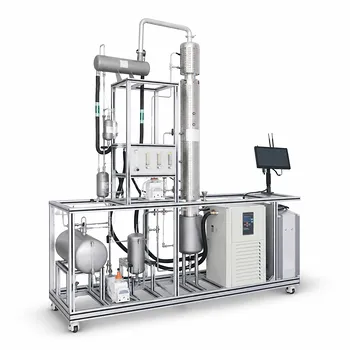
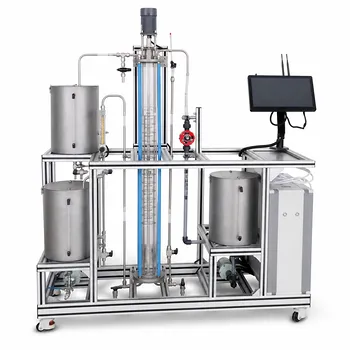
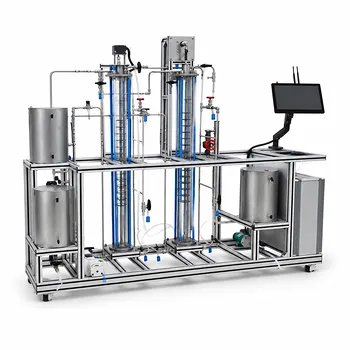
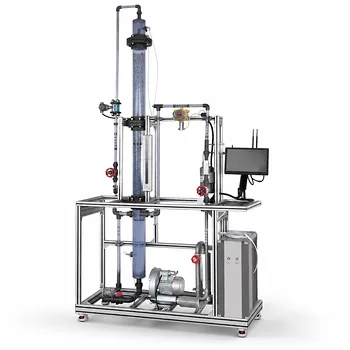
Bridge the gap between theoretical modeling and physical column operation. LABPARK provides state-of-the-art Educational and Vocational Unit Operations Pilot Plants in chemical engineering, bioprocess & biotech, and environmental & water treatment for universities, research institutes, and enterprises.
Help your students and researchers validate distillation models with reliable, high-performance equipment. Contact LABPARK today to find the perfect pilot plant for your laboratory!
Related Products
- Continuous Sieve-Plate Distillation Pilot Plant for Unit Operations Laboratory Education
- Multi-Functional Special Distillation Educational Pilot Plant
- Multi-Modal Distillation Unit Operations Training Pilot Plant
- Continuous Batch Extractive Distillation Educational Pilot Plant
- Dual-Mode Rectification Pilot Plant for Practical Training Unit Operations
People Also Ask
- Why is vacuum operation capability an essential feature for a distillation unit operations pilot plant? Unlock Efficiency
- How can real-time carbon number prediction improve distillation pilot plants? Optimize control.
- What are the primary reflux ratio control strategies? Master Distillation Unit Operations
- How to select the right activity coefficient model (Wilson, NRTL, UNIQUAC) for distillation pilot plants?
- How does catalyst water concentration affect distillation pilot plant design? Key separation train choices.