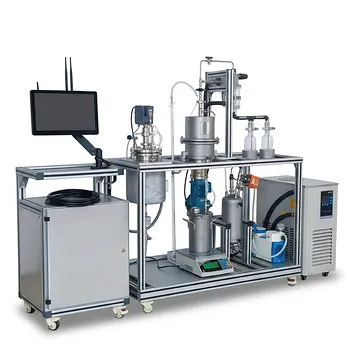
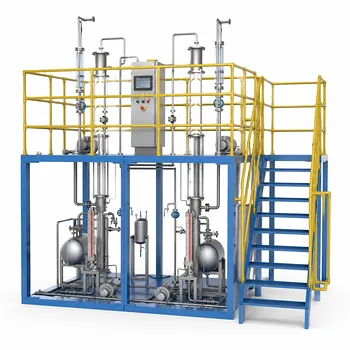
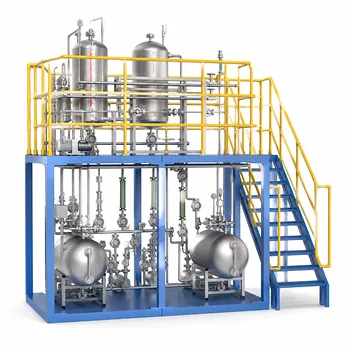
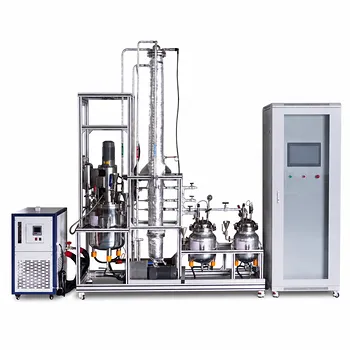
The choice between a hydrophobic and hydrophilic membrane in a pervaporation pilot unit is dictated by which component you need to remove, not simply by what is most abundant. When the feed contains a trace organic solvent in water, a hydrophobic membrane (like silicone rubber) is selected to preferentially permeate the organic. Conversely, when the feed is a nearly pure organic stream contaminated with a small amount of water, a hydrophilic membrane (like polyvinyl alcohol) is chosen to selectively remove the water. This concentration-driven selection strategy is the fundamental key to optimizing mass transfer and making the separation economically viable.
The feed concentration dictates membrane selection by identifying the minority component as the target for removal. A hydrophobic membrane is used when water is the bulk and organics are the dilute impurity; a hydrophilic membrane is used when the organic is the bulk and water is the trace impurity. This ensures the permeate is enriched in the dilute component, minimizing energy costs and equipment size.
Why the Minority Component Rules the Choice
The Core Principle: Permeate the Dilute Species
The pervaporation process is most efficient when the membrane selectively transports the component present in the lowest concentration. Attempting to remove the bulk component through a membrane would require an enormous membrane area and energy input, making the process impractical. By targeting the trace component, the permeate stream is highly enriched, while the retentate remains as a purified bulk stream.
The Energetic and Economic Logic
Allowing the minority component to permeate minimizes the mass that must pass through the membrane. For example, removing 1% acetone from water by vaporizing only the acetone requires a fraction of the energy needed to vaporize 99% water. This directly translates to smaller membrane modules, lower vacuum pump loads, and reduced heating/cooling duties—a critical learning objective for students analyzing pilot-plant economics.
Modeling the Separation: The Separation Factor
The effectiveness of this strategy is quantified by the separation factor (α) . It is defined as:
α = (yA / yB) / (xA / xB)
where y are permeate mole fractions and x are feed mole fractions. A high α means the membrane strongly enriches the target minority component. When you match membrane polarity to the minority component, you dramatically increase α, confirming the correct selection.
Practical Examples in the Lab
- Dilute acetone in water: Hydrophobic silicone rubber membrane. The acetone, though present in low concentration, permeates preferentially because it partitions strongly into the non-polar polymer matrix.
- Trace water in ethanol: Hydrophilic PVA membrane. The membrane’s high affinity for water drives water removal, producing dry ethanol while a small water-rich permeate is condensed.
- Azeotrope breaking: This principle is exactly why pervaporation replaces distillation for azeotropic mixtures. Rather than fighting the azeotrope, you simply remove the minority component by selective permeation.
Understanding the Trade-offs
Membrane Stability vs. Selectivity
The perfect membrane for a given feed concentration often faces a trade-off. Crosslinked PVA delivers excellent water selectivity but must be chemically stabilized (e.g., with glutaraldehyde) to survive hot organic streams. Without crosslinking, the membrane swells and loses performance. Students must learn that a high-separation-factor material becomes useless if it dissolves or cracks in the process environment.
Inorganic Options: Performance at a Price
Inorganic membranes (zeolites, silica) offer outstanding thermal and chemical stability, making them attractive when feeds are aggressive or when a very high selectivity is demanded. However, they are fragile and expensive. For pilot-scale teaching, balancing the high α of a custom inorganic against the lower cost and easier handling of a polymer film is a practical design exercise.
The Cost of Ignoring Concentration
Choosing a membrane based solely on “hydrophilic equals water removal” without considering concentration leads to disaster. Using a hydrophilic membrane to remove trace water from a 99% water feed would simply dewater the bulk, leaving a useless permeate. The process becomes an expensive water evaporator, not a separator. This error highlights why the minority-component rule is the first and most important selection filter.
Permeate Purity and Downstream Processing
While targeting the minority component yields a highly enriched permeate, that permeate is rarely 100% pure. The retentate still contains residual trace contaminants. The membrane selection thus directly influences whether additional polishing steps are needed, impacting the full process flow sheet students must design.
How to Apply This to Your Pilot-Unit Experiment
- If your primary focus is removing a low-concentration organic impurity from water: Start with a hydrophobic silicone-rubber membrane. Evaluate the separation factor for your specific organic and confirm the membrane’s chemical resistance to the organic at operating temperatures.
- If your primary focus is dehydrating an organic solvent (e.g., ethanol, isopropanol): Select a hydrophilic PVA membrane, preferably crosslinked. Verify its thermal stability matches your planned feed temperature and run long-duration tests to monitor any decline in selectivity.
- If your primary focus is teaching the fundamental design principle: Have students vary the feed concentration over a wide range and measure the separation factor for both a hydrophobic and a hydrophilic membrane. The dramatic change in performance with concentration will cement the rule that the minority component dictates the optimal membrane choice.
Empower your lab work by remembering that the membrane doesn’t care about the majority—it is the trace component that determines which side of the polarity spectrum you select to achieve a lean, efficient separation.
Summary Table:
| Feed Scenario | Target for Removal (Minority Component) | Membrane Type | Typical Materials | Example Application |
|---|---|---|---|---|
| Trace Organic in Water | Organic Solvent | Hydrophobic | Silicone rubber (PDMS) | Acetone recovery from water |
| Trace Water in Organic | Water | Hydrophilic | Polyvinyl alcohol (PVA) | Ethanol dehydration (azeotrope breaking) |
Scale Up Your Chemical Engineering Lab with LABPARK
Are you looking to enhance hands-on learning and research in membrane separation? LABPARK provides state-of-the-art Educational and Vocational Unit Operations Pilot Plants in chemical engineering, bioprocess & biotech, and environmental & water treatment.
Designed specifically for universities, research institutes, and enterprises, our pilot units offer students and researchers real-world experience in optimizing pervaporation, mass transfer, and process economics.
Contact LABPARK today to discuss your laboratory configuration and get a customized quote!
Related Products
- Supercritical High-Gravity Flash Evaporation Educational Unit Operations Pilot Plant
- Multi Pump Fluid Transport Process Piping Unit Operations Training Pilot Plant
- Rising and Falling Film Evaporation Educational Unit Operations Pilot Plant
- Natural Product Extraction Unit Operations Training Pilot Plant
- Absorption and Desorption Educational Unit Operations Pilot Plant
People Also Ask
- How is the heat transfer area calculated for an evaporation unit operations pilot plant during experimental design? Guide
- How to select educational evaporator pilot plants for thermal & scaling solutions? Complete Guide
- What is the practical significance of Kb in pilot plant evaporation? Master process design.
- How do flash calculations relate to flash evaporation pilot plants? Bridge Theory and Practice
- Vacuum vs. Atmospheric Evaporation: Key Pilot Plant Trade-Offs to Evaluate