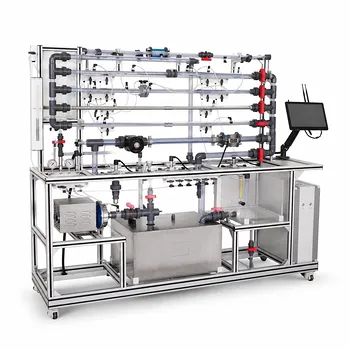
The true value of a chemical engineering pilot plant lies in its ability to demystify industrial reactor design by converting abstract theoretical principles into tangible, observable cause-and-effect relationships.
These scaled-down, fully instrumented systems serve as the critical bridge between textbook equations and the complex reality of technologies like methanol synthesis. By physically manipulating process variables such as pressure, temperature, and flow rates in real-time, students see firsthand how a decision made at the reactor fundamentally dictates the performance and economics of the entire downstream separation process.
The core challenge in scaling up complex synthesis technologies is managing the unpredictability of reaction kinetics and heat transfer. Pilot plants address this deep need by providing a safe, controlled environment where students link theoretical rate laws to physical observations—watching how a shift in space velocity instantly changes conversion, selectivity, and the subsequent purification burden. This direct, physical experience builds the intuitive judgment that pure simulation cannot.
From Theoretical Equations to Operational Reality
The fundamental struggle for any chemical engineering student is applying idealized rate laws to a real, flowing system. A pilot plant forces this connection by making the reaction a physical event that can be measured and controlled.
Visualizing Reaction Kinetics
The primary reference highlights that students can experimentally measure reaction rates, which is the first critical leap in understanding. Instead of just solving a differential equation for a second-order reaction on paper, they operate a real continuous stirred-tank reactor (CSTR) or plug flow reactor.
They physically inject a reactant, adjust the residence time by changing the feed pump speed, and then use online analytical sensors to watch the concentration change in real-time. This direct observation reveals how reaction pathways can shift under transport-limited conditions, a complexity rarely captured by a simple textbook problem.
Mastering the Temperature Profile
Temperature is the primary language of reactor control, and a pilot plant translates it from a single number into a dynamic curve. As the supplementary references note, precise temperature control is what optimizes conversion and selectivity in industrial configurations like fixed-bed or radial reactors.
In a pilot plant, a student can program the heat exchange system to manage an exothermic reaction front moving through a catalyst bed. If the cooling fails to keep pace, they see a "hot spot" form on the data acquisition screen, immediately visualizing the runaway risk. This teaches more about reactor safety and design in five minutes than a lecture can in an hour.
Understanding the Inseparable Link Between Reaction and Separation
One of the most vital lessons a pilot plant teaches is that a reactor never operates in isolation. It is the first domino in a chain of unit operations, and a pilot plant makes this interdependence physically unavoidable.
How Reactor Performance Dictates Downstream Cost
The supplementary references offer a powerful learning objective: students can observe how low selectivity directly creates byproducts that downstream separation must handle. You can physically see this when a distillation column’s heat duty must be increased to purify a product stream after a reactor selectivity drop.
This visceral experience cements the concept that overall process yield is not just a reactor problem. It is the product of reactor selectivity and separation efficiency. In a complex synthesis like coal-to-ethylene glycol, this insight is the foundation of process economics, and it's learned by tracking flow rates and concentrations from one module to the next.
The Modular View of Process Flows
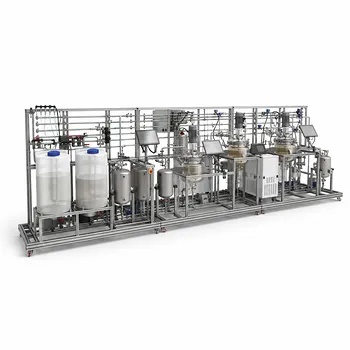
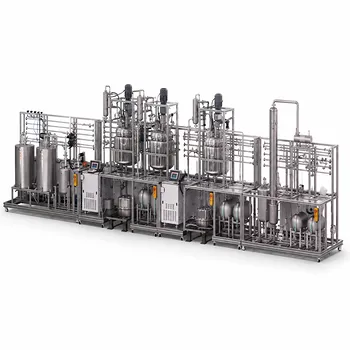
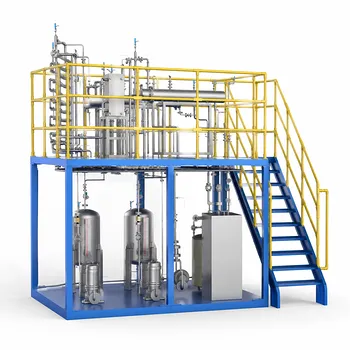
Educational pilot plants replicate the complete architecture of an industrial plant on a benchtop scale. They organize the chaos of pipes and valves into distinct, modular stages—raw material preparation, catalytic reaction, separation, and recycling.
By operating each module, a student learns the function of a recycle loop not in theory, but by opening a valve and watching unreacted feed return to the reactor inlet. This modular approach breaks down an overwhelming process flow diagram into a series of understandable physical steps, directly addressing the complexity outlined in the primary reference.
Understanding the Trade-offs
A purely theoretical education often presents idealized solutions. The honest education from a pilot plant comes from confronting real-world trade-offs, especially those related to materials and scheduling.
Construction Materials and Scale-up Laws
A crucial, often overlooked lesson involves reactor construction. The supplementary references explain how process economics are deeply tied to materials. By operating pilot-scale reactors of varying materials, students learn that a glass-lined reactor offers excellent corrosion resistance but has a far lower cost exponent (0.32-0.42) than a stainless steel one (~0.75).
This physically demonstrates a scale-up trade-off: the material that is perfect for a versatile, corrosion-prone batch chemistry in a small plant may become cost-prohibitive when scaled. The choice of material directly impacts the heat exchange jacket configuration, pressure rating, and ultimately, the economic viability of a process.
Identifying and Managing Bottlenecks
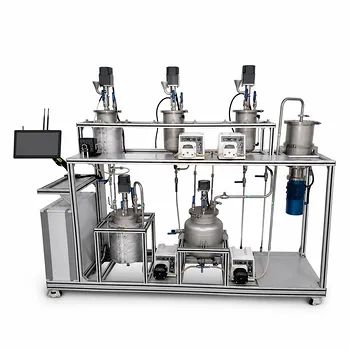
In a multi-step batch process pilot plant, the scheduling logic becomes a physical puzzle. By running consecutive batches and simply timing how long each unit sits idle, students can identify the scheduling bottleneck—the equipment with the least idle time that constrains the entire cycle.
This hands-on analysis directly shows how reducing cycle time isn't about optimizing everything, but just the bottleneck step. Adding an auxiliary unit operation, like a second hold tank, shifts the constraint and increases productivity. This principle of process optimization is far more powerful when physically discovered than when read in a textbook, turning abstract cycle time calculations into a tangible race against the clock.
Making the Right Choice for Your Educational Goal
The learning outcome of a pilot plant depends directly on the configuration you choose to study. The value is not in just using one, but in using the right one for a specific question.
- If your primary focus is mastering kinetic principles and safety: Concentrate your study on a pilot plant configured as a high-pressure catalytic reactor, like one simulating ammonia or methanol synthesis. Manipulating pressure-drop and temperature profiles in this system is the most direct way to understand how thermodynamics dictates safe operating envelopes.
- If your primary focus is grasping overall process economics: You must work with a fully integrated pilot plant that couples the reactor directly with separation and recycle modules. This configuration makes the financial cost of low selectivity an observable, measurable reality in the form of increased separation energy.
- If your primary focus is understanding scale-up and production logistics: Seek experience on a modular batch pilot plant with different construction materials. This will force you to confront the reality of scheduling bottlenecks and the non-linear cost-capacity laws that govern the economics of scaling a design from the bench to the plant floor.
The ultimate lesson from a pilot plant is not a single principle but a new way of seeing—it transforms a process flow diagram from a static drawing into a three-dimensional, interconnected system of energy, mass, and cost that the engineer must learn to control in concert.
Summary Table:
| Key Learning Area | Theoretical Concept | Pilot Plant Practical Experience |
|---|---|---|
| Reaction Kinetics | Idealized rate laws & residence time | Manipulating flow rates & measuring real-time concentration changes. |
| Temperature Control | Heat transfer & runaway reactions | Managing exothermic hot spots dynamically through data acquisition screens. |
| Process Integration | Isolated unit operations | Tracking how low reactor selectivity increases downstream separation energy costs. |
| Scale-up & Economics | Material costs & scheduling | Analyzing real-world material cost exponents and identifying cycle bottlenecks. |
Bring Industrial Reality into Your Lab with LABPARK
Bridge the gap between textbook equations and industrial practice. LABPARK provides state-of-the-art Educational and Vocational Unit Operations Pilot Plants in chemical engineering, bioprocess & biotech, and environmental & water treatment.
Designed specifically for universities, research institutes, and enterprises, our fully instrumented systems enable students and researchers to master reactor kinetics, temperature control, and process optimization in a safe, controlled environment.
Ready to elevate your engineering curriculum or research capabilities? Contact us today to explore our custom pilot plant solutions!
Related Products
- Natural Product Extraction Unit Operations Training Pilot Plant
- Fixed-Bed Chemical Reaction and Gas Dust Tar Removal Unit Operations Pilot Plant
- Ethyl Acetate Synthesis Unit Operations Pilot Plant for Practical Training
- Methanol Synthesis and Catalyst Performance Evaluation Educational Unit Operations Pilot Plant
- Electrolytic Hydrogen Production Educational Unit Operations Pilot Plant
People Also Ask
- How to Demo Solubility Sensitivity in SFE Pilot Plants? Practical Thermodynamics
- How do pilot plants differentiate physical vs chemical extraction? Enhance Chemical Engineering Training
- How are HTU and NTU applied to determine extraction column height? Guide to Pilot Plant Scaling
- Why use split-plot designs in pilot plants instead of CRD? Optimize process parameters effectively.
- How can Hotelling's T² & Q statistics detect pilot plant abnormalities? Optimize Safety