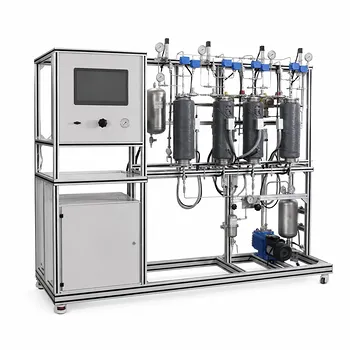
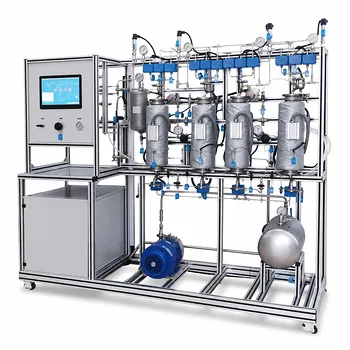
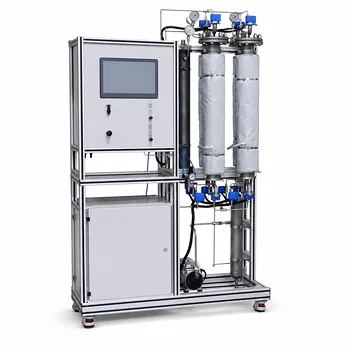
The invisible threat of airborne pollutants becomes a tangible, measurable challenge when unit operations pilot plants are configured to demonstrate air pollution control. You can create this educational setup by integrating a gas blending and pretreatment stage, a UV-activated photocatalytic reactor, and a downstream nanocatalyst filtration module into a single continuous gas purification loop. With real-time sensors tracking pollutant concentration, flow rate, and light intensity, students can directly quantify how titanium dioxide (TiO₂) photocatalysis breaks down volatile organic compounds (VOCs) and nitrogen oxides (NOx), and how nanostructured filters capture residual particulate matter.
The real power isn't just in building the hardware—it’s in configuring a seamless, instrumented process train that reveals the synergistic effect of photocatalytic degradation and nanocatalyst filtration. This transforms abstract environmental chemistry into a hands-on investigation of reaction kinetics, mass transfer, and nanomaterial efficiency, creating an unmatched learning platform for tomorrow’s chemical engineers.
The Modular Blueprint for an Air Pollution Control Pilot Plant
To teach air pollution control effectively, the pilot plant must mirror a real industrial gas purification sequence while keeping each step physically distinct and measurable. The goal is a fully integrated, modular system where students can isolate and study each unit operation.
Feed Preparation: Simulating Real Exhaust
The process starts not with a single pure gas, but with a blended pollutant stream. A dedicated gas mixing skid combines compressed air with calibrated flows of VOCs (e.g., toluene, acetone) and NOx from cylinders. This teaches pretreatment fundamentals: the need to control humidity, temperature, and concentration before the reaction stage. A simple vaporizer or saturator can add water vapor to mimic real flue gas, allowing students to observe how moisture impacts photocatalyst activity.
The Heart: Photocatalytic Reactor Design
The core unit is a continuous-flow photoreactor. In a typical educational configuration, a thin film or packed bed of immobilized TiO₂ is coated on a transparent quartz or borosilicate tube, surrounded by UV-A or UV-C lamps. The polluted gas flows through the reactor at a controlled space velocity. This design enables direct study of photocatalytic degradation kinetics: students vary light intensity, flow rate, and pollutant concentration to calculate the apparent rate constant and assess the impact of mass transfer limitations near the catalyst surface.
Nanocatalyst Filtration: Capturing the Unseen
Immediately downstream, a filter housing contains a bed or membrane made of carbon nanotubes (CNTs), nanofibers, or a functionalized nanofiber mat. This stage serves two purposes: it captures any particulate matter generated or not fully mineralized, and its high surface area can offer additional catalytic sites for residual pollutant breakdown. Students measure pressure drop, observe breakthrough curves, and calculate filtration efficiency for different nanoparticle loadings. This segment directly demonstrates how nanoscale manipulation enhances interfacial contact and overall removal performance.
Integrated Monitoring and Control
A robust educational pilot plant is a data-rich environment. Inline gas analyzers (photoionization detectors for VOCs, chemiluminescence analyzers for NOx) sample gas before and after each unit. Thermocouples, pressure transducers, and mass flow controllers feed into a central data acquisition system. This setup allows students to perform real-time mass balances and immediately see how a change in UV intensity alters outlet concentrations—a visceral lesson in cause and effect.
Connecting Theory to Practice: Educational Outcomes
The configured pilot plant moves beyond a simple demonstration. It becomes a rigorous experimental platform where theory is stress-tested with real data.
Kinetic Studies on TiO₂ Photocatalysis
By operating the photoreactor under differential conditions (low pollutant conversion), students can isolate the intrinsic reaction kinetics. They plot the reaction rate versus pollutant concentration to determine if the reaction follows a Langmuir-Hinshelwood model, a standard in photocatalysis. This teaches kinetic parameter estimation and the critical distinction between true reaction rate and mass transfer-limited rate.
Evaluating Filter Efficiency and Breakthrough
The nanocatalyst filter allows direct measurement of collection efficiency for different particle sizes and gas velocities. Students can run extended tests to generate a breakthrough curve, pinpointing the point at which the filter’s removal efficiency drops below a target threshold. This is a direct application of adsorption and filtration theory, connecting lab-scale data to industrial filter sizing.
Applying Quality by Design and DoE
The modular nature of the setup makes it a perfect candidate for a Design of Experiments (DoE) exercise. Using a Cause-and-Effect (C&E) matrix, students categorize variables: UV lamp power (controllable), ambient lab temperature (noise), and TiO₂ loading (experimental factor). They then execute a factorial design to determine the optimal combination of residence time, light intensity, and humidity for maximum NOx degradation, building the robust operating region thinking central to QbD.
Understanding the Trade-offs
No educational configuration is perfect. Being transparent about the limitations strengthens the learning experience.
- Photocatalyst Deactivation: TiO₂ activity can drop over time due to surface fouling from reaction intermediates. Students learn that real systems require periodic regeneration, prompting discussions on catalyst lifecycle management.
- Pressure Drop and Energy Cost: Nanofiber filters, especially when densely packed, can create a significant pressure drop. This forces a trade-off between filtration efficiency and the energy needed to push gas through the system—a core engineering dilemma.
- Light Source Uniformity: UV intensity around a cylindrical reactor is rarely perfectly uniform. Students must account for this irradiation profile when calculating quantum yield, preventing overestimation of catalyst performance.
- Analytical Complexity: Real-time VOC analysis at low concentrations requires sensitive, sometimes costly detectors. This can be a barrier, but it also teaches students about method detection limits and sensor selection in environmental monitoring.
- Scale vs. Insight: A benchtop pilot plant cannot perfectly replicate the fluid dynamics of an industrial-scale scrubber. The educational value lies in understanding the fundamental rate-controlling steps, not in exact geometric scaling.
Making the Right Choice for Your Laboratory
The specific configuration should align with your primary educational goal.
- If your primary focus is teaching reaction engineering fundamentals: Invest in a highly instrumented photoreactor with precise flow control and multiple analytical ports. Prioritize the ability to generate clean kinetic data over industrial mimicry.
- If your primary focus is demonstrating a complete process train: Include automated logic for recycling unreacted gas or a final demisting step, replicating a typical industrial feed-preparation-reaction-separation sequence to show the full cycle of gas purification.
- If your primary focus is green chemistry and sustainability: Add a CO₂ sensor to prove complete mineralization of VOCs and tasks that calculate atom economy for the photocatalytic reaction, tying the experiment directly to environmental impact metrics.
- If your primary focus is process control and QbD: Select a design where multiple variables (UV power, flow rate, humidity) can be programmed and perturbed from a central control interface, enabling advanced DoE and process analytical technology (PAT) projects.
The ideal pilot plant turns the abstract promise of nanomaterials into a tangible, data-driven story—one where each step of the process reinforces the next, and every measurement builds a deeper, unshakable understanding of the science that cleans our air.
Summary Table:
| Stage | Key Component | Educational Focus & Parameters |
|---|---|---|
| Feed Preparation | Gas mixing skid & vaporizer | Humidity control, simulating real flue exhaust |
| Photocatalysis Reactor | Immobilized TiO2 & UV lamps | Degradation kinetics, mass transfer, light intensity |
| Nanocatalyst Filtration | Nanofiber/CNT membrane | Filtration efficiency, breakthrough curves, pressure drop |
| Monitoring & Control | Inline gas analyzers & sensors | Mass balance calculation, process control, Design of Experiments |
Elevate Your Chemical Engineering Curriculum with LABPARK
To prepare the next generation of engineers, universities and research institutes need hands-on systems that turn abstract theories into visual, data-driven experiments.
LABPARK provides state-of-the-art Educational and Vocational Unit Operations Pilot Plants in chemical engineering, bioprocess & biotech, and environmental & water treatment for universities, research institutes, and enterprises. Our customizable, highly instrumented pilot plants allow students to study photocatalytic degradation, nanocatalyst filtration, and process kinetics in real-time.
How LABPARK adds value to your laboratory:
- Industrial-Grade Instrumentation: Equip your lab with real-time sensors and software for rigorous data analysis.
- Modular & Flexible Designs: Easily configure setups to cover multiple unit operations and chemical processes.
- Academic & Vocational Alignment: Designed specifically to support curriculum-based engineering laboratory courses.
Ready to transform your laboratory training? Contact LABPARK today to discuss your customized pilot plant configuration!
Related Products
- Methane Cracking Educational Unit Operations Pilot Plant
- Constant Pressure Filtration Educational Unit Operations Pilot Plant
- Bench Scale Carbon Dioxide Capture Educational Unit Operations Pilot Plant
- Carbon Dioxide Capture and Utilization Educational Pilot Plant for Unit Operations
- Fixed-Bed Chemical Reaction and Gas Dust Tar Removal Unit Operations Pilot Plant
People Also Ask
- How do ethane vs naphtha cracking influence teaching pilot plant analytical configurations? Key Design Guide
- How can flow-NMR be integrated with pilot plant reactors to monitor kinetics? A Complete Guide
- How do cracking temperature and residence time affect olefin yield? Pilot Plant Guide
- How do reactor pilot plants define QbD design space? Master chemical process scale-up.
- Why are Kw & activity pH critical in pilot plants? Achieve precise bioprocess scale-up.