Getting a reactor-recycle simulation to converge starts with a single, make-or-break decision: the initial estimate of the torn stream. Without a sound physical guess, the iterative solver will likely oscillate, diverge, or plod through hundreds of unnecessary cycles. This article gives you the practical, thermodynamically grounded rules to calculate those starting values—whether you’re training chemical engineering students or designing a pilot plant.
A successful simulation of any reactor-recycle system hinges on providing the tear stream with an initial guess that respects material balance and separation limits. For products, set the recycle flow to roughly 101% of the net product output; for excess reactants, use the conversion rate or excess ratio. These simple manual calculations stop the Wegstein method from chasing non-physical solutions and guarantee a stable path to steady-state.
The Critical Role of the Tear Stream in Process Simulation
Why Your Solver Needs a Starting Guess
All sequential modular simulators must break the recycle loop at a chosen tear stream to perform iterative calculations. The tear is an artificial break; the simulator guesses the stream’s composition and checks if the guess matches the result after one pass through the loop.
When that initial guess is far from reality, the acceleration algorithms—typically the Wegstein method—will oscillate wildly or push values into negative compositions, leading to divergence. A good manual estimate converts the steady-state conditions you already understand into numbers the solver can trust immediately.
The Educational and Pilot-Plant Connection
In a teaching environment, a non-converging simulation frustrates students and obscures the core thermodynamics. For a pilot plant, a diverging model wastes time and delays the determination of real operating parameters. Both cases share the same solution: compute the tear stream values by hand before pressing “run.”
The Two Thermodynamic Rules for Estimating the Tear Stream
The primary reference provides two simple mass-balance principles that cover the vast majority of reactor-recycle loops.
Estimating Product Flow Rates in the Recycle
Never assume that all product exits with the net stream. A fraction always remains with the recycle after separation. The correct starting estimate is:
Initial product flow in recycle = Net product output rate ÷ Separation recovery fraction
For a recovery fraction of 99% (a typical assumption for distillation or flash units), this gives an initial product recycle flow of about 101% of the net product rate. That 1% excess represents the material that inevitably returns to the reactor inlet. Critically, directly recycling product to the reactor should be avoided in the actual design—it promotes side reactions—but the tear stream estimate must still reflect the realistic overhead of imperfect separation.
Estimating Excess Reactant Flow Rates
For reactants fed in stoichiometric excess, the recycle stream carries the unreacted portion back to the reactor. Calculate it using either the reactant conversion rate or the stoichiometric excess ratio:
- If you know the per‑pass conversion X, the recycle flow of that reactant equals (1 – X) × fresh feed rate.
- If you design for, say, 20% excess, the recycle contains the 20% surplus after the reactor consumes the theoretical amount.
This keeps the tear stream composition within physically meaningful bounds and stops the solver from exploring impossible concentrations.
Handling Reactants That Are Not Recycled
If a reactant is deliberately purged or never returns via the recycle loop (e.g., a component that reacts completely or is removed in a dedicated knockout), set its flow rate in the tear stream to zero. The simulator then treats it as absent from the start, avoiding false accumulation that would otherwise wreck convergence.
Understanding the Limitations and Pitfalls
Even these robust estimates have boundaries. Knowing where they can fail will save you hours of debugging.
When Recovery Assumptions Break Down
The 99% recovery rule works for high‑purity separations. If your pilot‑plant separator is a simple knock‑out drum or a low‑efficiency stripping column, the actual recovery may be 80% or less. Using an over‑optimistic recovery fraction inflates the product in the recycle and pushes the solver toward a non‑physical accumulation point. Always verify your separation model’s expected performance before setting the initial tear composition.
Neglecting the Purge and Build‑Up of Inerts
Recycle loops often contain inert gases or trace components that have no exit path. If you don’t include a small purge stream and its corresponding tear‑stream guess, the simulator will endlessly accumulate mass and diverge. Set a tiny, physically plausible flow for any known inerts in the tear stream and ensure a purge exists in the flowsheet.
Choosing the Wrong Tear Location
The tear stream should be placed where the fewest components need guessing and the strongest streams are already well‑known. Tearing directly at the reactor outlet often works because the product distribution can be estimated from conversion and selectivity. Tearing on a highly mixed stream with unknown recycle ratios invites wild oscillations, even with good initial values.
Applying These Estimations in Education and Pilot Plant Design
- If your primary focus is teaching simulation fundamentals: Use the product‑and‑excess‑reactant formulas as a mandatory pre‑test. Have students compute the tear stream values manually and compare them to the first iteration results. This reinforces the link between hand‑calculated mass balances and solver behaviour.
- If you are designing a pilot plant experiment: Build a quick spreadsheet that calculates the tear stream composition from your desired product rate, recovery fraction, and conversion. Feed that into the simulation to get a robust steady‑state in minutes, which you can then use to size equipment and plan sampling points.
- If you are troubleshooting a diverging simulation: First, check that your tear stream estimate obeys the thermodynamic rules above. If it does, suspect a mismatch between your assumed recovery and the actual separator block settings, or look for an inert accumulation that needs a purge.
A few minutes spent on these manual estimates will transform your reactor‑recycle simulations from a battle of convergence failures into a reliable tool that teaches the fundamentals and guides real pilot‑plant design decisions.
Summary Table:
| Component Type | Estimation Formula / Rule | Key Goal |
|---|---|---|
| Product Flow in Recycle | Net product output rate ÷ Separation recovery fraction (typically ~101% of net) | Account for imperfect separation overhead |
| Excess Reactant | $(1 - X) \times \text{Fresh Feed}$ (where $X$ is conversion rate) | Keep composition within physical bounds |
| Non-Recycled Reactants | Set to 0 | Avoid false mass accumulation in solver |
| Inert Gases / Traces | Set a tiny flow + ensure a purge stream exists | Prevent infinite accumulation and divergence |
Validate Your Process Simulations with LABPARK
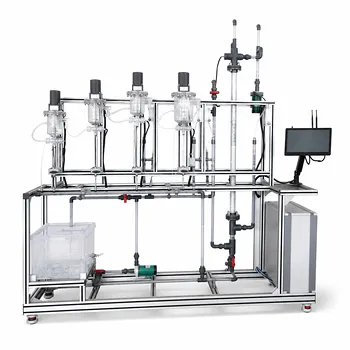
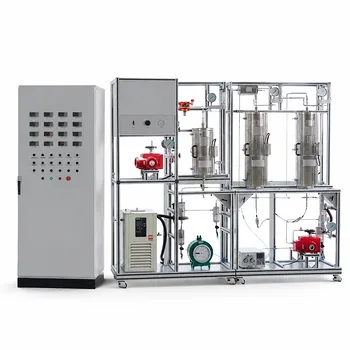
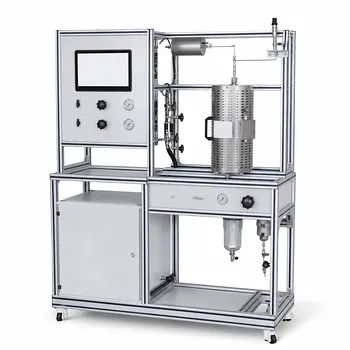
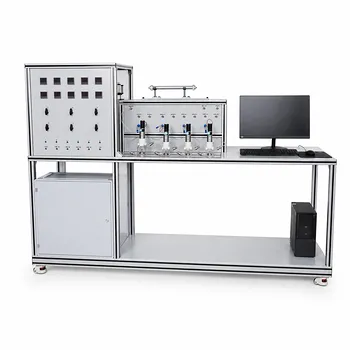
Transition seamlessly from theoretical process simulations to hands-on learning and research validation. LABPARK provides state-of-the-art Educational and Vocational Unit Operations Pilot Plants in chemical engineering, bioprocess & biotech, and environmental & water treatment.
Designed specifically for universities, research institutes, and enterprises, our pilot plants allow you to compare your hand-calculated simulation models with real-world physical data, ensuring your students and research teams master the practical side of chemical engineering.
Ready to elevate your engineering lab or research capabilities? Contact LABPARK today to explore our custom pilot plant solutions!
Related Products
- Residence Time Distribution and Reactor Flow Characteristics Determination Educational Pilot Plant
- 100L Continuous Loop Hydrogenation Educational Unit Operations Pilot Plant
- Multi-Reactor Educational Pilot Plant for Reaction Engineering Unit Operations
- Crude Benzene Hydrogenation Educational Unit Operations Pilot Plant
- Carbon Dioxide Hydrogenation Methanol Synthesis Educational Unit Operations Pilot Plant
People Also Ask
- Why is temperature regulation via a cooling jacket a critical feature in CSTR pilot plants used for laboratory training?
- How does steady-state multiplicity affect the operation and safety of exothermic reactions within a CSTR pilot plant? - Guide
- What parameters to monitor transitioning from Batch to CSTR? Master Pilot Plant Setup
- What role do customizable reactor pilot plants play in evaluating heat and catalyst performance? Scale-up Guide
- How Does Backmixing Affect 1st vs 2nd-Order Reaction Conversions in Pilot Plants?