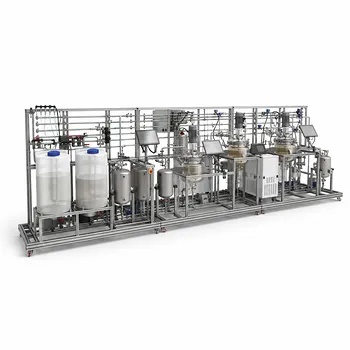
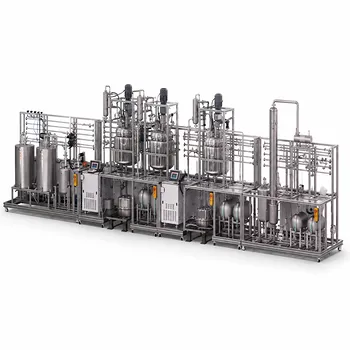
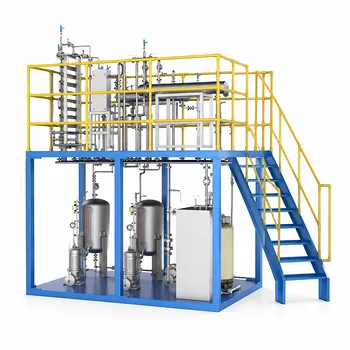
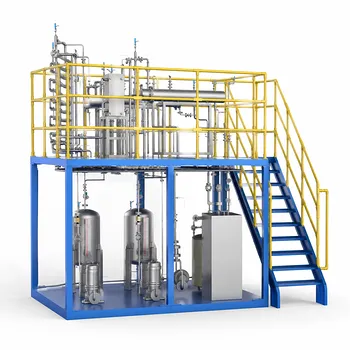
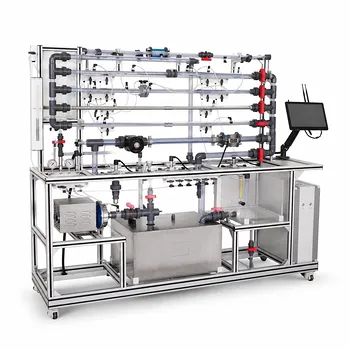
The starkest lesson a pilot plant can teach is that process development isn't a single discipline. For bulk chemicals, the pilot plant must demonstrate relentless optimization of a continuous, cost-driven process. For specialty chemicals, the same facility must pivot to showcase flexible batch strategies where product quality and rapid synthesis route scouting trump raw efficiency. The key differences to demonstrate are operational mode (continuous vs. batch), development objective (process vs. product improvement), and the role of automation and modularity in managing complexity versus minimizing cost.
While both worlds rely on pilot plants to de-risk scale-up, the fundamental question they answer is completely different. Bulk chemical pilots ask, "How do we make this cheaper and cleaner at massive scale?" Specialty chemical pilots ask, "How do we make this exact molecule reliably, safely, and quickly, even if the route changes tomorrow?" An effective curriculum must physically contrast these diverging philosophies on the same unit operations.
Two Divergent Worlds: Bulk vs. Specialty Chemicals
Training must first anchor students in the opposing business drivers that shape engineering decisions. The lifecycle, scale, and market dynamics define the development strategy before a single experiment is run.
The Bulk Chemical Mandate: Cost and Longevity
Bulk chemical R&D targets process improvement over a very long lifecycle. These commodities, produced via dedicated continuous plants, face a single, brutal benchmark: minimizing cost per kilogram.
A pilot plant exercise should fix the product and force optimization of raw material cost, energy efficiency, and environmental footprint. For example, testing a feedstock transition from fossil fuels to biomass becomes a lesson in supply chain economics, heat integration, and managing byproduct streams for a process that is designed for continuous, steady-state operation for decades.
The Specialty Chemical Mandate: Speed and Precision
Specialty chemicals, including pharmaceuticals and advanced intermediates, are defined by short product lifecycles and high market fluctuation. Production, typically in multiproduct plants (MPPs), is batch or semi-batch and focuses on product and route improvement.
The educational pilot must instead fix a product quality target and require rapid adaptation. Exercises in route scouting—comparing a traditional stoichiometric synthesis to a modern catalytic one for a molecule like ibuprofen—demonstrate how atom economy and E-factor directly translate from a laboratory concept to a pilot-scale decision impacting scheduling, waste removal, and cleaning validation.
Designing the Pilot Plant as a Contrast Engine
The unit operations pilot plant becomes the central teaching instrument only when it forces students to confront the consequences of these differences physically. A single, static setup is insufficient; the design must be dual-natured.
Demonstrating Operational Modes: Continuous vs. Batch
This is the most visible difference. A dedicated continuous loop, featuring continuous reactors and distillation columns, must simulate a bulk chemical plant. Students should grapple with achieving steady state, managing long-duration catalyst deactivation, and optimizing energy recovery.
In the very next module, the same or a parallel system must be reconfigured into a flexible batch suite. Here, the challenge shifts to writing and executing recipe-based control, defining clean-in-place (CIP) strategies between campaigns, and managing the complex scheduling of shared utilities. This stark transition teaches that bulk's steady-state efficiency is the enemy of specialty's required flexibility.
Contrasting Development Objectives with Ibuprofen
A powerful single-case study bridges the theory. Using a pilot-scale reactor, students can synthesize Ibuprofen via two routes.
First, they can run the traditional, multi-step stoichiometric route, measuring the copious salt waste and calculating the sub-40% atom economy. Then, they can switch to a modern catalytic route using hydrogenation and carbonylation. The pilot plant data—an atom economy leap to >77%, reaching >99% with acetic acid recovery—becomes a visceral lesson in how route selection is the primary lever for waste reduction in specialty chemicals, a concern secondary to throughput maximization in bulk continuous processes.
Visualizing Scale: From Kilo Lab to Pilot Plant
A critical conceptual distinction is between the kilo lab and the pilot plant, representing a transition from discovery to process validation.
Training must contrast the kilo lab—a realm of highly flexible, portable glass reactors (20–100 L) with manual operation—against the more rigid, larger pilot plant (200–4,000 L equivalents) with fixed stainless steel piping, advanced process automation (P&ID), and formal safety interlocks. This illustrates how the freedom of laboratory synthesis is intentionally constrained to build a reliable, regulatory-compliant manufacturing process, a critical step for both bulk and specialty scales but with entirely different end-state designs.
Understanding the Trade-offs and Teaching Them
Brilliant engineering is the management of trade-offs, and a pilot plant curriculum must make these explicit. Pure theory avoids these conflicts; a pilot plant magnifies them.
Flexibility vs. Efficiency
The primary trade-off. A pilot plant demonstrating Process Intensification (PI) for bulk chemicals—a top-down approach to shrink equipment size by an order of magnitude while maintaining output—teaches students how to achieve massive cost savings through high surface-area-to-volume ratios and enhanced mass transfer.
Conversely, a Multipurpose Plant (MPP) configuration for specialty chemicals prioritizes modularity. Students must learn that the cost of this flexible, non-dedicated piping and control system is a direct trade-off against the dead-time efficiency of a dedicated continuous line. The lesson is that capital strategy is different: one maximizes runtime for one product, the other maximizes utilization across many.
Physical vs. Chemical Extraction
An extraction module shows a parallel logic. For a simple bulk separation (like a petrochemical stream), students run a physical extraction column, optimizing based purely on partition coefficients and the "like dissolves like" rule.
They then operate a chemical extraction unit for a specialty application, such as a simulated hydrometallurgy process recovering copper. By monitoring pH and phase ratios, they see the chemical reaction's role in dramatically boosting selectivity. The lesson: specialty processes warrant complex, often stoichiometric separating agents due to high product value, while bulk processes will almost always use simpler, reusable physical solvents to minimize operating costs.
Making the Right Choice for Your Curriculum Goals
The goal of the pilot plant is to teach industrial judgment. The equipment configuration must align with your educational objective.
- If your primary focus is preparing students for petrochemical and commodity careers: Dedicate pilot space to integrated, continuous unit ops—coupled reactors and distillation columns—and process intensification modules. Focus relentlessly on steady-state energy economics, catalyst management, and long-run cost minimization.
- If your primary focus is producing graduates for the pharma and fine chemical sector: Invest in a flexible, modular batch system with automated recipe control and multiple portable reactor options. The core learning outcomes should be route scouting, atom economy validation, and the operational discipline of multiproduct changeover.
- If your program must bridge both, as most should: Invest in a unit operations platform that can be reconfigured. Run a continuous campaign for a week on a bulk-style reaction, then require a batch campaign on a specialty product in the same frame. The explicit comparison of control room logs from both modes will teach more than a semester of lectures.
Ultimately, the pilot plant's greatest teaching moment isn't demonstrating a perfect process, but revealing the different questions your future engineers must ask on the plant floor.
Summary Table:
| Feature | Bulk Chemicals | Specialty Chemicals |
|---|---|---|
| Operational Mode | Continuous, steady-state | Batch or semi-batch |
| Core Objective | Process optimization (min. cost/kg) | Product & route improvement |
| System Design | Dedicated continuous loops | Flexible, modular batch suites |
| Key Trade-off | High efficiency (Process Intensification) | High flexibility (Multiproduct Plants) |
| Separation Focus | Reusable physical solvents | Selective chemical extraction |
Upgrade Your Chemical Engineering Lab with LABPARK
Bridge the gap between classroom theory and real-world industrial practice. LABPARK provides state-of-the-art Educational and Vocational Unit Operations Pilot Plants in chemical engineering, bioprocess & biotech, and environmental & water treatment for universities, research institutes, and enterprises.
Whether you need to demonstrate continuous steady-state optimization for bulk commodities or flexible, recipe-based batch strategies for specialty pharmaceuticals, our customizable platforms deliver hands-on industrial experience.
Contact LABPARK today to design your custom pilot plant solution!
Related Products
- Natural Product Extraction Unit Operations Training Pilot Plant
- Fixed-Bed Chemical Reaction and Gas Dust Tar Removal Unit Operations Pilot Plant
- Ethyl Acetate Synthesis Unit Operations Pilot Plant for Practical Training
- Methanol Synthesis and Catalyst Performance Evaluation Educational Unit Operations Pilot Plant
- Electrolytic Hydrogen Production Educational Unit Operations Pilot Plant
People Also Ask
- How to Demo Solubility Sensitivity in SFE Pilot Plants? Practical Thermodynamics
- How do pilot plants differentiate physical vs chemical extraction? Enhance Chemical Engineering Training
- How are HTU and NTU applied to determine extraction column height? Guide to Pilot Plant Scaling
- Why use split-plot designs in pilot plants instead of CRD? Optimize process parameters effectively.
- What are the limitations of acentric factor models? Avoid pilot plant errors with polar fluids.