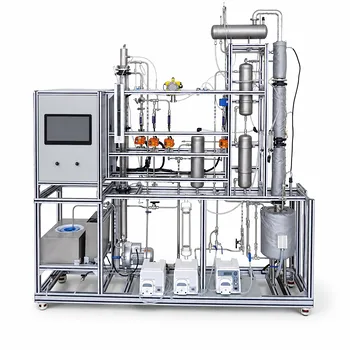
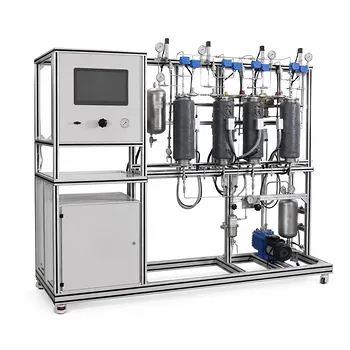
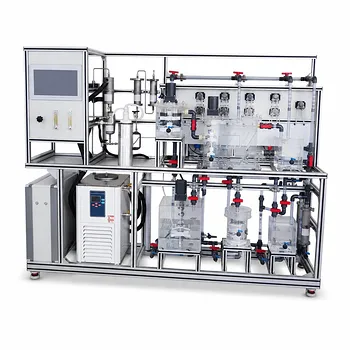
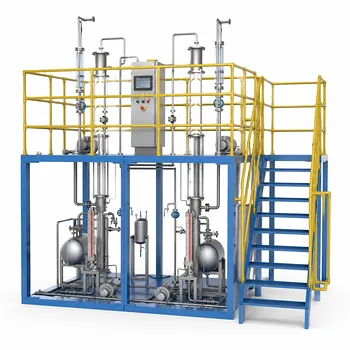
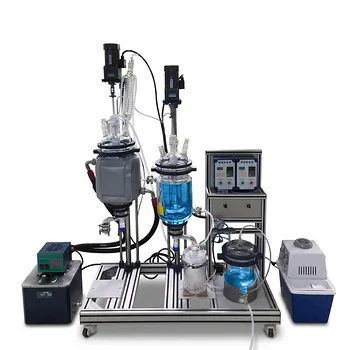
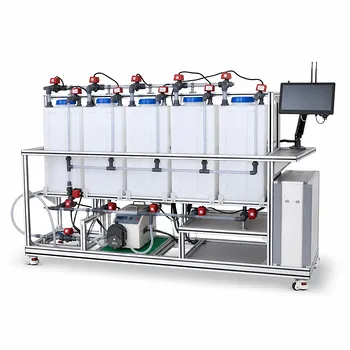
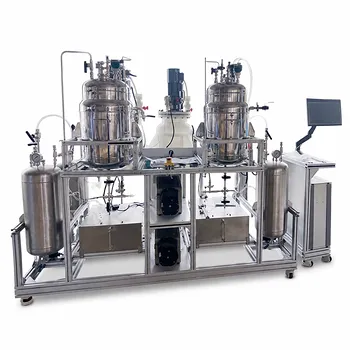
Physical deaeration strips the bulk of dissolved oxygen; chemical scavenging eliminates the last traces. In pilot plants designed to demonstrate boiler feedwater treatment, these two methods are combined in sequence: a vacuum degasifier or steam-based deaerating heater first reduces oxygen to parts-per-million levels, and then a chemical agent like catalyzed sodium sulfite or hydrazine polishes the residual to near zero. Students and operators validate the integrated process by monitoring both oxygen and scavenger concentrations using a single modified Winkler titration, making the system a complete teaching tool for unit operation principles and process control.
Effective dissolved oxygen removal is never a one-step operation. A pilot plant shows that physical deaeration provides the first line of defense, but achieving boiler-grade water—free from the pitting corrosion risk—requires the chemical scavenger to mop up residual oxygen, with analytical verification closing the loop.
The Two-Stage Defense Against Dissolved Oxygen
Boiler feedwater must be stripped of oxygen to prevent localized pitting corrosion. In a pilot plant, the demonstration splits the task into two distinct unit operations, allowing students to quantify the performance of each stage.
Physical Deaeration: Vacuum and Steam-Based Approaches
Physical methods leverage Henry’s Law to drive dissolved gases out of water.
- Vacuum degasifier: By pulling a strong vacuum on a packed column, oxygen partial pressure is reduced, dropping dissolved oxygen to about 0.3–0.4 ppm.
- Steam deaerating heater: This device preheats the feedwater and scrubs it with low-pressure steam, countercurrently stripping gases. It achieves an oxygen concentration around 0.04 ppm.
In a typical pilot plant skid, a student can switch between or compare these units to observe efficiency differences and energy requirements firsthand.
Why Physical Methods Alone Are Not Enough
Even 0.04 ppm of dissolved oxygen is sufficient to initiate pitting corrosion over months of boiler operation. Physical deaeration cannot economically reach the sub‑ppb levels required for long‑term reliability.
The pilot plant highlights this limitation by adding the chemical scavenger stage, making the intersection of mechanical and chemical engineering tangible.
Chemical Scavenging: The Precision Polishing Step
Once physical treatment has done the bulk removal, a chemical reagent reacts stoichiometrically with the remaining oxygen. The choice of scavenger introduces a rich set of learning points.
Sodium Sulfite and Catalysis – A Lesson in Reaction Kinetics
Sodium sulfite (Na₂SO₃) reacts with oxygen:
2 Na₂SO₃ + O₂ → 2 Na₂SO₄
This reaction is slow at temperatures below 100°C. Students can see a dramatic change by adding a cobalt catalyst, which accelerates the kinetics, demonstrating principles of catalysis and activation energy.
Sulfite is safe to handle and inexpensive, making it ideal for pilot-plant teaching environments. However, it leaves dissolved solids (sulfate) that can accumulate in the boiler water.
Hydrazine – A High-Pressure Solution with No Solids
Hydrazine (N₂H₄) follows a different path:
N₂H₄ + O₂ → N₂ + 2 H₂O
It yields only volatile water and nitrogen gas—no dissolved solids. This makes it the preferred choice for high-pressure utility boilers where water purity must be absolute.
In a pilot plant, hydrazine use is often limited to small, carefully controlled demonstrations due to its toxicity and handling hazards. It serves as an excellent case study for industrial safety protocols and material compatibility.
Monitoring the Process: The Modified Winkler Method
A combined physical‑chemical system is only credible if you can measure the results. The pilot plant exercise becomes a complete analytical experience through the modified Winkler method.
How One Sampling Setup Quantifies Both Oxygen and Scavenger
By adding manganous sulfate, alkaline potassium iodide, and then sulfuric acid to a sample protected from air, iodine is liberated in an amount equivalent to the original dissolved oxygen. Titrating this iodine with standard sodium thiosulfate lets you calculate the oxygen concentration.
The same sample also allows determination of residual sodium sulfite. Because sulfite consumes iodine, the difference between total iodine in a blank and the sample gives the sulfite concentration.
Stoichiometric relationships simplify the math:
- 4 moles of thiosulfate correspond to 1 mole of O₂.
- 2 moles of thiosulfate correspond to 1 mole of Na₂SO₃.
This single‑setup, dual‑measurement approach reinforces the concept of chemical mass balance and provides real‑time feedback on scavenger dosing.
Understanding the Trade-offs
Every engineering decision in the pilot plant reflects a real‑world compromise. These are the critical trade-offs students should dissect.
Sodium Sulfite vs. Hydrazine – Not Just a Chemical Choice
- Sodium sulfite is cheap, non‑toxic, and works well with catalysis. But it increases total dissolved solids and can cause foaming or scale if overdosed.
- Hydrazine leaves no solids and is ideal for high‑pressure systems (above 1000 psi). Its extreme toxicity and potential for explosive decomposition, however, demand rigorous handling protocols and make it unsuitable for some educational settings.
The pilot plant allows side‑by‑side comparison of these two philosophies—safety and simplicity versus ultimate water purity.
Temperature and Kinetics: The Catalyst's Role
Without a cobalt or copper catalyst, sulfite‑oxygen reaction kinetics are sluggish below 150°C. By running the pilot plant at different temperatures and catalyst dosages, students can experimentally determine activation energies and observe the direct impact of a catalyst on process efficiency. This transforms the scavenger vessel into a live reactor kinetics experiment.
Handling and Waste Disposal
Spent solutions from a pilot plant—containing sulfate, cobalt catalyst residue, or hydrazine—must be neutralized and disposed of properly. The demonstration becomes a vehicle for discussing industrial waste management and the full lifecycle of treatment chemicals.
Making the Right Choice for Your Educational Goal
When designing or operating a pilot plant demonstration, align the configuration with the core lesson you intend to teach.
- If your primary focus is integrated unit operations: Use a steam deaerating heater followed by catalyzed sodium sulfite injection. The sequence clearly shows the synergy between physical stripping and chemical polishing, and the modified Winkler method ties it all together with a single analytical protocol.
- If your primary focus is reaction engineering and kinetics: Isolate the chemical scavenger stage and run experiments varying temperature, catalyst concentration, and sulfite dosing. Measure dissolved oxygen over time to calculate rate constants and discuss activation energy.
- If your primary focus is high‑pressure boiler chemistry or safety: Introduce a small‑scale hydrazine demonstration with full PPE and engineered controls. Emphasize the trade‑off between water purity and operational risk, and use the analytical method to verify zero residual oxygen without solid byproducts.
Mastering this combined physical‑chemical approach in the pilot plant equips engineers with the intuition to protect full‑scale boiler systems from the silent threat of dissolved oxygen.
Summary Table:
| Stage | Method / Agent | Output DO Level | Key Learning Point / Characteristics |
|---|---|---|---|
| Physical (Stage 1) | Vacuum Degasifier | 0.3–0.4 ppm | Leverages Henry’s Law using a packed column under vacuum. |
| Physical (Stage 1) | Steam Deaerating Heater | ~0.04 ppm | Countercurrent steam scrubbing; highly efficient but energy-intensive. |
| Chemical (Stage 2) | Catalyzed Sodium Sulfite | Near zero | Safe and economical; demonstrates catalysis kinetics but increases TDS. |
| Chemical (Stage 2) | Hydrazine | Absolute zero | Leaves no dissolved solids; ideal for high pressure but highly toxic. |
| Analytical | Modified Winkler Method | N/A | Dual-titration using sodium thiosulfate to measure both DO and scavenger. |
Elevate Your Chemical & Environmental Engineering Training
Hands-on experience with integrated unit operations is key to preparing the next generation of engineers and operators. LABPARK provides state-of-the-art Educational and Vocational Unit Operations Pilot Plants in chemical engineering, bioprocess & biotech, and environmental & water treatment.
Designed specifically for universities, research institutes, and enterprises, our robust pilot plants allow students to safely explore physical stripping, chemical reaction kinetics, and precise analytical methods like the Winkler titration.
Ready to upgrade your laboratory or training facility? Contact LABPARK today to discuss your custom pilot plant requirements!
Related Products
- Carbon Dioxide Absorption and Desorption Educational Pilot Plant for Carbon Capture Studies
- Bench Scale Carbon Dioxide Capture Educational Unit Operations Pilot Plant
- Ion Exchange Water Purification Educational Pilot Plant for Engineering Unit Operations
- Electrolyte Distillation Purification and Formulation Educational Pilot Plant
- Thermal Desorption Exhaust Gas and Tail Water Treatment Educational Pilot Plant
People Also Ask
- How does operating pressure influence the transition between absorption and desorption in a CO2 pilot plant?
- How do temperature variations affect CO2 transport models in pilot plants? Model vs Reality
- What unit operations are critical for CCUS training pilot plants? Build hands-on engineering expertise.
- How do electrolytes affect phase equilibrium in absorption pilot plants, and how to calculate it?
- Why is critical surface tension key in column internals? Optimize gas absorption pilot plant efficiency