In chemical absorption pilot plant studies, the choice of mass transfer model has a surprisingly small effect on the estimated chemical enhancement factor (β). For an irreversible pseudo-first-order reaction—the most common scenario in unit operations experiments—calculations using the double-film, penetration, and surface renewal models all yield values of β that agree to within less than 10%. This practical convergence means you can confidently use the mathematically simplest model without sacrificing useful accuracy.
The chemical enhancement factor β quantifies the acceleration of absorption due to reaction. When analyzing pilot plant data, the three classical mass transfer models produce nearly identical β under pseudo-first-order conditions. Therefore, the simplest model—the double-film model—is recommended for routine estimation, allowing engineers and students to focus on obtaining reliable kinetic and thermodynamic data rather than wrestling with model complexity.
Why the Enhancement Factor Matters in Pilot Plants
Defining β and Its Driving Role
The enhancement factor β is the ratio of the liquid‑phase mass transfer rate with chemical reaction to the rate of pure physical absorption. In practice, the effective liquid‑side mass transfer coefficient becomes β·kL. A higher β means the reaction is aggressively consuming the transferred solute, steeply increasing the concentration gradient and boosting overall absorption capacity.
How Pilot Plants Measure β
Gas absorption pilot plants let you measure β directly through comparative runs. One experiment performs physical absorption (for example, CO₂ into water), while the second uses a reactive liquid (CO₂ into sodium hydroxide solution). By calculating the overall mass transfer coefficients for both operations, you isolate the reduction in liquid‑film resistance and compute β. This experimental approach makes the conceptual value of β tangible and links theory to column performance.
The Three Classical Mass Transfer Models
Double‑Film Model
The double‑film model assumes two stagnant fluid films at the gas‑liquid interface, with all mass transfer resistance concentrated in those films. Transport occurs by steady‑state molecular diffusion. Its mathematical simplicity makes it the backbone of most undergraduate teaching and many industrial shortcut calculations.
Penetration Model
The penetration model visualizes liquid elements arriving at the interface, staying for a fixed “exposure time,” and then being replaced by fresh elements. Mass transfer is unsteady‑state diffusion into each element. This model often correlates better with turbulent contactors like packed columns at moderate liquid rates.
Surface Renewal Model
The surface renewal model generalizes the penetration idea by assuming a statistical distribution of contact times—fluid elements at the interface are continuously replaced with a constant renewal rate. It introduces a more realistic time‑averaged profile of unsteady‑state diffusion and tends to match experimental kL values for highly turbulent systems.
How Model Choice Affects β Estimation
The Convergence Under Pseudo‑First‑Order Kinetics
When the liquid‑phase reactant is in large excess and the reaction is irreversible, the enhancement factor simplifies to β = √M, where M is a dimensionless group combining the reaction rate constant, the diffusivity, and the physical liquid‑side mass transfer coefficient. Crucially, the mathematical derivation of √M is robust: all three models reduce to this same functional form under these conditions. The residual differences come only from how each model exactly defines the reference physical kL—a minor second‑order effect.
Quantifying the Margin of Error
Experimental studies and numerical comparisons confirm that, within typical pilot‑plant operating ranges, the maximum divergence among models is less than 10%. This margin is often smaller than the uncertainties introduced by measuring inlet/outlet concentrations, gas flow rates, or reaction kinetics. Thus, from a practical standpoint, the choice of mass transfer model is not a significant source of error when estimating β.
Why the Simpler Double‑Film Model Suffices
Because all paths lead to essentially the same β, the double‑film model’s algebraic simplicity becomes a decisive advantage. It requires no integration of unsteady‑state equations, no assumptions about contact‑time distributions, and no computational overhead. For pilot‑scale design, kinetic screening, and educational demonstrations, it provides a fast, transparent way to relate reaction kinetics to absorption intensification.
Understanding the Trade‑offs
While the convergence holds beautifully for irreversible pseudo‑first‑order reactions, it is not a universal law. If the reaction is slow, equilibrium‑limited, or if the Hatta number falls into a transition regime where kinetics and mass transfer are tightly coupled, the model‑dependent estimation of the physical mass transfer coefficient can start to influence β more noticeably. In those cases, the penetration or surface renewal models may capture the true instantaneous mass transfer boundary layer more accurately, though the double‑film model often remains an acceptable first approximation. Additionally, the double‑film model’s stagnant‑film assumption is a gross simplification of real hydrodynamics, but this limitation does not propagate into β because the reaction‑diffusion coupling dominates the enhancement effect under the pseudo‑first‑order condition.
Making the Right Choice for Your Goal
When you stand at the pilot plant, the model you pick should serve your primary need—not become a source of unnecessary complexity.
- If your primary focus is rapid, engineering‑grade estimation of β for solvent screening: Use the double‑film model. Its speed and simplicity will not compromise practical accuracy, and you can invest time in running more experiments instead.
- If your primary focus is demonstrating theoretical principles to students: Start with the double‑film model to build intuition, then show how the penetration and surface renewal models give near‑identical results—reinforcing that robust engineering principles thrive on simple, reliable tools.
- If you are investigating extreme conditions (very slow reactions, high‑viscosity liquids, or non‑pseudo‑first‑order kinetics): Cross‑check your results with a more physically refined model. Even then, begin with the double‑film calculation as a baseline to gauge whether the extra effort is truly necessary.
Clarity in your experimental data and sound kinetic constants will always outweigh the marginal differences between mass transfer theories when you calculate β in your pilot plant.
Summary Table:
| Mass Transfer Model | Core Assumption | Math Complexity | β Divergence (Pseudo-1st Order) | Best Use Case |
|---|---|---|---|---|
| Double-Film | Two stagnant fluid films at interface; steady-state diffusion. | Low (Algebraic, $\beta \approx \sqrt{M}$) | Baseline reference (<10% difference) | Routine estimation & education |
| Penetration | Liquid elements stay for fixed time; unsteady-state diffusion. | Medium | <10% difference | Turbulent contactors, packed columns |
| Surface Renewal | Statistical distribution of contact times; continuous renewal. | High | <10% difference | Highly turbulent systems, extreme conditions |
Bring Theory to Life with LABPARK Pilot Plants
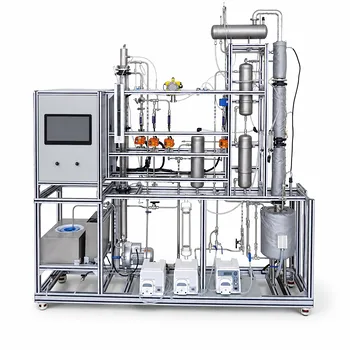
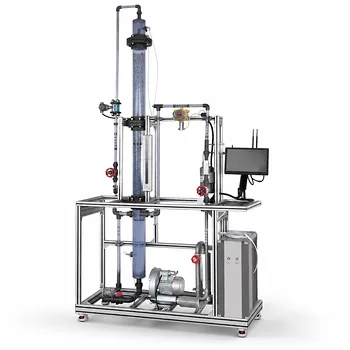
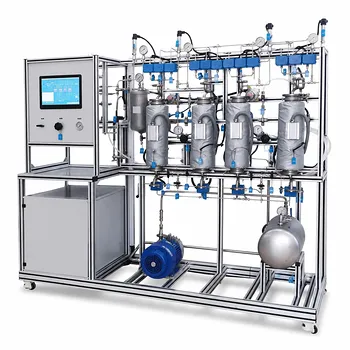
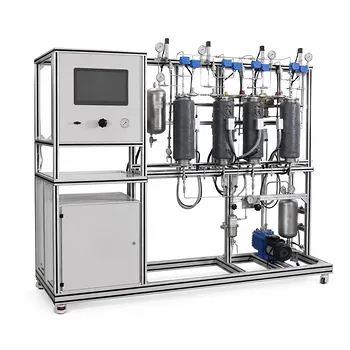
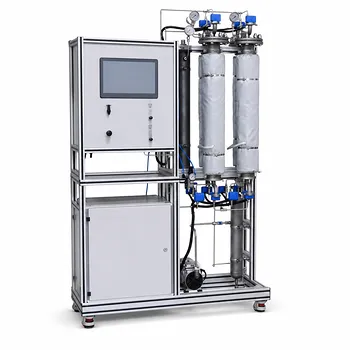
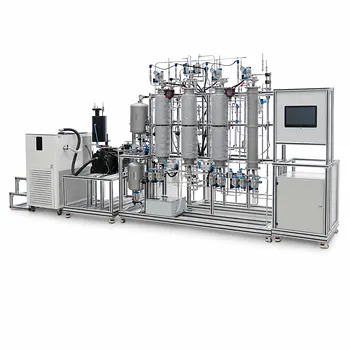
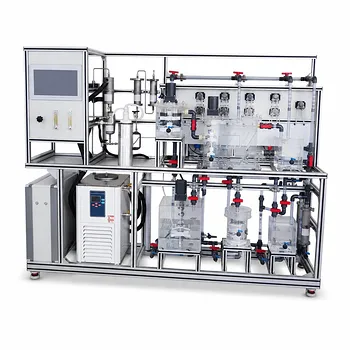
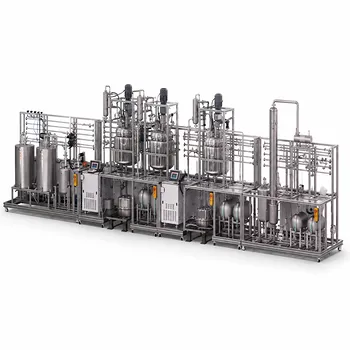
Are you looking to equip your laboratory with reliable unit operations equipment? LABPARK provides state-of-the-art Educational and Vocational Unit Operations Pilot Plants in chemical engineering, bioprocess & biotech, and environmental & water treatment.
Designed specifically for universities, research institutes, and enterprises, our systems make complex concepts like mass transfer and chemical absorption tangible for students and researchers alike.
Contact LABPARK today to discuss your lab requirements and get a customized solution for your institution!
Related Products
- Carbon Dioxide Absorption and Desorption Educational Pilot Plant for Carbon Capture Studies
- Absorption and Desorption Educational Unit Operations Pilot Plant
- Dual-Mode Gas Absorption and Desorption Unit Operations Training Pilot Plant
- Multimodal Absorption and Desorption Pilot Plant for Unit Operations Training
- Packed Bed Absorption Educational Unit Operations Pilot Plant
People Also Ask
- How does operating pressure influence the transition between absorption and desorption in a CO2 pilot plant?
- How do temperature variations affect CO2 transport models in pilot plants? Model vs Reality
- What unit operations are critical for CCUS training pilot plants? Build hands-on engineering expertise.
- How do electrolytes affect phase equilibrium in absorption pilot plants, and how to calculate it?
- Why is critical surface tension key in column internals? Optimize gas absorption pilot plant efficiency