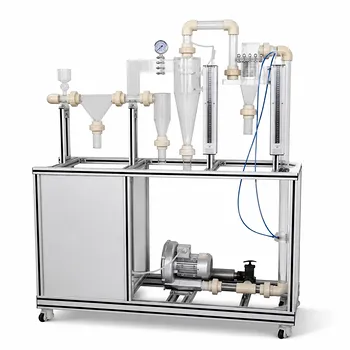
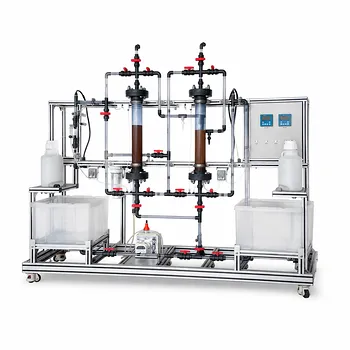
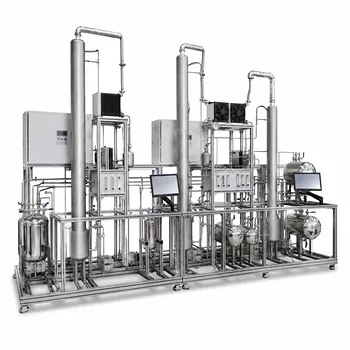
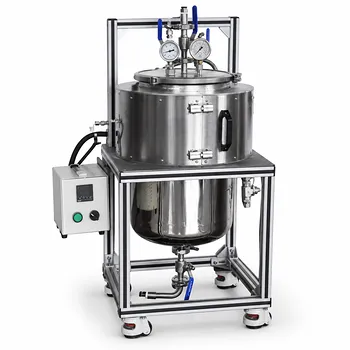
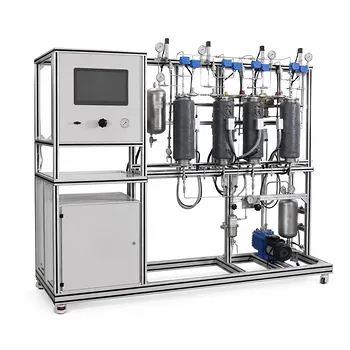
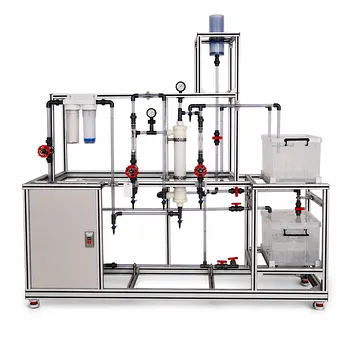
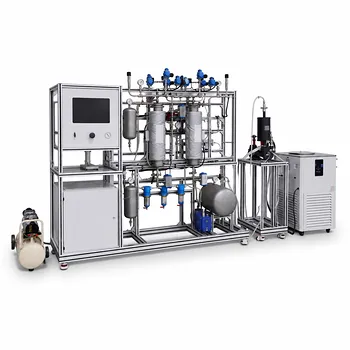
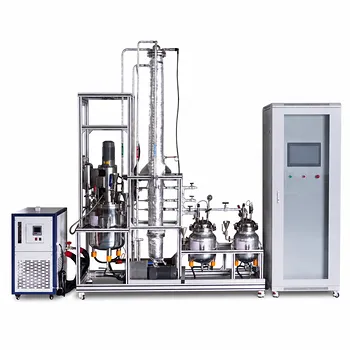
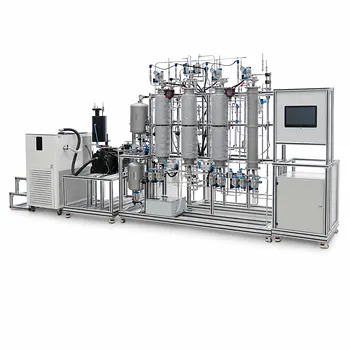
Hands-on pilot plant training transforms the abstract goals of green engineering into operational intuition. It is the critical bridge where engineers learn to feel the real-world consequences of their process decisions on energy bills and waste streams. By manipulating parameters like pressure, temperature, and solvent ratios on a scaled-down system, they directly observe how to radically minimize both energy and solvent usage without compromising product quality.
The fundamental issue isn't a lack of theoretical knowledge; it's a lack of operational feel. Separation and purification pilot plants solve this by providing a safe, contained environment where the high cost of energy and solvents is felt immediately. This hands-on experience ingrains a "green reflex," training future engineers to intuitively design and operate processes that use the least amount of energy and solvents possible, long before they are ever responsible for a full-scale industrial unit.
Beyond Theory: Feeling the Thermodynamic Cost
Green engineering on paper can be deceptively simple. A textbook suggests that lowering pressure reduces boiling points. A simulation calculates the energy saved. A pilot plant, however, reveals the full story. It's where you feel the trade-offs in your hands.
The Safe Space to Speculate
In a pilot plant, an engineer can test a bold energy-saving hypothesis without catastrophic risk. Operating a fractional distillation column under vacuum, as our core principle suggests, isn't just a button press in a simulator. It’s managing vacuum pump efficiency, observing how packing behaves under new vapor velocities, and seeing firsthand if the lower reboiler duty truly delivers the promised separation. This safe environment encourages the practical experimentation needed to push the boundaries of efficiency.
The Quest for the Alternative Solvent
The primary drive of green chemistry is replacing toxic solvents. A pilot-scale liquid-liquid extraction unit is the ultimate proving ground for this. An engineer in training might replace a harmful chlorinated solvent with supercritical carbon dioxide (scCO2) or a bio-based alternative. They move beyond just checking for target compound solubility. They learn to manage the new solvent's unique mass transfer limitations, control pressures for phases that behave unlike standard liquids, and directly correlate the choice of "green" solvent with the process's overall energy footprint and atom economy.
A Practical Framework for Minimizing Waste
The deep need here is a systematic method for engineers to internalize waste prevention. Pilot plants provide this by making waste streams tangible and unavoidable, shifting the mindset from treatment to prevention at the source.
Design-Build-Test the Recovery Loop
The most powerful lesson in solvent minimization is the closed-loop recovery system. Instead of discharging a used solvent, a pilot plant can be reconfigured to pipe the raffinate directly to a recovery distillation column. An engineer then works inside a complete mass-balance loop. They physically see how using a single, easily-recoverable solvent simplifies the entire system and drastically cuts fresh solvent purchases and hazardous waste disposal. They are directly influencing the process's E-factor in real time.
Integrating Intelligence for Efficiency
Modern pilot plants are wired for a data-rich future. Trainees don't just turn valves; they integrate Process Analytical Technology (PAT) tools. Inline sensors provide a live stream of data on composition and purity. By programming control loops to maintain optimal reflux ratios or solvent-to-feed ratios based on this real-time data, an engineer learns a fundamental truth: the most efficient use of a solvent is to add only the precise amount needed, at the precise moment it’s needed. This is automated, precision green engineering.
The Shift to Continuous Thinking
A static, batch process almost always carries more material inventory and idle energy time. Continuous manufacturing pilot plants force a different design logic. Engineers operating a continuous distillation or extraction unit learn to master steady-state dynamics. They focus on minimizing system volume and achieving perfect purity in a single, energy-uninterrupted pass. This hands-on training reveals how eliminating the repeated heating and cooling of batch processes inherently slashes energy demand and shrinks the physical work-in-process inventory.
Understanding the Trade-offs
The path to green engineering is not a straight line of pure optimization. It’s a landscape of deliberate, informed trade-offs. A pilot plant’s primary training value is in making these hard choices visible and quantifiable.
The Energy-to-Purity Curve. Every engineer must learn that the last 5% of purity can cost 50% of the energy input. In a pilot distillation, you push for 99.9% purity, watching the reboiler's energy consumption spike exponentially. The lesson? Perfect separation isn't always the greenest goal. An acceptable purity that eliminates a downstream polishing step or dramatically reduces energy load may be the more sustainable choice.
Solvent Swapping Isn't a Free Lunch. A "green" alternative solvent isn't a drop-in replacement. It may require higher operating temperatures, a larger ratio to achieve the same separation, or a more energy-intensive downstream purification. Operating a pilot plant teaches engineers to perform a full lifecycle analysis of their solvent choice, accurately comparing the direct process energy penalty against the eliminated toxic waste liability.
Intensification vs. Complexity. Intensifying a process—combining reaction and separation in one unit—can drastically reduce energy and solvent use. But it creates a complex, highly interactive system that is harder to control. Pilot plant training teaches an engineer how to weigh this fundamental trade-off: the radical efficiency gains of a divided-wall column against the operational simplicity and flexibility of a traditional sequential unit.
Making the Right Choice for Your Training Goal
The ideal pilot plant curriculum should be designed around the primary skill you want to embed. The green lessons are best absorbed when the tool matches the objective.
-
If your primary focus is energy minimization in distillation: Prioritize a pilot column equipped for vacuum operation and with highly sensitive differential pressure sensors. The key takeaway is to run dozens of tests manipulating reflux ratio and feed location to build an instinct for the point of diminishing energy returns.
-
If your primary focus is eliminating toxic solvents: Seek a multi-purpose extraction pilot plant rated for high pressure. The key takeaway is to become fluent in phase behavior of non-traditional solvents like scCO2 and to learn how to select a replacement based not just on solubility, but on its total systemic energy and recovery cost.
-
If your primary focus is process intensification and reducing liquid waste: Build a closed-loop system with a recovery column and membrane filtration unit. The key takeaway is to internalize the logic of the circular economy within a process, where solvent diversity is minimized and the real cost of waste treatment is constantly visible.
The journey from a theoretical green principle to an operational, profitable, and sustainable industrial practice begins here, in the tangible reality of the pilot plant.
Summary Table:
| Training Focus | Key Pilot Plant Features | Green Engineering Outcome |
|---|---|---|
| Energy Minimization | Vacuum distillation columns, differential pressure sensors, variable reflux control | Master thermodynamic costs, optimize reflux ratios, and reduce reboiler utility demand. |
| Solvent Alternative Testing | Multi-purpose liquid-liquid extraction, supercritical CO2 (scCO2) capability | Evaluate green solvent mass transfer, manage high-pressure phases, and run lifecycle analyses. |
| Waste Prevention & Recovery | Integrated recovery columns, closed-loop piping, continuous process setup | Minimize raw solvent intake, lower E-factor, and eliminate batch heating/cooling inefficiencies. |
Elevate Green Engineering Education with LABPARK
Prepare your students and researchers for a sustainable future with hands-on training systems designed for resource efficiency. LABPARK provides premium Educational and Vocational Unit Operations Pilot Plants in chemical engineering, bioprocess & biotech, and environmental & water treatment.
Engineered specifically for universities, research institutes, and enterprises, our pilot plants bridge the gap between theory and practice, helping future engineers intuitively master energy minimization and solvent recovery.
Ready to transform your lab or training facility? Contact LABPARK today to explore our customizable solutions!
Related Products
- Multi-Functional Membrane Separation Educational Pilot Plant for Unit Operations Lab
- Gas-Solid Heterogeneous Separation Demonstration Educational Unit Operations Pilot Plant
- Ion Exchange Water Purification Educational Pilot Plant for Engineering Unit Operations
- Green Anhydrous Ethanol Purification Extractive Distillation Unit Operations Training Pilot Plant
- Hot Filtration Educational Unit Operations Pilot Plant Laboratory System
People Also Ask
- What are the key differences in membrane configurations? Choose the Right Unit Operations Pilot Plant
- How Do Pervaporation, Vapor, and Gas Permeation Differ in Pilot Plants? Key Comparison
- What are the advantages of membrane separation pilot plants? Energy-saving process intensification.
- How do PEI, PVDF, and PSU membranes compare in pilot plants? Find the best fit.
- Pervaporation vs. Vapor Permeation: Handling Suspended Solids in Membrane Pilot Plants