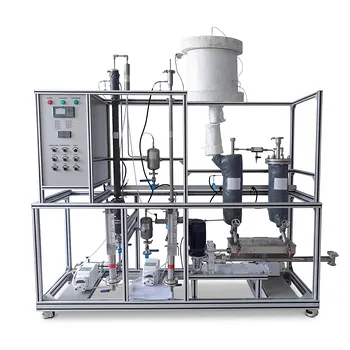
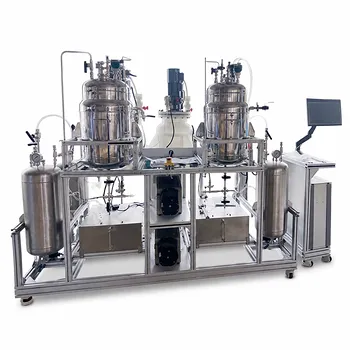
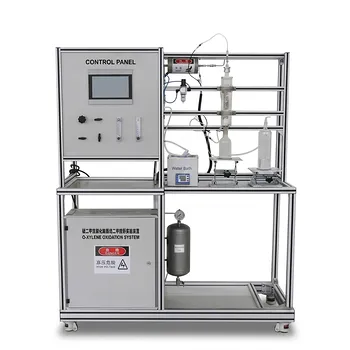
Catalyst selectivity in hydroformylation doesn’t just appear in a textbook—it reveals itself the moment you vary the reactor’s operating parameters. In a vocational pilot plant equipped with a continuous stirred-tank reactor (CSTR) and on‑line analytics, students can directly observe how temperature, pressure, and catalyst choice collaborate to dictate the linear-to‑branched aldehyde ratio and trigger side reactions like isomerization and hydrogenation. The clearest demonstration comes from comparing a phosphine‑modified rhodium catalyst (Rh/TPP) run at 20–50 bar and 90–110 °C with an unmodified cobalt catalyst run at 200–450 bar and 140–180 °C. The resulting product spectra—dominated by linear aldehydes with Rh/TPP, riddled with iso‑aldehydes and alkane by‑products with Co—make kinetic control tangible.
The power of a vocational pilot plant lies in its ability to convert abstract rate laws into visible outcomes. By stepping students through a pressure‑temperature‑catalyst matrix, the plant reveals that selectivity is never a fixed property; it’s a moving target that shifts with every operating lever, directly linking the Arrhenius equation to the purity of the downstream product.
Using the Catalyst as the First Selectivity Switch
The Rhodium‑Phosphine System: High Linearity at Mild Conditions
Rhodium catalysts modified with triphenylphosphine (TPP) are the workhorse of modern low‑pressure hydroformylation. When operated at 20–50 bar and 90–110 °C, the Rh/TPP system strongly favors the linear aldehyde. The phosphine ligand creates a sterically crowded metal center that directs the alkyl group to the less hindered end of the olefin, yielding a normal‑to‑iso ratio typically above 12:1. At these mild conditions, undesirable pathways such as hydrogenation of the aldehyde to alcohol or alkane formation are essentially shut down, so the product stream is nearly free of side‑reaction contaminants.
The Unmodified Cobalt System: High Pressure, High Branching
Unmodified cobalt tells a completely different story. Because the active cobalt‑carbonyl species is less stable and more prone to aggregation, the reactor must be pressurized to 200–450 bar and heated to 140–180 °C simply to keep the catalyst intact. Under these forcing conditions, double‑bond isomerization of the olefin becomes kinetically competitive; the internal olefins that result from isomerization give branched aldehydes, collapsing the linear‑to‑branched ratio to around 3–4:1. Students who compare chromatograms from the two catalyst systems immediately see how a single catalyst choice can flip the product slate from “mostly linear” to “an isomeric mixture.”
Pressure as the Master Dial for Side‑Reaction Kinetics
Suppressing Isomerization with the Right Operating Window
Pressure doesn’t just keep the catalyst dissolved—it directly influences the concentration of CO and H₂ in the liquid phase. In the Rh/TPP system, a moderate CO partial pressure (part of the 20–50 bar total) stabilizes the phosphine‑modified complex and maintains a high coordination number, which suppresses hydride shifts that lead to isomerization. When students deliberately lower the pressure toward the bottom of the window, the onset of isomerization becomes visible as iso‑aldehyde peaks begin to grow, teaching them that a “safe” operating band exists for each catalyst.
Forcing the Isomerization Pathway with Cobalt
The cobalt system can be used to illustrate the opposite extreme. At the high temperatures needed for unmodified cobalt, even a slight drop in CO pressure accelerates cobalt‑alkyl isomerization via β‑hydride elimination and reinsertion. By designing a series of runs where the pressure is systematically reduced from 450 bar to 200 bar while holding temperature constant, students witness the iso‑aldehyde fraction climb. This hands‑on exploration makes the concept of kinetic competition between the desired hydroformylation cycle and isomerization pathways concrete.
Temperature: The Accelerator of Both Primary and Side Reactions
Mapping the Rate–Selectivity Trade‑off
Temperature affects every elementary step, but not equally. In a CSTR pilot plant, raising the temperature by 10 °C bumps the overall olefin conversion rate noticeably—but it can also tilt the selectivity. For the Rh/TPP catalyst, a climb from 90 °C to 110 °C may still deliver excellent linearity, but minor by‑products from hydrogenation or aldol condensation start to appear. With unmodified cobalt, the same temperature rise dramatically boosts the isomerization rate constant relative to the hydroformylation rate constant, exacerbating branching. Students who plot conversion versus selectivity at multiple temperatures internalize the concept of activation energy differences between competing pathways.
Using Temperature to Illustrate Deactivation Kinetics
Vocational training also benefits from monitoring catalyst stability. At temperatures above 180 °C, unmodified cobalt begins to precipitate as cobalt metal, causing an irreversible loss of activity. By holding all other parameters constant and ramping temperature, students observe a sudden drop in conversion, providing a direct lesson in catalyst degradation kinetics that parallels the industry’s need to avoid thermal runaway.
Demonstrating Side Reactions Through Analytical Monitoring
The Fingerprint of Hydrogenation
A well‑instrumented pilot plant allows quantification of side products that tell the kinetic story. With cobalt catalysts at high pressure, the hydrogenation of aldehyde to alcohol—or even the over‑hydrogenation of the starting olefin to alkane—becomes measurable. By configuring the on‑line gas chromatograph to track alkane peaks together with the aldehyde peaks, students can calculate mass balances that reveal exactly how many moles of reactant vanished via undesired routes.
Spotting Aldol Products as a Temperature‑Driven Consequence
Even with the selective Rh/TPP system, running at the upper end of the temperature range can generate heavier aldol condensation products. These compounds appear in the high‑boiling fraction of the product stream and serve as an object lesson in how post‑reaction chemistry can degrade product purity if the operating envelope is not carefully managed.
Understanding the Trade‑offs
Pressure Rating vs. Capital Cost
The stark difference in operating pressure between the cobalt and rhodium systems imposes a real‑world economic dimension on the experiment. A cobalt‑based pilot plant requires heavy‑walled vessels, high‑pressure gas dosing systems, and extensive safety interlocks—costs that must be weighed against the lower price of cobalt metal itself. When students discuss why industry shifted toward rhodium, they are not just comparing catalysts; they are evaluating the entire plant’s pressure rating, maintenance burden, and process safety management.
Selectivity vs. Downstream Purification Load
High linear selectivity does not merely improve yield—it drastically reduces the size and energy demand of the downstream distillation columns. The 12–15:1 normal‑to‑iso ratio achieved with Rh/TPP means the crude product can often be used with minimal separation, whereas the 3–4:1 ratio from unmodified cobalt forces a much larger purification train. In a training setting, the pilot plant run sheets can include a simple distillation simulation to quantify this purification penalty, driving home how reactor kinetics ripple through the entire process flow sheet.
Catalyst Lifetime and Operating Window Rigidity
Phosphine‑modified rhodium catalysts are extremely sensitive to ppm levels of poisons like sulfur or excess oxygen, demanding rigorous feed purification. Unmodified cobalt, while less selective, can tolerate dirtier feeds and is less prone to permanent poisoning under upset conditions. This trade‑off teaches students that the “best” catalyst on paper may be impractical if the feed supply is inconsistent—a critical lesson for plant‑floor decision making.
Making the Right Choice for Your Training Objective
A vocational pilot plant’s parameter‑switching protocol should match the educational goal. Below are goal‑specific strategies for hydroformylation experiments.
- If your primary focus is illustrating the concept of catalytic selectivity: Run a head‑to‑head comparison of Rh/TPP at 30 bar/100 °C versus unmodified cobalt at 300 bar/160 °C, holding all other variables constant, and let students interpret how the product spectrum shifts.
- If your primary focus is demonstrating side‑reaction kinetics: Design a pressure‑lowering sequence with the cobalt catalyst alone, starting at 450 bar and stepping down to 200 bar, while students track the rise in iso‑aldehyde and alkane peaks.
- If your primary focus is connecting reaction engineering to plant economics: Combine the catalyst comparison with a simple downstream separation simulation, so learners link reactor selectivity to distillation column size and energy cost.
- If your primary focus is safety and hazard awareness: Use the cobalt system to highlight the engineering requirements of high‑pressure operation, then contrast it with the milder Rh/TPP system to show how catalyst innovation can inherently reduce plant risk.
By deliberately dialing pressure, temperature, and catalyst identity, the pilot plant transforms hydroformylation from a set of equations into a living demonstration of how kinetics governs product purity, safety, and profitability.
Summary Table:
| Catalyst System | Operating Temp (°C) | Operating Pressure (bar) | Linear-to-Branched Ratio | Key Side Reactions |
|---|---|---|---|---|
| Rhodium-Phosphine (Rh/TPP) | 90–110 °C | 20–50 bar | High (>12:1) | Minimal (suppressed isomerization/hydrogenation) |
| Unmodified Cobalt (Co) | 140–180 °C | 200–450 bar | Low (3–4:1) | Active double-bond isomerization, olefin hydrogenation |
Bring Real-World Chemical Engineering into Your Lab
Ready to elevate your training curriculum? LABPARK provides state-of-the-art Educational and Vocational Unit Operations Pilot Plants in chemical engineering, bioprocess & biotech, and environmental & water treatment. Designed specifically for universities, research institutes, and enterprises, our pilot plants bridge the gap between textbook theory and industrial practice.
Help your students master catalyst selectivity, reaction kinetics, and process safety on scale-up systems built for hands-on learning.
Contact LABPARK today to customize your pilot plant solution!
Related Products
- 100L Continuous Loop Hydrogenation Educational Unit Operations Pilot Plant
- Steam Methane Reforming Hydrogen Production and Purification Educational Pilot Plant
- Carbon Dioxide Hydrogenation Methanol Synthesis Educational Unit Operations Pilot Plant
- Crude Benzene Hydrogenation Educational Unit Operations Pilot Plant
- Electrolytic Hydrogen Production Educational Unit Operations Pilot Plant
People Also Ask
- Why is the chemical plant startup schedule crucial? De-risk scale-up with pilot plants.
- Why Use PTFE & Hastelloy in Chemical Pilot Plants? Prevent Corrosion & Ensure Safety
- How to study gasification in pilot plants? Compare exit gas composition & efficiency
- How do deviations in estimating latent heat impact pilot plant thermal systems? Avoid hardware mis-sizing.
- Why Compare Predicted and Experimental Excess Enthalpy? Key to Accurate Pilot Plant Scale-up