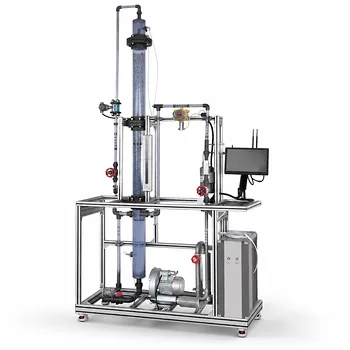
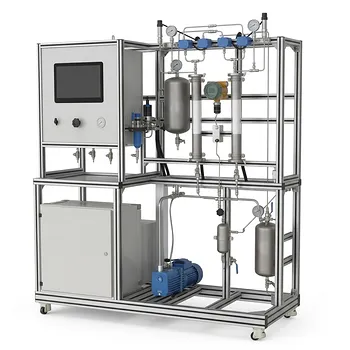
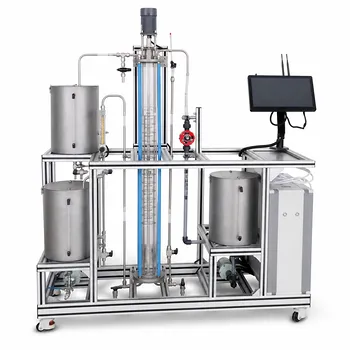
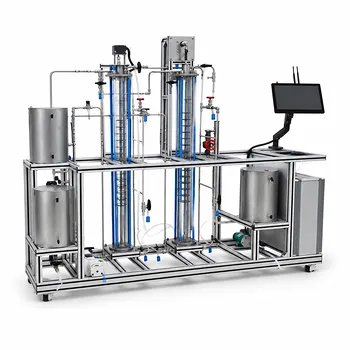
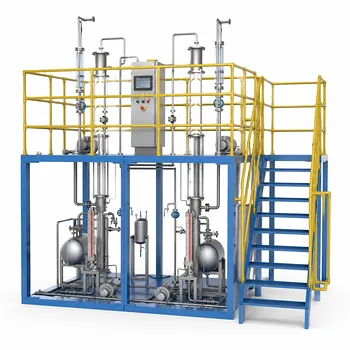
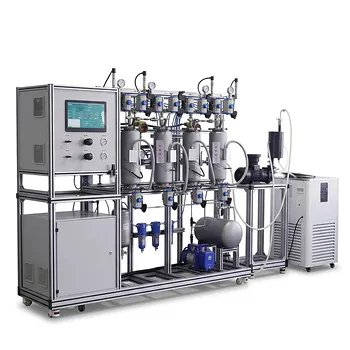
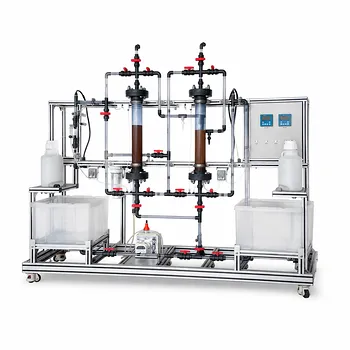
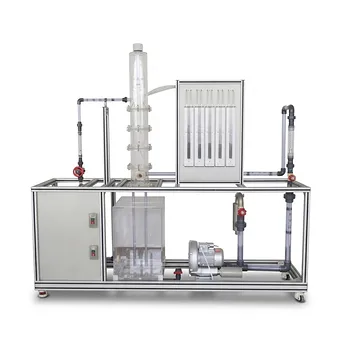
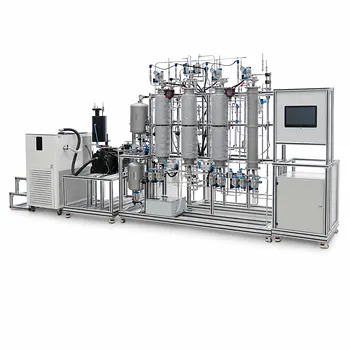
At 98.3% H₂SO₄, the absorbing acid’s total vapor pressure plummets to its absolute minimum—a physical sweet spot that chokes off the root causes of acid mist. Below this concentration, water vapor escapes the liquid surface and reacts homogeneously with SO₃ in the gas phase to generate a stable, sub-micron mist that packing cannot capture. Above it, the SO₃ partial pressure surges, slashing the absorption driving force and letting unreacted SO₃ slip through. Your pilot plant makes this boundary condition tangible, allowing you to move deliberately away from 98.3% and watch the mist appear—or the tail gas analyzer spike—in real time.
Mist formation in an SO₃ absorption tower isn’t a random nuisance; it’s a predictable phase-equilibrium outcome. The threshold at 98.3% H₂SO₄ represents the point where the sum of H₂O, SO₃, and H₂SO₄ partial pressures above the liquid is lowest, shutting down both the gas‑phase hydrolysis reaction that creates mist and the SO₃ breakthrough that signals incomplete absorption. A pilot plant turns this thermodynamic boundary into an observable “on/off” switch for mist generation.
The Phase-Equilibrium Logic of 98.3%
The Vapor Pressure Valley
Every liquid holds a characteristic vapor pressure for each component it can release—water, SO₃, and even sulfuric acid itself. When you plot the total vapor pressure of sulfuric acid solutions versus concentration, you get a deep trough with its floor exactly at 98.3% H₂SO₄. At this concentration, the liquid’s thermodynamic activity is balanced so that neither water molecules nor free SO₃ molecules are energetically eager to escape into the gas phase. This is the point of maximum gas‑liquid affinity—the driving force for absorption is highest, and the driving force for unintended side reactions in the vapor space is lowest.
Why Mist Forms Below 98.3%
When the absorbing acid concentration falls below 98.3%, the water vapor pressure on the liquid surface rises sharply. Incoming SO₃ gas, which reacts with water with terrifying speed, meets these water molecules not at the liquid interface but in the gas phase itself. The result is a homogeneous gas‑phase reaction:
H₂O(g) + SO₃(g) → H₂SO₄(vapor) → ultrafine liquid droplets
These droplets—typically 0.1–1 µm—are acid mist. Because they form away from the packing surface, they are not captured by the liquid film; they behave like a gas and are swept out with the tail gas. In your pilot plant, even a 1% drop in concentration can turn a transparent exhaust into a visible plume.
Why Over‑Concentration Causes SO₃ Breakthrough
If the acid concentration drifts above 98.3%, the equilibrium shifts in the opposite direction. The SO₃ partial pressure above the liquid rises exponentially. This reduces the concentration gradient between the bulk gas and the liquid interface—the very driving force for mass transfer. SO₃ molecules cannot move into the liquid fast enough to keep up with the incoming gas stream. Unabsorbed SO₃ escapes the tower, often reacting downstream with ambient moisture to form mist outside the plant, or damaging downstream equipment. The problem here is not mist formed inside the tower but the loss of absorption efficiency that lets SO₃ fumes pass through entirely.
Why a Pilot Plant Transforms Theory into Intuition
Observing the Boundary Condition
A teaching pilot plant lets you deliberately swing the acid concentration away from 98.3% and see the immediate consequences. You can sample the absorbing acid, measure its concentration, and simultaneously note the tail gas clarity or SO₃ breakthrough. This direct feedback loop cements the concept that 98.3% is not an arbitrary number—it is a physical law made visible.
Linking Phase Equilibrium to Mass Transfer
In the pilot plant, you can also measure the temperature rise across the tower and the pressure drop, connecting the phase equilibrium at 98.3% to the practical unit operation. You see that when the concentration is on‑target, the absorption is so efficient that the heat of reaction is fully transferred to the liquid, and the packing remains fully wetted. Step away from that valley, and the heat profile distorts, often signaling the onset of mist or lowered driving force.
Understanding the Trade‑offs and Operational Pitfalls
Even when the bulk acid titrates at exactly 98.3%, a pilot plant quickly reveals that mist doesn’t just disappear by magic. Local concentration gradients around the packing surface, inadequate liquid distribution, or insufficient circulation rate can create micro‑environments where water or SO₃ partial pressures are locally elevated. The supplementary references highlight that too low a circulation rate causes dry spots on the packing—these dry spots can expose gas to a hotter, more concentrated liquid film, momentarily spiking SO₃ vapor pressure. Conversely, poor mixing in the acid sump can send a slightly dilute stream to the top of the tower, triggering mist despite a perfectly controlled make‑up acid concentration. So, while 98.3% is the thermodynamic optimum, it is a necessary condition, not a stand‑alone guarantee. The pilot plant teaches that maintaining this concentration simultaneously demands disciplined control of liquid-to‑gas ratio, temperature, and distribution—without which the valley floor can’t be fully exploited.
Making the Right Choice for Your Demonstration or Process Goal
- If your primary focus is demonstrating the mechanism of acid mist: Deliberately reduce the absorbing acid concentration to 97% and have students observe the immediate appearance of a mist plume. Then raise it to 98.3% and watch it vanish. This creates an unforgettable link between vapor pressure water and mist.
- If your primary focus is maximizing absorption efficiency for a scaled‑up design: Use the pilot plant to map the total vapor pressure vs. temperature shift around 98.3%, showing that the optimum concentration shifts slightly with temperature but remains tightly defined, and correlate it with SO₃ slip measurements.
- If your primary focus is troubleshooting operational limits: Run the plant at the correct concentration but reduce the circulation rate until dry spots form; you’ll see breakthrough even at 98.3%, teaching that equilibrium and hydrodynamics are inseparable partners.
A pilot plant doesn’t just prove that 98.3% acid prevents mist—it shows you exactly when and why the physics holds, preparing you to control one of the tightest balances in absorption chemistry.
Summary Table:
| Acid Concentration | Vapor Pressure Status | Process Outcome & Mist Behavior |
|---|---|---|
| Below 98.3% H₂SO₄ | High H₂O vapor pressure | Gas-phase reaction creates stable, sub-micron acid mist |
| Exactly 98.3% H₂SO₄ | Minimum total vapor pressure | Maximum absorption efficiency; mist and SO₃ breakthrough prevented |
| Above 98.3% H₂SO₄ | High SO₃ vapor pressure | Reduced mass-transfer driving force; unabsorbed SO₃ breakthrough |
Bring Chemical Engineering Concepts to Life with LABPARK
To master complex thermodynamic principles like phase equilibrium, students and researchers need hands-on experience. LABPARK provides state-of-the-art Educational and Vocational Unit Operations Pilot Plants in chemical engineering, bioprocess & biotech, and environmental & water treatment for universities, research institutes, and enterprises.
Our custom-engineered systems allow operators to safely manipulate critical variables—such as absorbing acid concentrations—and observe real-world chemical reactions in real time.
Ready to upgrade your training or research facility? Contact LABPARK today to find the ideal pilot plant solution!
Related Products
- Packed Bed Absorption Educational Unit Operations Pilot Plant
- Absorption and Desorption Educational Unit Operations Pilot Plant
- Pressure Swing Adsorption Educational Unit Operations Pilot Plant
- Multimodal Absorption and Desorption Pilot Plant for Unit Operations Training
- Bench Scale Dual Column Gas Separation and Capture Educational Pilot Plant
People Also Ask
- How Do Flow Regimes Transition in Packed Bed Pilot Plants? Key Scale-up Insights
- How does reactant concentration determine absorption column control? Gas-film vs. dual-film.
- How is the packing height of an absorption column calculated? Master HTU & NTU Concepts
- How does static vs. operating holdup affect pilot plant calibration? Avoid Critical Scale-Up Errors
- Why is counter-current flow selected for gas absorption? Maximize Pilot Plant Efficiency