Particle size is the master variable that dictates whether a fluidized bed roasting pilot plant operates as a stable, efficient reactor or a plugged-up mess. In essence, the solid feed’s particle size controls both the kinetics of the roasting reaction and the hydrodynamics of the fluidized bed. Get it wrong, and you either fail to roast the core of your ore or choke your downstream gas-cleaning system with dust.
The particle size of the solid feed is a critical compromise. It must be small enough to provide sufficient surface for rapid, complete roasting, yet large enough to prevent excessive dust carryover and maintain a stable, controllable fluidized bed. For educational pilot plants, a controlled range of 0.07 to 3.0 mm offers the ideal balance between clear demonstrations of reaction kinetics and practical system operability.
Particle Size: The Twin Pillars of Reaction and Fluidization
In a fluidized bed roaster, the solid feed does two things simultaneously: it reacts with the gas and it behaves as part of a fluid-like solid bed. Particle size simultaneously governs both processes.
How Size Governs Gas-Solid Contact and Reaction Rate
Roasting is a gas-solid reaction. The reaction can only occur at the particle’s surface, so the total available surface area is paramount. Smaller particles have a vastly greater surface-to-volume ratio. This means more reactive sites per unit mass, leading to faster overall reaction rates and more complete conversion. If particles are too large, the core remains unreached, requiring excessive retention time in the reactor.
Beyond just area, particle size also dictates diffusion resistance. In non-porous particles, the reactant gas must permeate through a growing product layer. Smaller particles shorten these diffusion paths, allowing the reaction to approach the particle core more easily and preventing an unreacted center.
How Size Dictates Fluidization Quality and Bed Dynamics
Particle size determines the bed’s fluidization regime. Powders that are too fine can become cohesive, leading to channeling—where gas rushes through cracks rather than suspending particles evenly. Materials that are too coarse require such high gas velocities that they can suffer from slugging, causing violent pressure fluctuations and poor gas-solid contact.
Crucially, particle size influences bed expansion and bubble behavior. Finer particles tend to produce smaller, more uniform bubbles, enhancing gas-solid contact within the emulsion phase. Coarser particles, however, can cause the bed expansion ratio to drop below a stable range, leading to poor fluidization quality and potentially dangerous localized hot spots within the bed. These hot spots can sinter the feed material and ruin the experiment.
The Operation Window: Consequences of Getting It Wrong
Straying outside the optimal particle size range transforms your pilot plant from a research tool into a troubleshooting nightmare. The primary issues are clear and deeply educational.
When Particles Are Too Large: Unreacted Cores and Sluggish Beds
Feeding overly coarse particles reveals classic reaction-diffusion problems. The limited surface area and long diffusion paths mean the interior of the particle never reaches roasting temperature or sees the reactant gas. You observe a two-phase product: a well-roasted shell around an unreacted, raw core.
From a fluidization standpoint, large particles demand high gas velocities. This can shift the bed from smooth bubbling to a harsh, unstable slugging regime. The result is a loss of reliable temperature control, as gas bypasses the solids in large voids, potentially forming localized zones of severe overheating that deactivate the material.
When Particles Are Too Fine: Dust Storms and Downstream Blockage
Reducing particle size too much creates a different set of problems. Ultra-fine particles are easily entrained and carried out of the bed by the gas stream. This dust carryover dramatically increases the load on downstream cyclones, scrubbers, or baghouse filters. In a worst-case scenario, the high dust load can cause immediate blockages in the piping, requiring a shutdown to clear.
The raw material preparation costs also escalate. Grinding a solid feed down to an overly fine size is energy-intensive and often economically unjustifiable, a trade-off that is highly visible even on a pilot scale. Furthermore, very fine particles can exhibit problems like static build-up and uneven circulation in the bed, making consistent operation a major challenge.
Understanding the Practical Trade-offs
Selecting particle size is never about finding a single “best” number. It’s about managing a fundamental conflict. Reaction rate wants microscopic powder; operability wants robust granules.
- Cost of Preparation vs. Conversion: Finer grinding increases energy and equipment costs pre-reactor. The gain is a higher conversion in the roaster. The optimal size minimizes the combined cost of grinding and lost unreacted product.
- Fluidization Stability vs. Gas-Solid Contact Efficiency: While the finest particles create the best instantaneous contact, they often lead to the most unstable fluidization (channeling, sticking) unless precisely managed. A slightly coarser cut, within the 0.07–3.0 mm range, often provides a more durable, forgiving fluidization state that is easier for students to control and analyze.
- Dust Collection as a Critical Bottleneck: A pilot plant’s gas handling system has a fixed capacity. A key teaching point is that particle size selection must respect the hydraulic capacity of the cyclone or filter. Exceeding this limit turns a reaction problem into a solids-handling crisis, a powerful lesson in systems integration.
Applying Particle Size Insight to Your Pilot Plant Goals
Your specific objective with the pilot plant should directly inform your particle size strategy.
- If your primary focus is teaching fundamental fluidization hydrodynamics: Use a narrow cut of coarse particles (e.g., 1.0–3.0 mm). This makes bubble formation and slugging visible and demonstrates the dangers of poor gas-solid contact without excessive dust issues.
- If your primary focus is maximizing roasting conversion for a product quality study: Select a finer cut within the recommended range (e.g., 0.1–0.5 mm) and carefully pair it with the optimized gas velocity. Accept the need for a very efficient cyclone system.
- If your primary focus is mimicking an industrial scale-up from pilot data: You must replicate the industrial feed’s size distribution, not just the average. A broad distribution (e.g., 0.07–3.0 mm) will reveal the full spectrum of bed behavior, from fine particle elutriation to coarse particle segregation, that engineers must manage in a full-scale plant.
A precisely chosen particle size does not just make the reaction work—it makes the entire system predictable, safe, and deeply instructive for the operators who will one day manage industrial roasters.
Summary Table:
| Particle Size | Reaction Kinetics Impact | Fluidization & Bed Dynamics | Operational Risks |
|---|---|---|---|
| Too Large (> 3.0 mm) | Low surface area, slow roasting, unreacted cores | High gas velocity required, slugging | Poor temperature control, hot spots, sintering |
| Optimal (0.07 - 3.0 mm) | Balanced reaction rate, complete conversion | Stable, uniform bubbling bed | High efficiency, reliable, safe operation |
| Too Fine (< 0.07 mm) | Rapid reaction, high surface area | Cohesive powder, channeling | High dust carryover, downstream blockages, high milling costs |
Equip Your Lab with Industry-Grade Unit Operations
To effectively teach complex fluidization dynamics and reaction kinetics, hands-on experience with high-quality equipment is essential. LABPARK provides advanced Educational and Vocational Unit Operations Pilot Plants in chemical engineering, bioprocess & biotech, and environmental & water treatment.
We help universities, research institutes, and enterprises bridge the gap between theory and industrial practice with safe, scalable, and highly educational pilot systems.
Ready to enhance your teaching or research capabilities? Contact us today to discover our customized pilot plant solutions!
Related Products
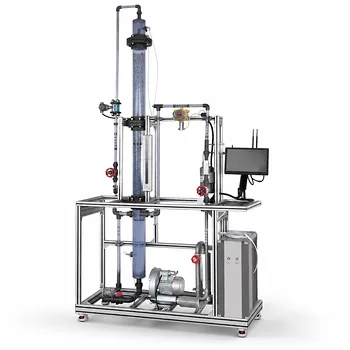
- Fluidized Bed Gas Solid Catalytic Reaction Educational Pilot Plant
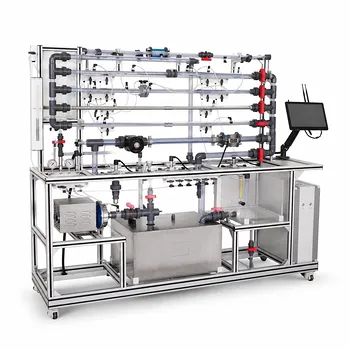
- Multi-Reactor Educational Pilot Plant for Reaction Engineering Unit Operations
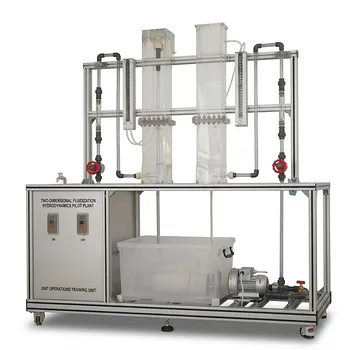
- Two-Dimensional Fluidization Hydrodynamics Educational Pilot Plant for Unit Operations Training
- Multi-Functional Drying Educational Unit Operations Pilot Plant
- Multi Functional Catalytic Reaction and Reactor Evaluation Educational Unit Operations Pilot Plant
People Also Ask
- Why is the bed height-to-diameter ratio (L/dt) critical? Fluidized bed pilot plant selection guide.
- How is the minimum fluidization velocity (U_mf) determined and utilized? A Unit Operations Guide
- How does the Mears criterion evaluate transport resistance? Key Guide to Intrinsic Kinetics
- How do reactor pilot plants safely study gas-solid reactions? Master kinetics with thermal & flow control.
- How do pilot plants demonstrate fluidized-bed reactor advantages over fixed-bed? Find Out Now