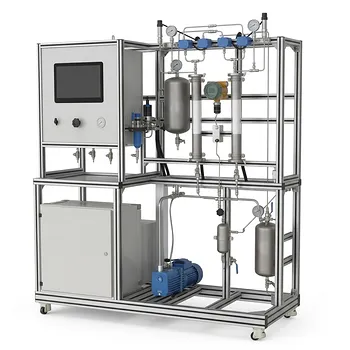
The appropriate number of compression stages is a direct function of your target discharge pressure. For vocational training pilot plants, a single stage is sufficient for pressures below 500 kPa. Between 500 and 1,000 kPa, you’ll need 1 to 2 stages, and for higher ranges like 1,000 to 3,000 kPa, a 2- or 3-stage configuration is essential. These thresholds are not arbitrary—they are drawn from empirical industrial data that balance safety, mechanical integrity, and the faithful reproduction of real-world compression physics.
A simple pressure-based rule cuts through the complexity: <500 kPa → single stage, 500–1000 kPa → 1–2 stages, 1000–3000 kPa → 2–3 stages. The deeper need is to understand that stage count is your primary lever for managing temperature, compression ratio, and material stress—ensuring your pilot plant is both an accurate teaching tool and a safe one.
The Golden Rule: Pressure Dictates Stages
The most direct way to determine stage count is to map your target discharge pressure to a proven range. This approach is widely used in unit operations labs because it instantly gives students a safe, replicable framework.
Matching Pressure Ranges to Stage Counts
Based on operational data from training and small-scale industrial plants:
- < 500 kPa: A single-stage compressor delivers sufficient pressure without excessive temperature rise. It’s the simplest setup and ideal for introducing basic gas laws.
- 500–1,000 kPa: The compression work starts generating heat that threatens discharge temperatures and lubricant life. Adopting 1–2 stages—with intermediate cooling—keeps conditions within safe, instructive bounds.
- 1,000–3,000 kPa: Without splitting the compression into 2–3 distinct stages, cylinder wall stresses and gas temperatures can escalate dangerously. Multi-staging becomes non-negotiable for both safety and a truthful demonstration of scale-up.
Why This Rule Works for Vocational Education
In a training environment, the pilot plant must simultaneously represent authentic industrial practice and be manageable for student operators. Using a pressure-based stage rule gives instructors a clear, memorable guideline while preventing the “just add another stage” oversimplification that ignores thermal and structural realities.
The Physics That Forces Multi-Staging
The stage-count requirement is not a preference; it is the physical answer to the limits of single-stage compression. Understanding these principles equips students to design, not just follow rules.
Controlling the Compression Ratio
Each stage has a practical maximum compression ratio—typically around 8. Above this ratio, discharge temperatures climb sharply, and the thermodynamic efficiency plummets. When your overall pressure ratio exceeds the stage limit, you must split the work. For a 1000 kPa discharge from 100 kPa inlet, the overall ratio is 10, demanding two stages of roughly 3.2 each—safe and efficient.
Taming the Temperature Spike
Adiabatic compression can raise air temperatures by hundreds of degrees in a single jump. These temperatures can degrade seals, coke lubricants, and create an ignition hazard. Intercoolers between stages reset the temperature, bringing the overall process closer to isothermal compression—the energy-efficient ideal. For a training plant, that temperature drop is also a brilliant demonstration of thermodynamic cycles.
Preventing Mechanical Overload
High final pressures in a single cylinder would require impractically thick walls and a massive low-pressure intake cylinder. Multi-staging distributes the load across cylinders sized for their individual pressure ranges. This avoids the impossible geometry of a cylinder that must handle both a huge initial volume and a high terminal pressure, and teaches students why industrial compressors look the way they do.
Understanding the Trade-offs
More compression stages improve thermal performance but introduce new considerations. A responsible training plant design weighs these factors openly.
Component Complexity and Maintenance
Each additional stage brings an intercooler, moisture separator, extra piping, and instrumentation. While this complexity demonstrates real industrial hardware, it also multiplies the leak points, maintenance routines, and initial cost. In a teaching environment, this can be an educational asset—if you have the resources to keep the system reliable.
Flow Resistance and Pressure Drop
Intercoolers and separators create pressure losses that eat into the efficiency gain. For small pilot-scale piping, the cumulative resistance can reduce inter-stage pressure and require larger driver power than expected. Students should be shown that the “ideal” stage count is a balance, not a quest for infinite stages.
Safety and Simplicity
A single-stage compressor operating below 500 kPa is inherently simple and poses fewer operational hazards. Pushing a single stage beyond its pressure limit to save cost is dangerous and sets a poor example. The stage rule inherently enforces safety margins, which is exactly the culture an educational plant must instill.
Making the Right Choice for Your Training Goal
Your stage configuration should reflect the primary learning objectives and practical constraints of the lab. Use these goal-driven recommendations to finalize your design.
- If your primary focus is demonstrating industrial scale‑up: Adhere strictly to the pressure‑based stage counts. This gives students a direct link between pilot‑plant decisions and full‑scale plant designs.
- If your primary focus is thermal efficiency and thermodynamics: Incorporate at least two stages with a well‑instrumented intercooler, even at moderate pressures (e.g., 600 kPa). The measured temperature drops and power savings become a powerful teaching moment.
- If your primary focus is operational simplicity and low maintenance: Stick to a single stage for pressures up to 500 kPa, and only then add a second stage. Never compromise the safety limit; if the process demands 600 kPa, two stages are required.
- If your primary focus is student safety and risk‑free experimentation: Interpret the stage rule as a minimum. Adding an extra stage at the high end (e.g., 3 stages at 2,500 kPa) lowers per‑stage pressure ratios further, reducing temperature and mechanical stress—ideal for frequent student handling.
The right number of stages is the one that turns your pilot plant into a bridge between textbook theory and industrial reality, without ever sacrificing safety.
Summary Table:
| Target Discharge Pressure | Recommended Stages | Key Operational Focus |
|---|---|---|
| < 500 kPa | 1 Stage | Simple setup, low temperature rise, ideal for teaching basic gas laws. |
| 500–1,000 kPa | 1–2 Stages | Requires intermediate cooling to protect lubricants and control temperatures. |
| 1,000–3,000 kPa | 2–3 Stages | Essential for managing thermal stress and mechanical load safely. |
Optimize Your Unit Operations Lab with LABPARK
Building safe, educational, and realistic training systems requires expert engineering. LABPARK designs and supplies premium Educational and Vocational Unit Operations Pilot Plants in chemical engineering, bioprocess & biotech, and environmental & water treatment for universities, research institutes, and enterprises.
Our systems help you bridge textbook theory with hands-on practice, offering students realistic industrial experiences under strict safety standards.
Contact LABPARK today to discuss your laboratory training goals and get a custom system configuration!
Related Products
- Fixed Bed Gas Solid Catalytic Reaction Educational Pilot Plant
- Multi Pump Fluid Transport Process Piping Unit Operations Training Pilot Plant
- Educational Compression Refrigeration Performance Determination Unit Operations Pilot Plant
- Multi-Modal Distillation Unit Operations Training Pilot Plant
- Fixed-Bed Chemical Reaction and Gas Dust Tar Removal Unit Operations Pilot Plant
People Also Ask
- How do reactor pilot plants safely study gas-solid reactions? Master kinetics with thermal & flow control.
- How does the Mears criterion evaluate transport resistance? Key Guide to Intrinsic Kinetics
- Fluidized vs. Fixed Bed Reactors: Comparing Heat & Complexity in Pilot Plants
- Why is a multibed configuration necessary for exothermic reactions? Optimize your pilot plant trajectory.
- What are the differences between pseudohomogeneous and heterogeneous models in pilot plants?