The simple rule: match the cell’s constant to the conductivity range of your sample. For boiler water and most industrial wastewater streams you’ll encounter in an educational unit‑ops lab, that means start with a cell constant of 2.0 cm⁻¹.
Boiler water is highly alkaline and often carries dissolved solids in the thousands of μmho/cm. Industrial wastewater, too, regularly falls in the 20–20 000 μmho/cm window. A cell constant of 2.0 directly mates this window with the instrument’s readout, giving you accurate, direct readings without manual scaling and minimizing electrode polarization.
Because boiler water and process wastewater naturally sit in a high‑conductivity band, selecting the right cell constant isn’t about finding a “one‑size‑fits‑all” number—it’s about placing the measurement squarely inside the cell’s sweet spot. A 2.0 cm⁻¹ cell is the pragmatic starting point; from there you can refine your choice based on the specific ranges you measure most often.
Why the Cell Constant Defines Your Measurement Accuracy
The Physical Principle
The cell constant (K = d/A) sets the geometry of the sensing electrodes. A low‑constant cell (e.g., 0.1 cm⁻¹) puts electrodes close together with a large surface area, which is ideal for the tiny currents that flow through clean, low‑conductivity water. A high‑constant cell (e.g., 2.0 cm⁻¹) spaces them further apart, giving the larger currents in saline or caustic solutions room to move without overloading the instrument.
What Boiler and Wastewater Samples Actually Look Like
Boiler water is intentionally dosed with alkaline chemicals and cycles up total dissolved solids (TDS) to several thousand ppm. Its specific conductance easily exceeds 1000 μmho/cm and can reach 20 000 μmho/cm in poorly blown‑down systems. Industrial wastewater sources—rinse waters, plating baths, cooling tower blowdown—dwell in that same mid-to-high band. In an educational unit‑ops lab, you are measuring these concentrated streams, not polishing-grade effluent.
The Risk of a Mismatched Cell
If a student tries to measure boiler water with a 0.1 cm⁻¹ cell, the instrument will saturate, show an out‑of‑range error, or produce a reading that must be multiplied by a huge factor—adding needless uncertainty. Conversely, using a 10 cm⁻¹ cell on a tap‑water sample would bury the signal in noise. The 2.0 cm⁻¹ cell sits in the middle of the high‑conductivity range, giving you a wide usable span and forgiving behaviour in a teaching environment.
Translating Conductivity to Total Dissolved Solids
The Gravimetric Bridge
In many educational experiments, the goal is not just conductivity but TDS. Direct‑reading instruments assume a specific relationship between conductivity and TDS, usually derived from a gravimetric factor. The primary reference reminds us that accurate TDS conversion requires you to determine that factor for your particular water matrix by evaporating a sample and weighing the residue. A correctly chosen cell constant ensures the raw conductivity measurement is rock‑solid, so the only variable left to control is your laboratory‑derived factor.
Practical Tip for the Lab
Once you have a reliable conductance value from a 2.0 cm⁻¹ cell, multiply it by your experimental gravimetric factor. For a typical boiler water matrix, a factor around 0.65‑0.70 often works, but you must verify this on your own water because the composition changes with treatment chemicals and operating pressure.
Understanding the Trade-offs and Common Pitfalls
One Cell Does Not Fit Every Experiment
A 2.0 cm⁻¹ cell is perfect for the boiler‑water and concentrated‑wastewater scenarios, but unit‑ops courses often rotate through multiple processes. If your next lab involves deionized water or condensate return, the 2.0 cm⁻¹ cell will be too insensitive. You will need a lower constant (e.g., 0.1 cm⁻¹) for those clean streams. Keeping a small set of cells—0.1, 1.0, and 2.0—covers the entire educational curriculum without breaking the budget.
Electrode Material Matters at the Extremes
The supplementary references highlight that electrode surface plays a role when conductivity swings extremely high or low. For the 20–20 000 μmho/cm range, a standard platinum or stainless‑steel electrode is sufficient. If your waste streams occasionally spike into the 2×10⁶ μS/cm territory (heavily salted brine), you might benefit from platinum‑black or four‑ring electrodes, but these are rare in foundational unit‑ops labs. The 2.0 cm⁻¹ constant with a conventional electrode body will serve you reliably in the vast majority of runs.
Avoiding Polarization Error in High Conductivity
When conductivity is high, the current passing through the electrodes can alter the local ion concentration—polarization—which depresses the measured value. A higher cell constant (like 2.0) physically spaces the electrodes and reduces the current density, naturally suppressing this error. That’s the engineering reason why the primary reference recommends stepping up the constant, not down, for boiler water.
Making the Right Choice for Your Educational Lab
Your selection strategy should be driven by the dominant sample type in your curriculum and the need to teach the principle of range‑matching. Use this simple decision guide:
- If your primary experiments revolve around boiler blowdown, highly alkaline water, or concentrated wastewater: Equip each station with a 2.0 cm⁻¹ cell. It will cover 99 % of your measurements without the fuss of frequent cell swaps.
- If your course also features reverse‑osmosis permeate, condensate polishing, or raw freshwater: Supplement with a 0.1 cm⁻¹ cell. Switch to it and let students see how a low‑constant cell must be used for clean, low‑conductivity streams.
- If you want a single “general‑purpose” cell that can span teaching examples from tap water to mild boiler water: A 1.0 cm⁻¹ cell is a fair compromise, but be prepared to lose accuracy at the boiler‑water extreme; students will need to apply a manual range correction.
By deliberately matching the cell constant to the conductivity band you expect to dominate—and teaching the “why” behind that choice—you turn a simple hardware selection into a lasting lesson on sensor geometry, range optimization, and process‑driven measurement design.
Summary Table:
| Cell Constant | Target Sample Type | Conductivity Range | Key Application Benefit |
|---|---|---|---|
| 0.1 cm⁻¹ | Deionized water, condensate | Low (< 20 µS/cm) | Prevents noise in clean, low-current streams |
| 1.0 cm⁻¹ | Tap water, mild process water | Mid (20 - 1,000 µS/cm) | General-purpose compromise for teaching |
| 2.0 cm⁻¹ | Boiler blowdown, industrial wastewater | High (20 - 20,000 µS/cm) | Minimizes polarization & avoids instrument saturation |
Optimize Your Unit Operations Labs with LABPARK
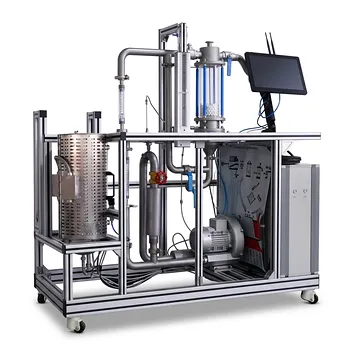
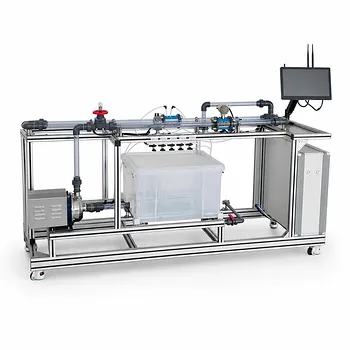
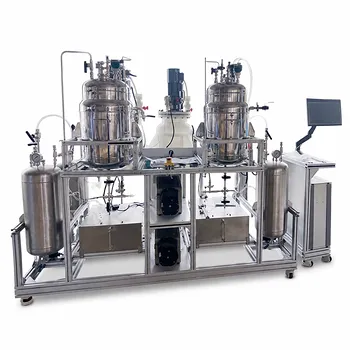
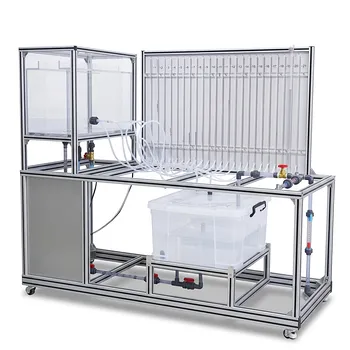
Are you looking to enhance hands-on learning and research accuracy? LABPARK provides state-of-the-art Educational and Vocational Unit Operations Pilot Plants across chemical engineering, bioprocess & biotech, and environmental & water treatment.
Tailored for universities, research institutes, and enterprises, our pilot plants help students master critical process controls—including precise conductivity and water quality analysis—using industry-grade systems.
Ready to upgrade your laboratory setup? Contact our engineering experts today to find the perfect pilot plant configuration for your curriculum!
Related Products
- Constant Pressure Filtration Educational Unit Operations Pilot Plant
- Multi Functional Catalytic Reaction and Reactor Evaluation Educational Unit Operations Pilot Plant
- Comprehensive Heat Transfer Coefficient Determination Educational Unit Operations Pilot Plant
- Educational Compression Refrigeration Performance Determination Unit Operations Pilot Plant
- Continuous Batch Extractive Distillation Educational Pilot Plant
People Also Ask
- How do educational unit operations pilot plants bridge theory and design? Bridge the Engineering Gap
- How do educational unit operations pilot plants address safety and waste management when scaling up?
- Why splitting a filtration batch doesn't always reduce cycle time? Pilot Plant Insights
- Why Demo Constant-Rate to Constant-Pressure Filtration on a Pilot Plant? Key Practical Insights
- How to select solid-liquid separation equipment for pilot plants? A Step-by-Step Guide