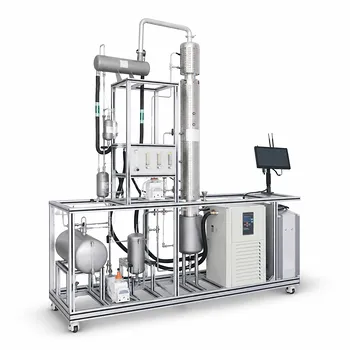
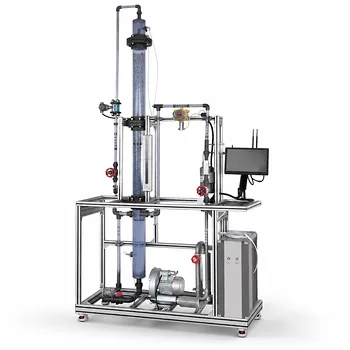
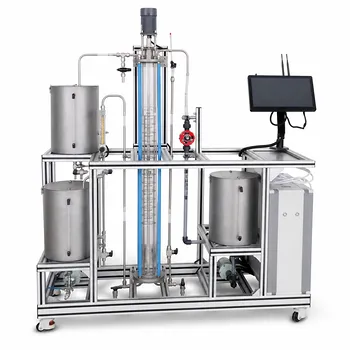
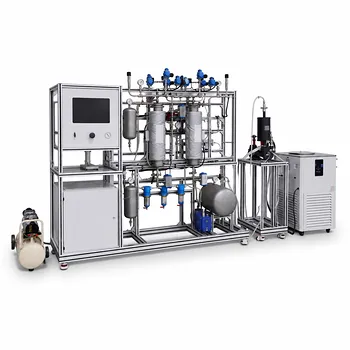
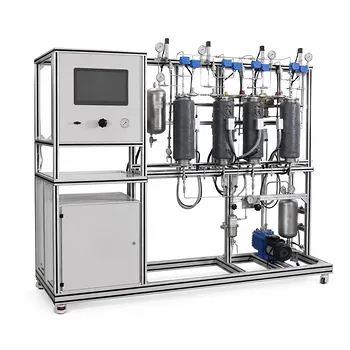
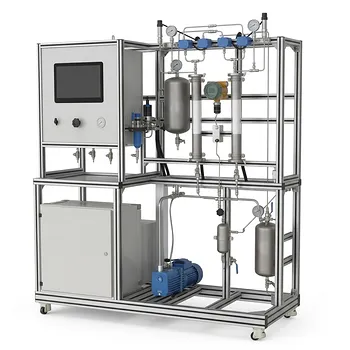
Flat seal pans are the default choice for most educational pilot columns—especially those under 800 mm in diameter. For larger columns, concave seal pans become attractive because they sustain a reliable liquid seal at low flow rates and simplify lateral liquid extraction. However, if your experimental fluid contains polymers or suspended solids, concave pans are a hidden trap that can ruin your data and your column’s reliability.
The seal pan decision hinges on two factors: column diameter and fluid cleanliness. In educational unit operations, small-diameter columns (≤800 mm) run best with simple flat pans, while larger columns benefit from the low-flow capability of concave pans—unless fouling is a risk. Always match the pan geometry to what your pilot plant will actually handle, not just to a nominal diameter.
Why Seal Pans Matter in a Teaching Pilot Plant
Seal pans sit at the base of a downcomer in tray columns.
Their job is to create a hydraulic seal that stops vapor from leaking up the downcomer and bypassing the tray above.
In a distillation or absorption column, even a tiny vapor leak kills stage efficiency.
That distorts every experiment and frustrates every student who is trying to measure separation performance.
The choice between flat and concave pans is not cosmetic.
It directly affects liquid hold‑up, weeping behavior, and how the column handles turndown.
For laboratory engineers, this is a reliability decision first.
A pilot plant that clogs, floods, or loses its seal mid‑demonstration teaches the wrong lesson.
The Diameter Decision: Flat vs. Concave
When to Choose a Flat Seal Pan
Small columns (diameter under 800 mm) overwhelmingly prefer flat seal pans.
This is not just convention; it is rooted in how liquid behaves at small scales.
In a thin column, the liquid stream from a downcomer is small.
A flat pan provides a uniform, predictable landing surface that fills evenly and builds a stable seal without adding unnecessary complexity.
Flat pans also minimize fabrication cost and make it easier to inspect and clean the column internals.
For a teaching lab, where the column may be frequently reconfigured or exposed to different fluids, that simplicity is a huge advantage.
Another practical benefit: flat pans create no dead zones.
Because the surface is level and open, liquid sweeps across the pan and flows out laterally without creating stagnant pockets.
When to Shift to a Concave Seal Pan
Once the column diameter passes roughly 800 mm, concave seal pans start to shine.
The reason is tied to turndown performance and liquid extraction geometry.
In a large-diameter column, a flat pan must handle a wider liquid front.
At low flow rates—common when students run a column at reduced throughput to study turndown—this liquid can become so shallow that the seal is easily lost.
A concave pan concentrates the liquid in a central depression, ensuring that a sufficient liquid height is maintained even at minimal flow.
This makes the seal far more resilient during turndown operation.
Additionally, in larger pilot plants, lateral liquid extraction (for side‑streams or intermediate draws) becomes more practical.
Concave pans can guide liquid toward an extraction nozzle without disturbing the main seal, something a flat pan struggles to do cleanly.
The Fluid Factor: When to Stay Flat—Always
The Clogging Crisis with Concave Pans
There is one condition where a concave seal pan is categorically wrong:
When the process fluid contains polymers, suspended solids, or any material that can deposit.
The very geometry that gives concave pans their turndown advantage—that central depression—creates a dead zone.
Liquid slows down, settles, and leaves behind solids that build up over time.
In an educational pilot plant, you might be distilling a synthetic mixture with polymerization potential or running a slurry‑based absorption experiment.
A clogged concave pan leads to erratic liquid levels, uneven tray hydraulics, and eventually a completely plugged downcomer.
Once that happens, experimental data becomes worthless, and the column has to be opened and cleaned.
For a busy teaching laboratory, that downtime destroys the learning schedule.
Flat Pans Are Self‑Cleaning
Because flat seal pans have no basin, they promote a continuous, sweeping liquid flow.
Solids are kept in suspension and carried out of the pan toward the outlet.
This makes flat pans the only safe choice for any pilot plant where the fluid is not guaranteed to be perfectly clean.
Even trace polymer formation can cause grief with a concave design.
Understanding the Trade‑offs
Even without fouling fluids, the decision involves a balancing act.
Concave pans increase liquid hold‑up.
In a small column, that extra inventory can dampen the very transient responses students are supposed to measure during dynamic experiments.
Flat pans, while simple, struggle to provide a positive seal at extreme turndown in large diameters.
So if your educational goal involves demonstrating low‑flow stable operation on a 1‑meter column, flat might not give you the stable baseline you need.
Another subtle compromise: concave pans make vessel level control slightly more complex because the liquid depth in the pan is not linear with flow rate.
Flat pans offer a more direct relationship between weir flow and seal behavior—again, an advantage for clear data interpretation in a teaching lab.
These trade‑offs mean you cannot just pick a pan style by column diameter alone.
You must understand the operating envelope students will explore and the pedagogical signals you want the column to produce.
Making the Right Choice for Your Educational Pilot Plant
Your seal pan selection should flow directly from the teaching objectives and the process chemistry you plan to use. Here is a goal‑based decision guide:
- If your primary focus is a compact, flexible pilot plant for small‑group experiments (column <800 mm, potential for varied fluids): Stick with flat seal pans. They are forgiving, easy to clean, and give predictable hydraulics across the widest range of test mixtures.
- If your primary focus is a large, dedicated distillation or absorption column (>800 mm) that will only run clean, non‑fouling model fluids: Choose concave seal pans. You will achieve a much more robust liquid seal at low flow rates, enabling credible turndown demonstrations and reliable side‑stream withdrawal.
- If your facility plans to test even one mixture with polymerizable components or suspended solids: Forbid concave pans regardless of column diameter. Always go flat. The cost of one plugged pan can exceed the cost of re‑designing the internals upfront.
- If you are designing a modular pilot plant that will be used across multiple courses with different fluids: Default to flat pans for all column sizes. The operational safety net of cleanability and simplicity outweighs any low‑flow advantage you might sacrifice.
A well‑configured pilot plant is a silent teacher. Choose your seal pans so the column teaches mass transfer, hydraulics, and data integrity—not maintenance and troubleshooting.
Summary Table:
| Feature | Flat Seal Pans | Concave Seal Pans |
|---|---|---|
| Optimal Column Diameter | Under 800 mm | Over 800 mm |
| Turndown Performance | Lower at very low flow rates | High (maintains seal at low flows) |
| Clogging & Fouling Risk | Low (self-cleaning sweeping flow) | High (solids settle in central basin) |
| Recommended Fluids | Polymerizing fluids, slurries, or solids | Clean, non-fouling model fluids |
| Maintenance & Cleaning | Easy to inspect and clean | Complex; prone to dead zones |
Optimize Your Unit Operations with LABPARK
Configuring the right column internals is critical for generating reliable experimental data and minimizing lab downtime. LABPARK provides high-quality Educational and Vocational Unit Operations Pilot Plants in chemical engineering, bioprocess & biotech, and environmental & water treatment designed specifically for universities, research institutes, and enterprises.
Whether you need expert guidance on seal pan selection or a complete custom-designed distillation column, our engineering team is ready to support you. Contact LABPARK today to discuss your project requirements!
Related Products
- Continuous Sieve-Plate Distillation Pilot Plant for Unit Operations Laboratory Education
- Multi-Functional Special Distillation Educational Pilot Plant
- Continuous Batch Extractive Distillation Educational Pilot Plant
- Multi-Modal Distillation Unit Operations Training Pilot Plant
- Absorption and Desorption Educational Unit Operations Pilot Plant
People Also Ask
- What are the primary reflux ratio control strategies? Master Distillation Unit Operations
- Why is vacuum operation capability an essential feature for a distillation unit operations pilot plant? Unlock Efficiency
- How can real-time carbon number prediction improve distillation pilot plants? Optimize control.
- How does catalyst water concentration affect distillation pilot plant design? Key separation train choices.
- How to select the right activity coefficient model (Wilson, NRTL, UNIQUAC) for distillation pilot plants?