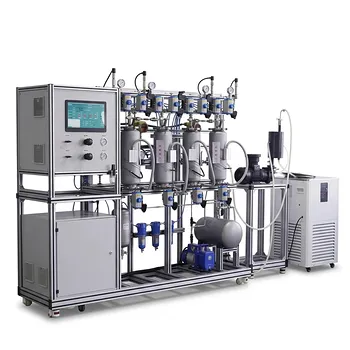
The bare distillation column is never the true cost of a unit operations training system. Academic and vocational facilities must budget for the full suite of auxiliary equipment—reboiler, condenser, feed and product pumps, reflux drum, and internal trays or packing—which typically represent the majority of the total investment. Material selection can further shift the budget by a factor of two, with stainless steel components costing roughly twice as much as their carbon steel equivalents. A realistic budget must account for these system-wide factors from the very first planning session.
The column tower is just the centerpiece. The real cost drivers are the hidden utilities: reboiler, condenser, pumps, reflux drum, and internal mass-transfer hardware. Materials amplify these costs—stainless steel internals can double the price of critical components, so your budget must scale accordingly.
The Hidden Costs of Auxiliary Equipment
A standalone column cannot perform separation—it needs an entire energy and flow infrastructure. Neglecting these components leads to a budget that is dangerously incomplete.
The Reboiler: Heat and Energy Input
Distillation requires vapor at the column base. The reboiler (often a kettle or thermosyphon type) provides this thermal energy and must be sized for the desired boil-up rate.
This single unit often becomes one of the most expensive line items. It involves process piping, heating media connections, and safety interlocks for laboratory use.
The Condenser and Reflux Drum
At the top, a condenser liquifies the overhead vapor. A portion of that liquid returns to the column as reflux via a reflux drum and control system.
The condenser’s surface area dictates cooling duty, directly affecting capital cost. The reflux drum plus the reflux splitter/pump add further hardware, instruments, and controls.
Feed and Product Pumps
Moving feed into the column and withdrawing distillate and bottoms requires precise pumping. Peristaltic or positive-displacement pumps with variable speed drives are typical for training labs.
These pumps are not commodity items. They must handle the system’s flow range and corrosive potential, which drives motor sizing and wetted material costs.
Internals: Trays, Packing, and Support
The tower’s mass-transfer performance is dictated by its internals. Sieve trays, valve trays, or structured packing each come with different price points and fabrication complexity.
Even within the same diameter, switching from carbon steel to 316 stainless steel valve trays or packing roughly doubles the internal hardware cost. This is where the material premium becomes starkly visible.
Material Selection: The Stainless Steel Premium
Choosing between carbon steel and stainless steel is not a minor footnote—it can reshape your entire budget.
Why the Twofold Cost Multiplier Matters
A carbon steel tray set might cost $X. The equivalent in 316 stainless steel will approximate $2X because of higher raw material prices, more expensive fabrication, and stricter welding requirements.
For a training system with multiple sections or spare internals, this difference compounds rapidly. A facility that needs corrosion resistance or long service life must plan for this premium from the outset.
When Stainless Steel Is Non-Negotiable
If the test mixtures include even mildly acidic, saline, or otherwise corrosive fluids, carbon steel internals will degrade quickly. Replacement costs and safety concerns make stainless steel the only practical choice.
For long-term durability with repetitive student use, stainless steel reduces maintenance frequency and preserves the educational consistency of the equipment.
Understanding the Trade-offs
Every budgeting decision involves balancing initial capex against educational value, maintenance, and safety.
The Peril of Under-Scoping the System
A common mistake is to buy the cheapest bare column and piecemeal the auxiliaries. This often results in insufficient heat transfer area, undersized reflux drums, or pumps that cannot hold steady flow.
The result is a column that cannot demonstrate key concepts like flooding, weeping, or stable steady-state operation—undermining its pedagogical purpose. The “savings” vanish when the lab instructor cannot complete the curriculum.
Carbon Steel’s Lower Cost vs. Shorter Life
Carbon steel components reduce the initial outlay dramatically, especially for large-diameter trays or custom-fabricated reboilers. However, they require diligent drying and maintenance to prevent rust.
For vocational facilities where cleanliness and rapid changeover are less critical, carbon steel can be acceptable if the system is operated only with non-corrosive mixtures. But the long-term maintenance burden must be factored into the operational budget.
Scalability for Curriculum Depth
Buying a minimal system may limit the range of experiments. A column that cannot run atmospheric and vacuum operations, or lacks multiple feed points and side draws, shortchanges advanced modules.
Facilities should weigh whether they can afford a slightly larger, more versatile system now rather than upgrading later. The cost of a second system far exceeds the incremental cost of adding features upfront.
Making the Right Choice for Your Goal
Base your decision on the specific learning outcomes and operational realities of your training program.
- If your primary focus is maximizing educational versatility: Budget for stainless steel internals, a flexible reboiler/condenser set, and multiple feed/product ports. This lets students explore flooding, weeping, and side-stream operation across a range of test mixtures.
- If your primary focus is minimizing capital expenditure for a single-demonstration lab: Use carbon steel components, but strictly limit the chemical training set to non-corrosive fluids and schedule thorough drying protocols after every session.
- If your primary focus is long-term durability with minimal technician intervention: Invest in 316 stainless steel for all wetted parts, even if that doubles the pump and tray costs. The reduced maintenance and longer service life justify the premium in high-use labs.
- If your primary focus is teaching corrosion’s impact alongside distillation: Deliberately specify a split system—carbon steel for one section and stainless for another—so students can observe material degradation. This requires a careful safety protocol but provides a unique learning outcome.
Budget for the system, not the column. When you treat the reboiler, condenser, pumps, and internals as co-equal pillars of the purchase, you deliver a training platform that meets your curriculum goals without surprise costs.
Summary Table:
| Cost Component | Description | Budget Impact & Considerations |
|---|---|---|
| Reboiler & Condenser | Thermal energy input & vapor liquefaction | High; dictates heating/cooling utilities and safety interlocks. |
| Pumps & Reflux Drum | Flow control for feed, reflux, and products | Medium; requires precise rate control and corrosion-resistant wetted parts. |
| Column Internals | Sieve/valve trays or structured packing | Medium; essential for mass-transfer performance and pedagogical goals. |
| Material Selection | Carbon steel vs. 316 Stainless Steel | Very High; SS doubles wetted part costs but ensures longevity. |
Build Your Unit Operations Lab with Confidence
Designing a process engineering lab requires balancing pedagogical goals with strict budget realities. LABPARK helps universities, research institutes, and enterprises successfully deploy high-performance training systems without unexpected cost overruns.
We specialize in providing premium Educational and Vocational Unit Operations Pilot Plants across:
- Chemical Engineering (including custom-configured distillation columns)
- Bioprocess & Biotech
- Environmental & Water Treatment
Let our engineering experts help you size auxiliary equipment and select the right materials for your curriculum. Contact LABPARK today to request a detailed technical proposal and quote!
Related Products
- Multi-Modal Distillation Unit Operations Training Pilot Plant
- Continuous Sieve-Plate Distillation Pilot Plant for Unit Operations Laboratory Education
- Dual-Mode Rectification Pilot Plant for Practical Training Unit Operations
- Multi-Functional Special Distillation Educational Pilot Plant
- Green Anhydrous Ethanol Purification Extractive Distillation Unit Operations Training Pilot Plant
People Also Ask
- How can energy balance equations for condensers & reboilers be validated experimentally? Guide
- How do distillation pilot plants validate VLE data? Achieve reliable solvent separation scale-up.
- How does catalyst water concentration affect distillation pilot plant design? Key separation train choices.
- How does thermodynamic model selection affect pressure-sensitive azeotropic distillation pilot plants? Design with validated VLE
- What are the primary reflux ratio control strategies? Master Distillation Unit Operations