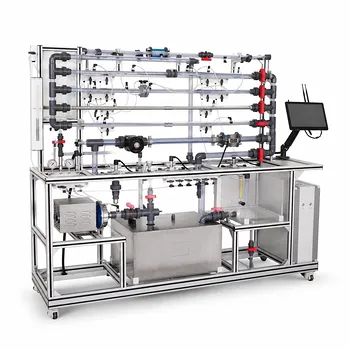
The selection hinges on the catalyst particle size and the core transport phenomena you want your students to master. For a university unit operations lab, the primary decision factors are whether you need to illustrate isothermal reaction control with finely divided catalysts or the plug‑flow behavior and pressure drop characteristics of coarser, fixed catalyst beds. Slurry reactor pilot plants excel with particles under 100 μm, actively suspended in the liquid phase, while fixed‑bed reactors are the straightforward choice when catalyst particles are larger than 1 mm and downstream separation must be avoided.
At its core, a slurry reactor pilot plant teaches isothermal operation, catalyst suspension hydrodynamics, and the industrially critical problem of product–catalyst separation. A fixed‑bed pilot plant, by contrast, excels at demonstrating plug‑flow behavior, pressure drop analysis, and the challenge of hot‑spot management. For a university laboratory, the choice is rarely about absolute superiority—it is about which configuration best illuminates the specific transport and reaction engineering concepts prioritized in your curriculum.
The Decision‑Making Framework: Reactor Type vs. Training Goal
Start with the Catalyst: Size Dictates the System
The catalyst particle size is the first gate in your selection. Slurry reactors are designed for fine catalysts, typically below 100 μm, which can be uniformly suspended with mechanical agitation. Fixed‑bed reactors require coarser particles, generally exceeding 1 mm, to maintain a stable packed bed and prevent excessive pressure drop.
This physical difference immediately defines which transport regimes your students will encounter. Fine catalysts maximize internal diffusion rates and activity, while coarser catalysts bring pore‑diffusion limitations that can be directly measured and modeled in a fixed‑bed experiment.
Heat Management and the Isothermal Ideal
Slurry reactors offer outstanding heat transfer, making them the default choice for highly exothermic demonstrations. The continuous movement of catalyst and liquid provides near‑isothermal conditions, eliminating hot spots that could distort kinetic data. Fixed‑bed reactors, in contrast, often develop axial and radial temperature gradients, a phenomenon that is itself a valuable teaching point but can complicate straightforward kinetic studies.
The Fouling Factor: When Feedstock Defines the Reactor
If your educational pilot plant will process heavy or solids‑containing feeds—even as a simulation—the choice shifts decisively. Slurry reactors tolerate fouling feedstocks and solids far better than fixed‑bed designs, where plugging can quickly cause maloperation and excessive pressure drop. This makes the slurry configuration essential for curricula covering heavy oil upgrading, biomass conversion, or any process where organometallic compounds cause rapid catalyst deactivation.
The Separation Step: Hidden Complexity of Slurry Systems
A slurry reactor’s biggest pedagogical “bonus” is also its greatest operational burden: the absolute requirement for a downstream catalyst separation unit. Students must learn to filter, centrifuge, or settle out the fine catalyst particles from the product stream. This adds an entire additional unit operation to the lab, which is excellent for a comprehensive process design course but introduces extra equipment cost, cleaning, and safety considerations.
Pressure Drop and Fluid Dynamics: Fixed‑Bed’s Double‑Edged Sword
Fixed‑bed pilot plants inherently illustrate plug‑flow behavior, with a well‑defined liquid residence time distribution that students can trace. They also generate measurable pressure drops across the bed, a direct demonstration of momentum transport. However, if the reaction requires very long residence times or if the feed contains even traces of solids, the pressure drop can become unmanageably high. Under such conditions, a slurry reactor’s backmixed liquid phase offers a clear advantage, and the trade‑off itself becomes a powerful lesson in reactor analysis.
Educational Infrastructure: What Makes a Lab‑Ready Pilot Plant
Modularity: The Power of Side‑by‑Side Comparison
For many university labs, the ideal solution is not a single‑purpose unit. Modular pilot plant systems allow the same core equipment to be reconfigured from a slurry to a fixed‑bed mode, enabling students to compare hydrodynamic regimes, mass transfer limitations, and pressure drops under nearly identical chemistry. This direct comparison is the fastest way to embed the fundamental reactor selection principles that industry values.
Utility Footprint: The Silent Deciding Factor
Before committing to a reactor type, audit your laboratory’s utility infrastructure. Slurry reactors typically require robust electrical supply for agitators, a reliable high‑flow cooling water circuit to maintain isothermal conditions, and suitable drainage for cleaning. Fixed‑bed pilot plants often have a lighter utility demand, needing mainly process heating and simple gas/liquid feed lines. Matching the pilot plant to your available electricity, cooling water, and ventilation capacity prevents operational failures and ensures safe, repeatable student experiments.
Understanding the Trade‑offs in Pilot Plant Selection
Every reactor choice involves a compromise between pedagogical depth and operational simplicity. A slurry reactor brings catalyst attrition, complex fluidization dynamics, and the very real challenge of product–catalyst separation—all of which are invaluable lessons, but they increase the time and cost per student experiment. A fixed‑bed reactor, while mechanically simpler, cannot demonstrate the isothermal behavior of finely dispersed catalysts or handle solid‑laden feeds; it can also develop hot spots that demand careful temperature control. Neither configuration is universally “better,” but each makes a different set of transport and separation phenomena visible and measurable. Your goal is to select the system that most closely aligns with the unit operations phenomena you have committed to teaching.
Making the Right Choice for Your Lab’s Training Goals
Your final decision must be driven by the specific learning outcomes of your unit operations course. Use this guidance to narrow your options:
- If your primary focus is demonstrating core transport phenomena (heat, mass, and momentum) in multiphase systems: Choose a slurry reactor pilot plant to showcase isothermal operation, gas–liquid–solid mass transfer, and the critical downstream separation step.
- If your primary focus is plug‑flow reaction engineering and industrial simplicity: A fixed‑bed pilot plant allows students to measure residence time distributions, pressure drop, and catalyst deactivation without the added complexity of catalyst recovery.
- If your curriculum covers heavy oil processing, biomass conversion, or fouling‑prone feedstocks: The slurry reactor’s ability to handle solids and fouling makes it an indispensable teaching platform that a fixed‑bed simply cannot replicate.
- If your lab’s utility infrastructure is limited or safety protocols favor simpler operation: A small‑scale fixed‑bed setup generally demands fewer utilities and less complex waste handling, enabling faster student turnover and lower installation risk.
- If you aim to teach comprehensive process design across multiple unit operations: Invest in a modular pilot plant that can operate in both slurry and fixed‑bed modes, empowering students to compare hydrodynamic behavior, pressure drop, and separation challenges head‑to‑head.
A well‑chosen reactor pilot plant transforms abstract equations into tangible, unforgettable engineering insight—select the configuration that turns your curriculum’s toughest concepts into your students’ most confident skills.
Summary Table:
| Feature | Slurry Reactor Pilot Plant | Fixed-Bed Reactor Pilot Plant |
|---|---|---|
| Catalyst Size | Fine (< 100 μm) | Coarse (> 1 mm) |
| Heat Control | Isothermal (excellent transfer) | Axial/radial gradients (hot spots) |
| Key Teachings | Mass transfer, catalyst separation | Plug-flow, bed pressure drop |
| Fouling Tolerance | High (handles solids/heavy feeds) | Low (prone to plugging) |
Equip Your Lab with the Right Training Tools
Choosing the right reactor configuration is critical for preparing the next generation of chemical engineers. LABPARK provides high-quality Educational and Vocational Unit Operations Pilot Plants in chemical engineering, bioprocess & biotech, and environmental & water treatment.
Tailored for universities, research institutes, and enterprises, our modular systems enable students to compare slurry and fixed-bed technologies side-by-side. Contact us today to consult with our experts and design the perfect pilot plant setup for your curriculum!
Related Products
- Natural Product Extraction Unit Operations Training Pilot Plant
- Fixed-Bed Chemical Reaction and Gas Dust Tar Removal Unit Operations Pilot Plant
- Ethyl Acetate Synthesis Unit Operations Pilot Plant for Practical Training
- Methanol Synthesis and Catalyst Performance Evaluation Educational Unit Operations Pilot Plant
- Multi-Functional Special Distillation Educational Pilot Plant
People Also Ask
- How to Demo Solubility Sensitivity in SFE Pilot Plants? Practical Thermodynamics
- How do pilot plants differentiate physical vs chemical extraction? Enhance Chemical Engineering Training
- How are HTU and NTU applied to determine extraction column height? Guide to Pilot Plant Scaling
- Why use step disturbance in pilot plants? Master process control dynamic response.
- What are the limitations of acentric factor models? Avoid pilot plant errors with polar fluids.