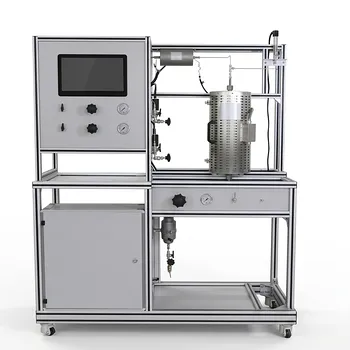
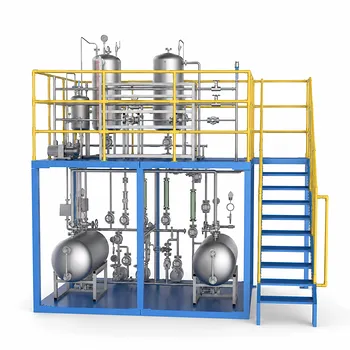
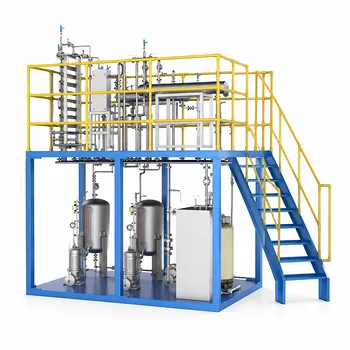
To demonstrate physical blending modification, a pilot plant requires high-shear mixing equipment like a twin-screw extruder, while chemical modification demands precisely controlled chemical reactors with initiator dosing and temperature management. Physical blending uses mechanical shear forces and heat to disperse fillers or other polymers into a uniform alloy, whereas chemical modification changes the polymer chains through grafting, cross-linking, or copolymerization—a fundamentally different unit operation. A well-designed educational pilot plant must make this distinction immediately obvious by giving operators side-by-side access to both an extrusion compounding line and a stirred tank chemical reactor system.
The true value lies in modularity. A pilot plant that can switch between an extrusion compounding line and a stirred tank reactor lets you compare how shear-induced mixing versus controlled chemical reaction affects final polymer properties. This direct, hands-on contrast cements the core engineering principles and equips users to select the right modification method for any target performance profile.
The Core Difference Between Physical Blending and Chemical Modification
Polymer modification splits cleanly into two camps: physical rearrangement and chemical transformation. A pilot plant must reflect that split not only in equipment but in the entire operating philosophy.
Physical Blending Relies on Mechanical Shear and Heat
Physical blending is a compounding operation. It demands a twin-screw extruder or an internal mixer that subjects the polymer melt to intense shear forces, distributing and dispersing fillers, plasticizers, or other polymers.
No permanent chemical bonds change. The blend’s properties emerge from the morphology and dispersion of the phases, driven purely by thermodynamic mixing and kinetic shear history. Observing this in a pilot plant teaches how screw design, temperature profiles, and residence time control phase size and final property uniformity.
Chemical Modification Requires a Controlled Reaction Environment
Chemical modification alters the molecular architecture of the polymer backbone. This is a reaction engineering problem, not a mixing one.
A pilot plant must therefore provide a stirred tank reactor or a tubular reactor with precise temperature control, initiator/catalyst dosing systems, and often inert gas blanketing or vacuum removal of volatile byproducts. Whether you are grafting maleic anhydride onto polyethylene or introducing cross-links, the reactor configuration must allow you to carefully manage heat, stoichiometry, and reaction time to avoid unwanted side reactions or runaway exotherms.
Designing a Versatile Pilot Plant for Comparative Demonstration
The pilot plant’s physical layout should make the two modification mechanisms teachable in a single shift. That requires an architecture that isolates the two processes while sharing utilities and data infrastructure.
Modular Skid-Based Architecture
Place the extrusion compounding line and the chemical reactor system on separate, wheeled skids with quick-connect utility couplings. This allows the same facility to reconfigure for either operation within minutes. Shared cooling water, electric power, and a common data acquisition backbone keep costs manageable while maximizing flexibility.
Extrusion Compounding Line for Physical Alloys
This line should include a co-rotating twin-screw extruder with multiple feed ports, a strand pelletizer, and a small injection molder or compression press for sample preparation. Key instrumentation—melt pressure transducers, torque sensors, and thermocouples along the barrel—lets students correlate screw speed and shear rate directly with blend quality.
Stirred Tank Reactor System for Chemical Reactions
For chemical modification, a jacketed glass or stainless-steel reactor with a mechanical agitator is the heart of the system. Critical add-ons include a syringe pump for initiator dosing, a reflux condenser with knockout traps for solvent recovery, and a gas manifold to maintain nitrogen or argon headspace. Temperature ramps and hold steps are controlled by a programmable logic controller (PLC) that logs data in real time, making the kinetics visible.
Instrumentation and Data Acquisition for Deeper Learning
Running both processes on the same pilot plant allows direct comparison of property outcome versus energy input. Install an online rheometer or torque sensor on the extruder and a reaction calorimeter on the reactor. Then students can measure that physical blending is overwhelmingly driven by viscous dissipation, while chemical modification’s progress tracks initiator consumption and reaction enthalpy.
Understanding the Trade-offs
A pilot plant that does both blending and chemical modification well is inherently more complex. Acknowledge these trade-offs openly to build credibility.
Safety and Solvent Management
Chemical modification frequently involves hazardous initiators (peroxides, azo compounds) and solvents. The pilot plant must include robust fume extraction, secondary containment, and explosion-proof ratings where needed. Physical blending lines are simpler—mainly thermal and mechanical hazards—but adding chemical capability raises the safety envelope and compliance overhead.
Batch vs. Continuous Operation
Extrusion is inherently continuous, delivering consistent product over time and aligning with industrial compounding practice. Chemical modification reactors for teaching are often batch, which simplifies sampling and allows students to observe polymer property evolution over time. Bridging this gap—showing how a batch chemical modification recipe could be translated to a continuous reactive extruder—requires additional teaching modules, not just hardware.
Compromising True Industrial Fidelity
A small pilot-scale twin-screw extruder cannot fully replicate the mixing dynamics of a large production machine; similarly, a bench-top reactor may mask heat-transfer limitations. Be transparent: the pilot plant demonstrates principles, not exact scale-up conditions. Combining the two into one facility, however, teaches students when to choose one modification route over another, a decision they will carry into plant design.
How to Apply This to Your Pilot Plant Project
The best configuration maps directly to your primary educational or research goal. Use the following guidelines to choose where to invest.
- If your primary focus is teaching the fundamental contrast: Prioritize the two separate skids with identical polymer feedstocks available for both lines. Schedule back-to-back experiments so students can observe how the same base resin behaves after mechanical blending versus after chemical grafting.
- If your primary focus is maximizing flexibility with limited space: Invest in a high-torque twin-screw extruder that can operate both as a compounder and, with small modifications, as a continuous reactor for reactive extrusion. Complement it with a single, well-instrumented batch reactor to cover all use cases.
- If your primary focus is producing polymers for downstream testing: Ensure the extrusion line ends with an injection molding station, and the reactor system includes a vacuum oven and compression molder. Consistent sample geometry allows meaningful comparison of mechanical properties between physically blended and chemically modified materials.
A pilot plant that clearly separates the worlds of mechanical mixing and controlled chemical reaction doesn’t just illustrate modification methods—it builds an intuitive, systems-level understanding that turns theory into actionable engineering judgment.
Summary Table:
| Feature | Physical Blending | Chemical Modification |
|---|---|---|
| Key Equipment | Twin-screw extruder, internal mixer | Stirred tank reactor, dosing systems |
| Mechanism | Mechanical shear & heat dispersion | Chemical reaction (grafting, cross-linking) |
| Process Type | Continuous compounding | Batch reaction |
| Key Variables | Screw speed, temperature profile | Stoichiometry, temperature ramps, kinetics |
Elevate Your Chemical Engineering Lab with LABPARK
Are you looking to demonstrate complex polymer engineering concepts like physical blending versus chemical modification? LABPARK provides premium Educational and Vocational Unit Operations Pilot Plants in chemical engineering, bioprocess & biotech, and environmental & water treatment for universities, research institutes, and enterprises.
Our highly modular, instrumented systems give students and researchers hands-on experience with real-world process dynamics. Contact LABPARK today to discuss your custom pilot plant configuration and bring industry-grade technology to your laboratory!
Related Products
- Polymerization Granulation and Pellet Processing Educational Unit Operations Pilot Plant
- Ethyl Acetate Synthesis Unit Operations Pilot Plant for Practical Training
- Carbon Dioxide Hydrogen Methanol Synthesis Educational Unit Operations Pilot Plant
- Multi-Modal Distillation Unit Operations Training Pilot Plant
- Methanol Synthesis and Catalyst Performance Evaluation Educational Unit Operations Pilot Plant
People Also Ask
- How do educational unit operations pilot plants bridge theory and design? Bridge the Engineering Gap
- How do educational unit operations pilot plants address safety and waste management when scaling up?
- What role do educational pilot plants play in scaling green chemistry? Bridging the Lab-to-Industry Gap
- How do educational pilot plants teach scale-up? Bridge the gap to commercial manufacturing.
- Why Compare Predicted and Experimental Excess Enthalpy? Key to Accurate Pilot Plant Scale-up