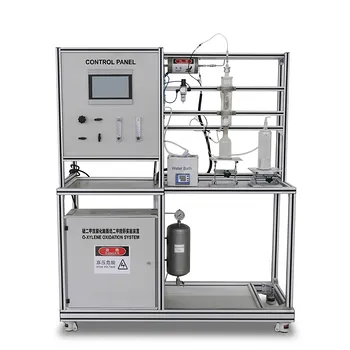
The specific configuration required is a reactor equipped with multi-zone temperature controllers, a precise internal thermocouple array, and a hydrogen quench gas injection system. This trifecta of monitoring, control, and active intervention is non-negotiable for safely managing the intense exotherms generated when hydrogenating aromatic rings and removing heteroatoms. Without this setup, a pilot-scale demonstration of hydrocracking risks an immediate and dangerous thermal runaway.
Hydrocracking is a race between highly exothermic hydrogenation and mildly endothermic cracking. Safely demonstrating this process hinges not on a single design choice, but on a layered defense: using internal bed profiling to see the heat, multi-zone control to contain it, and cold hydrogen quench to stop it from accelerating out of control.
Deconstructing the Hydrocracking Heat Challenge
The thermal behavior of hydrocracking is a deceptive sum of its parts. While the overall process is exothermic, it is the specific, intense heat from saturation reactions that demands a robust configuration.
The Asymmetric Heat Source
The primary heat management problem stems from the hydrogenation reactions. Saturating an aromatic ring can release around 326 kJ/mol, and removing sulfur or nitrogen atoms liberates even more energy.
These reactions occur rapidly at the top of the catalyst bed when the feed first contacts the catalyst. This creates a sharp, localized temperature spike, or "hot spot," which is the single greatest threat to stable pilot plant operation.
The Temperature-Safety Cascade
An uncontrolled hot spot is the initiation point for a dangerous cascade. The local temperature rise accelerates the reaction rate according to the Arrhenius equation, which in turn generates heat even faster.
This positive feedback loop defines thermal runaway. The immediate consequence is permanent catalyst deactivation through sintering, while the ultimate risk is a catastrophic loss of containment.
Engineering the Solution: The Three Pillars of Control
A safe demonstration reactor is built on the principle of layered control. You must see the heat, control the environment, and have a direct-action kill switch for temperature excursions.
Pillar 1: High-Resolution Bed Profiling
A single skin thermocouple is useless for piloting hydrocracking. You need a multipoint thermocouple assembly placed directly inside the catalyst bed, along the axial flow path.
This internal thermocouple array provides a real-time profile of the bed, revealing the location, magnitude, and movement of the hot spot. This data is the foundational input for all other control actions and allows students to visually grasp the heat generation dynamics.
Pillar 2: Multi-Zone Temperature Control
The reactor must be divided into independently controlled thermal zones, each managed by its own controller and heating/cooling circuit. This configuration directly addresses the asymmetric heat generation pattern.
The zone at the reactor inlet, where hydrogenation is most intense, will require aggressive cooling to act as a heat sink. Downstream zones, where endothermic cracking dominates, may actually require heat input to maintain the kinetic rate. This zonal approach allows the operator to enforce a specific, safe temperature profile along the entire bed length.
Pillar 3: Hydrogen Quench Gas Injection
The final and most direct safety instrument is an inter-stage hydrogen quench system. This involves injecting a precisely metered stream of cold hydrogen gas at one or more points along the catalyst bed.
This "cold-shot" method cools the reaction mixture immediately at the source of the problem. It serves a dual purpose: it prevents runaway temperatures during operational upsets and, alongside multi-zone control, is a primary technique for compensating for the slow decline in catalyst activity over a days-long demonstration.
Understanding the Operational Trade-offs
A configuration built for perfect safety introduces operational compromises that must be understood. A pilot plant is a balance between ideal control and industrial relevance.
The Quench Gas Conundrum
While cold hydrogen quench is the most effective safety tool, it introduces complexity. The injected quench gas dilutes the hydrocarbon partial pressure, potentially shifting the chemical equilibrium and masking the true catalyst selectivity you are trying to measure. The operator must perfectly track and account for this dilution in the material balance to ensure the data is valid for scale-up calculations.
Configuration vs. Reaction Type
The active heat management configuration required for hydrocracking is fundamentally different from other pilot plant setups. A thermal cracking demonstration, being highly endothermic, would instead require precise, uniform heating to force the reaction.
In contrast, a fluidized-bed demonstration manages exotherms passively through intense particle mixing. A hydrocracking fixed-bed cannot rely on this mechanism and is entirely dependent on its active "pillars of control" to prevent catastrophic failure.
Making the Right Choice for Your Goal
Your configuration is a tool to demonstrate specific engineering principles. The system must be reconfigurable in its focus to teach the complete picture.
- If your primary focus is operational safety and run-away prevention: Deploy the full quench system actively. Use the bed profile data to show how adjusting cold-shot flow immediately suppresses a developing hot spot.
- If your primary focus is studying catalyst deactivation kinetics: Use multi-zone control as the first line of defense. The demonstration should track how the hot spot front slowly moves down the bed over time, and how inlet zone temperatures must be incrementally raised to maintain constant conversion.
- If your primary focus is accurate kinetic data for scale-up: Minimize quench gas usage to reduce dilution corrections. Rely primarily on a highly aggressive multi-zone cooling circuit at the inlet to manage the heat, treating the quench system strictly as a safety backstop.
The art of pilot-scale hydrocracking is not just in seeing the exotherm, but in orchestrating a controlled thermal environment that keeps the reaction productive, stable, and unequivocally safe.
Summary Table:
| Control Pillar | Key Component | Primary Function |
|---|---|---|
| 1. Bed Profiling | Multipoint thermocouple array | Tracks real-time axial temperature profiles and detects localized hot spots. |
| 2. Thermal Control | Multi-zone heating & cooling circuits | Balances exothermic hydrogenation and endothermic cracking across catalyst zones. |
| 3. Active Safety | Hydrogen quench gas injection ("cold-shot") | Delivers immediate cooling to suppress thermal runaways and adjust for catalyst aging. |
Scale Up Your Lab Safely and Effectively with LABPARK
Building a safe and educationally rich environment for advanced chemical reactions requires precise engineering. LABPARK provides state-of-the-art Educational and Vocational Unit Operations Pilot Plants in chemical engineering, bioprocess & biotech, and environmental & water treatment designed specifically for universities, research institutes, and enterprises.
Ensure your laboratory is equipped with industry-grade safety controls and high-fidelity data collection systems. Contact our application specialists today to customize a pilot plant configuration that meets your academic and research objectives!
Related Products
- Fixed Bed Gas Solid Catalytic Reaction Educational Pilot Plant
- Multi-Reactor Educational Pilot Plant for Reaction Engineering Unit Operations
- Residence Time Distribution and Reactor Flow Characteristics Determination Educational Pilot Plant
- Fixed-Bed Chemical Reaction and Gas Dust Tar Removal Unit Operations Pilot Plant
- Tubular Reactor Flow Characteristics Determination Educational Unit Operations Pilot Plant
People Also Ask
- Fixed-Bed vs. Fluidized-Bed Reactor: How to Choose the Right Pilot Plant for Gas-Solid Catalytic Reactions
- How to determine catalyst pore radius & porosity? Optimize your chemical engineering pilot plant.
- What reactor configurations study gas-solid reactions? Guide to key types and applications.
- How does identifying the rate-limiting step optimize reaction conditions? Pilot Plant Guide
- How do reactor pilot plants safely study gas-solid reactions? Master kinetics with thermal & flow control.