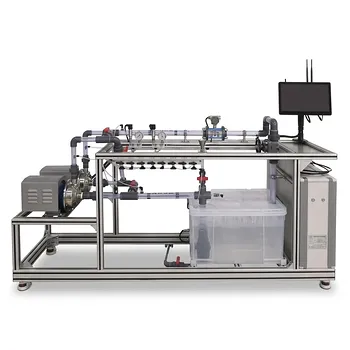
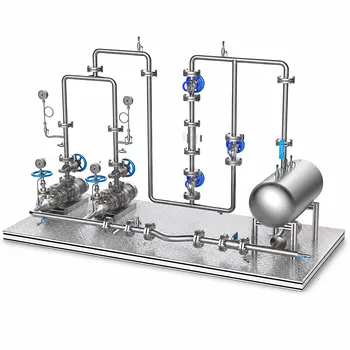
The required adsorbent mass in a PSA pilot trainer is calculated by balancing the molar feed of the target gas with the adsorbent's working capacity over a complete cycle. Specifically, you divide the total moles of the key component you need to capture during the adsorption step by the difference in its equilibrium loading between the high-pressure feed condition and the low-pressure regeneration condition. This foundational step transforms abstract thermodynamic data into a tangible engineering quantity, making the invisible process of selective surface attachment visible and measurable.
Calculating the adsorbent mass is the pivotal link between a gas's molecular affinity for a solid surface and the real-world size of the equipment. It’s the moment where chemical engineering education moves isotherms off the theory page and into a physical column, teaching students to translate equilibrium data directly into a capital cost and geometric specification.
Understanding the Core Calculation
The calculation is not a single equation you find in a standard reference book; it’s a logical sequence of mass balances specifically tailored to the cyclic nature of PSA. The goal is to determine how many kilograms of solid are needed to achieve a target separation for a defined feed flow and cycle time.
Breaking Down the Input Parameters
The calculation begins with three essential pieces of information. The feed gas molar flow rate under the adsorption pressure conditions tells you how many moles of the target component enter the column per unit of time. The adsorption cycle time defines the duration for which the bed will actively adsorb before switching to regeneration. Multiplying these two gives the total moles of target component that the adsorbent mass must hold within one cycle.
The Role of the Working Capacity
You cannot use a single-point adsorption capacity from an isotherm. Because the PSA process is cyclic, the useful storage capacity of the adsorbent, called the working capacity, is the difference between the solid's loading at the high-pressure feed condition and its residual loading at the low-pressure regeneration condition. This value is read directly from the relevant adsorption isotherm for the target gas on the chosen material. Using the absolute capacity would drastically underestimate the mass needed.
From Adsorbent Mass to Column Geometry
Once the required mass ($M_a$) is found, it directly determines the physical dimensions. Dividing $M_a$ by the bulk density of the packed adsorbent gives the minimum bed volume. This volume then becomes the design target. Engineers use an acceptable aspect ratio (height-to-diameter ratio), typically constrained by pressure drop and flow distribution considerations, to iteratively solve for a final column height and diameter that provide the required volume.
The Deep Educational Purpose
This single calculation does far more for a student than teach a design formula. It serves as the perfect case study for integrating fragmented chemical engineering concepts into a cohesive design thinking process.
Connecting Thermodynamics to Unit Operations
The most common disconnect in the curriculum is between the "paper" world of thermodynamic models and the "hardware" world of unit operations. By forcing a student to extract data directly from an isotherm chart and use it as the primary input for a mass balance, the PSA trainer makes the link irreversible. It shows that an isotherm is not just a curve to be fitted, but a material's direct specification sheet for process design.
Demonstrating Practical Design Constraints
The step that turns mass into geometry introduces real-world constraints. A student can immediately see how a high working capacity (a good material property) leads to a smaller, cheaper column (a good economic outcome). They also encounter the trade-off directly when a calculated column height of 20 meters with a 2 cm diameter is impractical, forcing them to adjust parameters or select a different adsorbent. This teaches that a "correct" calculation can still yield a bad engineering solution.
Teaching Dynamic Systems Through a Steady-State Slice
A PSA unit is inherently dynamic, yet the core adsorbent mass calculation is often performed using a simple, time-averaged mass balance. This beautiful simplification introduces students to the concept of "snapshot" analysis for cyclic processes. It provides a reliable first-pass estimate before engaging in more complex dynamic simulations, showing the power of applying fundamental principles to unsteady-state problems.
Understanding the Trade-offs
While the calculation is foundational, its simplicity comes with critical assumptions that can become pitfalls if ignored.
The Assumption of a Perfect Working Capacity
The calculation assumes that every particle in the bed achieves the equilibrium loading stated by the isotherm, which ignores mass transfer resistances. Real PSA cycles operate on finite time scales, and kinetic limitations can significantly reduce the effective working capacity, requiring a safety factor.
The Oversimplification of Gas Properties
The calculation uses a single isotherm for a pure component, while real gas mixtures exhibit competitive adsorption. For a multicomponent feed, this can lead to inaccuracies because the working capacity of one gas is influenced by the presence of others.
Ignoring Thermal Effects
Adsorption is exothermic. A simple mass balance assumes an isothermal bed, but in reality, temperature swings during the cycle alter the isotherm's shape and the working capacity. A purely equilibrium-based mass calculation can therefore be overly optimistic without empirical adjustment.
Making the Right Choice for Your Educational Goal
This calculation's pedagogical power lies in its adaptability. How you frame it dictates what your students learn.
- If your primary focus is process synthesis: Emphasize the iterative loop—how an initial mass calculation reveals an impractical geometry, forcing a redesign of the adsorbent choice or the cycle time itself.
- If your primary focus is the value of material science: Frame the calculation as a sensitivity study, showing how a 20% increase in the adsorbent’s working capacity cascades into a direct reduction in column diameter and adsorbent inventory cost.
- If your primary focus is practical pilot-plant skills: Instruct students to compare their calculated mass against an empirical measurement, using the discrepancy to analyze mass transfer zones and invalid assumptions, turning a design exercise into a diagnostic tool.
Ultimately, this calculation demystifies the black box of a separation column and replaces it with a clear, solvable puzzle that builds the confidence to move from a molecular property to a designed, functional system.
Summary Table:
| Design Step | Key Parameter / Formula | Educational Significance |
|---|---|---|
| 1. Moles to Capture | Feed flow rate $\times$ Adsorption cycle time | Integrates dynamic process time into a steady-state mass balance |
| 2. Working Capacity | $q_{high} - q_{low}$ (from isotherms) | Demonstrates how thermodynamic data dictates equipment size |
| 3. Adsorbent Mass | Moles to capture / Working capacity | Translates molecular surface affinity to physical material quantity |
| 4. Bed Volume | Adsorbent mass / Bulk density | Converts mass of solids into volumetric spatial requirements |
| 5. Column Geometry | Volume & Aspect Ratio $\rightarrow$ Height & Diameter | Teaches students real-world design trade-offs and pressure drop limits |
Bring Chemical Engineering Theory to Life with LABPARK
Bridge the gap between textbook thermodynamics and hands-on laboratory practice. LABPARK provides state-of-the-art Educational and Vocational Unit Operations Pilot Plants in chemical engineering, bioprocess & biotech, and environmental & water treatment for universities, research institutes, and enterprises.
Our gas separation and PSA pilot trainers allow students to calculate, design, and validate real column dynamics in real-time. Contact LABPARK today to discover how our custom pilot plants can transform your educational or research facility!
Related Products
- Multi-Component Gas Pressure Swing Adsorption Pilot Plant for Unit Operations Education
- Low Concentration Carbon Dioxide Capture Pressure Swing Adsorption Educational Pilot Plant
- Bench Scale Carbon Dioxide Capture Educational Unit Operations Pilot Plant
- Bench Scale Dual Column Gas Separation and Capture Educational Pilot Plant
- Pressure Swing Adsorption Educational Unit Operations Pilot Plant
People Also Ask
- How does Pressure Swing Adsorption (PSA) technology operate? Optimize gas separation with pilot plants.
- How is the direction and driving force of mass transfer determined in a gas absorption unit operations pilot plant?
- How do two-film & penetration theories apply to gas absorption pilot plant teaching? Key pedagogical insights.
- How does partial pressure behavior influence gas absorption pilot plants? Master Mass Transfer
- What are the limitations of Henry's Law in gas absorption pilot plants? Avoid critical lab errors.