Here is the core chemical truth: pH regulation achieves selective precipitation by precisely manipulating the concentration of a specific anion (like hydroxide or sulfide) in the wastewater to exceed the solubility product constant (Ksp) of one target metal hydroxide or sulfide, while remaining below the Ksp of other metals in the mixture. This creates a selective, controlled phase change where the least soluble compound precipitates out as a solid first, allowing for its physical separation by filtration or settling.
The deep challenge in wastewater treatment isn't just knowing that metals precipitate at different pH levels—it's about engineering the system to hold a target pH steady against chemical feedback loops that fight you. Success hinges on viewing pH not as a simple meter reading, but as a dynamic thermodynamic control lever for anion concentration and metal speciation, requiring buffer chemistry and a clear understanding of Ksp thresholds.
The Foundational Chemistry: pH as a Precision Tool
The key to selective separation is recognizing that pH control is actually a method for controlling the concentration of a common ion. You aren't just adding a base; you are injecting a precisely calculated dose of reactivity.
The Solubility Product Constant (Ksp)
Every sparingly soluble metal salt has a fixed solubility product constant at a given temperature. This value dictates the maximum product of ion concentrations that can exist in a stable solution.
When the ion product exceeds this Ksp value, the solution becomes supersaturated, and precipitation begins. For metal hydroxides, the Ksp equation is tied directly to the concentration of hydroxide ions, which pH defines. A small pH change creates an exponential shift in hydroxide availability, giving you an extremely sensitive switch to toggle precipitation on or off for a specific metal.
Reading the pH Landscape: Hydroxide Precipitation
Different metal hydroxides have vastly different Ksp values, meaning they drop out of solution at distinct pH thresholds. This is the core principle of fractional precipitation.
For example, trivalent ions like ferric iron ($Fe^{3+}$) precipitate as $Fe(OH)_3$ at a very low pH around 3 to 4, while divalent ions like magnesium ($Mg^{2+}$) remain highly soluble until the pH climbs above 9. By ramping up the pH in stages within a continuous stirred-tank reactor, you can sequentially remove metals. A primary reference example demonstrates that locking the pH at approximately 9 using a buffer system ensures the complete precipitation of aluminum hydroxide while allowing magnesium ions to pass through, achieving a clean separation in a single unit operation.
The Sulfide Route: Enhanced Selectivity and Toxicity Control
For many heavy metals like zinc, lead, or copper, using sulfide ions ($S^{2-}$) instead of hydroxide offers an even greater degree of separation because the Ksp values for metal sulfides are incredibly low and span a wider logarithmic range.
However, the concentration of free sulfide ions is a direct function of pH because hydrogen sulfide ($H_2S$) is a weak diprotic acid. The concentration of $[S^{2-}]$ is inversely proportional to the square of the $[H^+]$ concentration. This creates a powerful, but dangerous, tool: lowering the pH too far suppresses sulfide formation and risks releasing toxic $H_2S$ gas. Pilot plant data shows that for a zinc-manganese mixture, a precise pH window—theoretically between 1.59 and 4.68—must be maintained to precipitate zinc sulfide completely without pulling down manganese sulfide.
The Dynamic Challenge: Beyond Static pH Theory
A static titration curve in a textbook is never enough because the precipitation reaction itself changes the solution's chemistry in real-time during pilot plant operations.
The Acid-Generating Feedback Loop
High-valence metal cations like aluminum ($Al^{3+}$), iron ($Fe^{3+}$), and copper ($Cu^{2+}$) act as polyprotic acids in water. As you add base to raise the pH, these ions undergo stepwise hydrolysis, releasing hydronium ions ($H_3O^+$) that fight against the pH increase.
This means the pH doesn't rise linearly with base addition; it stalls or resists near the point of precipitation. If the operator isn't prepared for this buffering effect, the precipitator can swing wildly from under-dosing (causing no separation) to over-dosing (causing massive co-precipitation). A calculated amount of strong acid must often be added to the feed just to control the speciation of these high-ionic-potential metals before treatment even begins.
Speciation: Knowing What Actually Exists
The concept of a "free" metal ion is an oversimplification. In an aqueous solution, metals like nickel exist as a family of hydroxide complexes ($NiOH^+$, $Ni(OH)_2^0$, $Ni(OH)_3^-$) depending on the pH and temperature.
Pilot plant engineers must model this speciation behavior to predict the true minimum solubility point. A common pitfall is raising the pH too high, which re-dissolves the pollutant by forming soluble anionic complexes. Validating these chemical equilibria using concentration-pH diagrams ensures the filtration stage is positioned precisely at the point of minimum solubility, not just at the onset of turbidity.
Leveraging Complexation for Separation and Purification
Sometimes the goal isn't just to precipitate one metal and leave the other, but to re-dissolve a target metal selectively from a mixed sludge using coordination chemistry.
Selective Dissolution with Ligands
Ammonia is a classic ligand that can be used to reverse a precipitation. In a mixed zinc and magnesium hydroxide precipitate, ammonia selectively forms a stable, colorless $[Zn(NH_3)_4]^{2+}$ complex, pulling the zinc back into the liquid phase while the magnesium hydroxide remains a solid. This leverages the massive difference in the stability constants of the metal ammine complexes.
pH-Dependent Chelating Agents
Common chelating agents like EDTA are weak acids whose ability to bind metals is entirely pH-dependent. At a low pH, hydrogen ions outcompete the metal for the ligand’s active site, causing the complex to fall apart.
For example, EDTA forms a much stronger complex with zinc ($Zn^{2+}$) than with calcium ($Ca^{2+}$) due to a higher formation constant. By holding the reactor pH in a narrow window between 4 and 5, the EDTA will selectively strip zinc ions from a solution without touching the calcium. This precision is essential in educational and industrial pilot plants for demonstrating resource recovery where simple hydroxide precipitation fails.
Understanding the Trade-offs
Mastering pH-controlled separation requires accepting that no single method is perfect. You are constantly trading off purity against operational stability.
- The "Cliff" Effect: Because Ksp values are logarithmic, the transition from a soluble metal to a completely precipitated one happens over a very narrow pH range (often less than 0.5 pH units). This demands high-precision probes and immediate actuator response.
- Co-precipitation Contamination: Even if the theoretical Ksp of a secondary metal hasn't been reached, it can be physically "swept out" of solution by adsorbing to the surface of the primary precipitate. This is a common purity failure in pilot plants unless the primary sludge is washed.
- The Acidic Shift in Sulfide Removal: When using sulfide precipitation for metals like zinc, the reaction $Zn^{2+} + H_2S \rightarrow ZnS(s) + 2H^+$ releases acid. Without an automated dosing system or a robust buffer, the pH quickly crashes, stops the reaction, and risks generating lethal $H_2S$ gas. The buffer isn't just a stabilizer; it's a safety-critical component.
- Amphoteric Metal Loss: Metals like aluminum and zinc dissolve under both highly acidic and highly alkaline conditions. If a pH overshoot occurs beyond the target of ~9 for aluminum, it forms soluble aluminate ions, undoing the separation.
Making the Right Choice for Your Separation Goal
Your operating strategy must match the specific chemical gap you are trying to exploit between the two metals in your waste stream.
- If your primary focus is separating a high-valence metal from a divalent alkali earth metal: Exploit hydroxide chemistry with a buffer system to cement the pH where the gap in Ksp is largest, such as separating $Al^{3+}$ from $Mg^{2+}$ at pH ~9 or $Fe^{3+}$ from $Mg^{2+}$ at pH ~4.
- If your primary focus is removing a toxic heavy metal from a benign metal with similar hydroxide behavior: Use a sulfide precipitation system, as the Ksp differences for sulfides are orders of magnitude greater, but budget for a scrubber and a pH controller to safely lock the free $[S^{2-}]$ concentration within the safe and effective window.
- If your primary focus is selectively recovering a valuable metal from a mixed sludge: Don't just use precipitation; apply pH-controlled complexation with a ligand like ammonia or EDTA. Use the differences in complex stability constants to dissolve the target metal while leaving contaminants in the solid phase.
- If your primary focus is process stability in a pilot plant: Never rely solely on feedback control from a pH probe. Use a buffer solution strategy (like an ammonia-ammonium chloride system) to provide chemical inertia against the acid-generating hydrolysis reactions of the metals themselves, ensuring that the unit operation reaches equilibrium predictably.
A robust pH strategy transforms a simple mixing tank into a precise separation column, turning a hazardous waste problem into a recoverable resource.
Summary Table:
| Separation Method | Target Metals | Control Parameter | Key Operational Challenge |
|---|---|---|---|
| Hydroxide Precipitation | $Fe^{3+}$ (pH 3-4), $Al^{3+}$ (pH ~9) | $K_{sp}$ of metal hydroxides | Amphoteric dissolution & hydrolysis feedback |
| Sulfide Precipitation | Heavy metals ($Zn^{2+}$, $Cu^{2+}$) | Dynamic pH window ($H_2S$ equilibrium) | Risk of toxic $H_2S$ gas release |
| Complexation (Ammonia) | $Zn^{2+}$ vs. $Mg^{2+}$ | Stability constants ($K_f$) | Ligand dosing accuracy |
| Chelation (EDTA) | $Zn^{2+}$ vs. $Ca^{2+}$ | pH-dependent ligand protonation | High-precision pH window control |
Bring Practical Wastewater Unit Operations to Your Lab with LABPARK
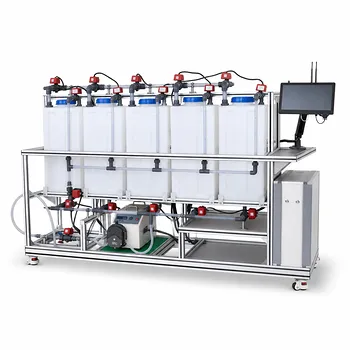
Demonstrating dynamic thermodynamic controls like pH-regulated selective precipitation requires robust, real-world equipment. LABPARK provides state-of-the-art Educational and Vocational Unit Operations Pilot Plants in chemical engineering, bioprocess & biotech, and environmental & water treatment.
Tailored for universities, research institutes, and enterprises, our pilot plants help students and researchers master critical chemical feedback loops, automated dosing systems, and filtration stages.
Contact us today to discover how LABPARK can elevate your engineering and research training.
Related Products
- Electrochemical Water Treatment Educational Unit Operations Pilot Plant
- Solid Waste Pyrolysis and Refining Educational Pilot Plant for Unit Operations
- Multi-Functional Membrane Separation Educational Pilot Plant for Unit Operations Lab
- Dual-Mode Rectification Pilot Plant for Practical Training Unit Operations
- Hot Filtration Educational Unit Operations Pilot Plant Laboratory System
People Also Ask
- What design features do educational electrochemical pilot plants utilize to manage gas liberation and water loss?
- How can unit operations pilot plants show lead-acid concentration vs state of charge? Real-time monitoring guide.
- How do educational electrochemical pilot plants scale up electrolysis? Master industrial engineering.
- How to Estimate Sulfate in Water Treatment Pilot Plant Deposits: Gravimetric Guide
- How can foaming be managed during steam generation experiments in water treatment unit operations pilot plants? Tips