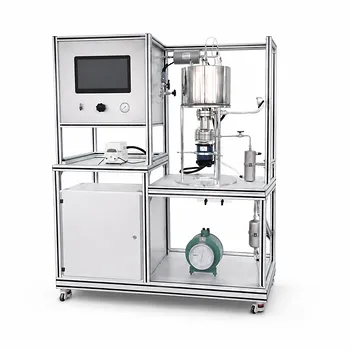
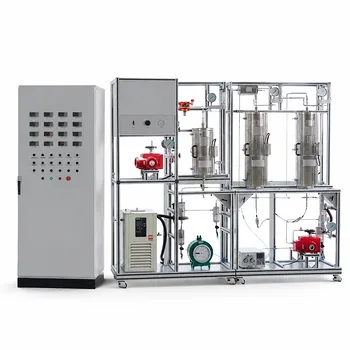
The core process for determining reaction kinetics and heat transfer parameters from a pilot plant involves systematically adjusting mathematical model parameters until simulated outputs match your experimental measurements. This is a multi-layered challenge that moves from simply collecting data to solving a numerical optimization problem, where you're tuning constants in a proposed rate law or energy balance to minimize the difference between what your model predicts and what your sensors actually recorded.
The entire workflow is a cycle of hypothesis and refinement. You start with a postulated model, use your pilot plant to generate dynamic concentration and temperature data, and then apply sophisticated parameter estimation algorithms to nail down the exact kinetic constants and heat transfer coefficients. This is not just curve-fitting; it's about extracting physically meaningful constants that allow you to predict behavior at a larger scale.
From Physical Data to a Mathematical Framework
Before you can estimate a single number, you need a solid physical foundation and a clear definition of the problem you're trying to solve. The pilot plant provides the essential controlled environment to make this possible.
Structuring the Kinetic and Energy Models
Your pilot plant data defines the goal. You might collect reactant concentrations at various times in a batch reactor or at points along the length of a plug flow reactor (PFR). The reactor type dictates the form of your model equations. A Continuous Stirred-Tank Reactor (CSTR) will give you a single, steady-state set of conditions, while a transient batch run provides a rich, time-dependent profile.
These experimental data vectors become your target for simulation. You create a mathematical representation of the reactor—a system of differential equations that includes a postulated reaction rate expression (e.g., ( r_A = k C_A^n )) and an energy balance that accounts for heat transfer. The unknowns in these equations—activation energy, frequency factor, reaction order, and the overall heat transfer coefficient ( UA )—are the parameters you need to estimate.
The Calorimetric Foundation for Heat Transfer
Determining heat transfer parameters requires precise thermal data. A jacketed reactor pilot plant essentially acts as a calorimeter. By continuously measuring the temperature difference between the reaction mixture (( T_R )) and the jacket fluid (( T_J )), and using an integrated calibration heater, the system can directly calculate the key thermal parameter group, ( UA ).
This is crucial for scale-up. You must evaluate heat removal limits to prevent hazardous thermal runaway. An enthalpy table, combined with the calculated extent of reaction, allows you to determine the total heat duty (( \Delta H )) and confirm that your plant-scale heat exchangers can maintain stable, isothermal conditions.
The Engine of Estimation: Sensitivity and Optimization
The transition from a model with guesswork parameters to a validated, predictive model happens in the optimization engine. The key is understanding how your model’s output responds to changes in each unknown parameter.
The Bridge Between Parameters and Prediction
Sensitivity analysis forms the mathematical core of parameter fitting. A sensitivity coefficient, ( z_k(t) = \partial y / \partial p_k ), directly quantifies how a state variable ( y ) (like concentration or temperature) changes in response to a perturbation in a parameter ( p_k ) (like the rate constant).
Imagine you're tuning the activation energy. If a tiny change causes a massive swing in the simulated reactor temperature, the sensitivity is high, and the parameter is easily identifiable. If the model output barely flinches, the parameter is in the "noise floor" and can't be reliably determined from your data. Modern solvers use an elegant shortcut here: the Jacobian matrix, calculated at each integration step when solving the state equations, is re-used to efficiently solve all the sensitivity equations at once.
Navigating the Pitfalls of Parameter Correlation
A direct assault on an unrefined model is often doomed. Parameters like the pre-exponential factor and activation energy have vastly different magnitudes, creating a strongly correlated, needle-like valley in the optimization landscape that causes numerical chaos. The solution is reparameterization. By rescaling your equation around a reference temperature—usually the midpoint of your pilot plant’s operating range—you remove a large portion of this inherent correlation. This simple transformation makes the objective function far better behaved and allows the optimization algorithm to converge reliably.
Another structural problem is local blindness. If you start with a poor initial guess for the rate constant, a Local Sensitivity Analysis is useless; it only tells you about the landscape directly around an incorrect point. The solution is a Global Sensitivity Analysis (GSA) . Here, you sample parameters across a wide, physically reasonable space (like broad bounds for activation energy) and perform a local analysis at each sample point. By averaging the sensitivity metrics from all these points, you can identify the truly dominant parameters no matter where your final solution will end up, enabling a targeted and effective calibration strategy.
Understanding the Trade-offs
No single method is universally best, and being aware of the pitfalls is what separates a usable model from a misleading one.
Data Quality vs. Model Complexity
A complex, multi-step kinetic model with a dozen parameters will fit your pilot plant data perfectly. But this is often a trap called overfitting. You end up modeling the noise and equipment quirks, not the true chemistry. The resulting model will fail miserably on a different reactor at a different scale. The art is finding the simplest model structure that captures the essential reaction mechanism and can predict behavior at the production scale.
The Inherent Limits of Sensitivity
Sensitivity-based optimization is inherently local. While GSA helps you scope out the terrain, the final fit can still end up in a local, non-optimal "valley" if your experimental data lacks information in a critical region. For example, if your pilot plant data was only collected at low conversions, you have zero information to constrain a model for high-conversion behavior. No amount of advanced mathematics can extract kinetic information that simply isn't present in your measurements.
Making the Right Choice for Your Project
Your strategy depends entirely on your end goal and the quality of your initial information.
- If your primary focus is ultimate scale-up reliability: Invest heavily in calorimetric experiments to directly measure ( UA ) and heat of reaction. Use reparameterized, well-posed models and Global Sensitivity Analysis to isolate only the most statistically meaningful kinetic parameters, avoiding overfitting at all costs.
- If your primary focus is teaching fundamental principles: Use the integral and differential methods on batch data to give students an intuitive feel for rate laws. Let them directly see the difference between a first-order and second-order fit on a linearized plot.
- If your primary focus is rapid parameter screening for a well-known reaction: Use the built-in optimization and implicit sensitivity calculations to rapidly converge on a few key values, leveraging the known functional form of the rate law and a good initial guess from literature.
The goal is to transform raw sensor streams into a set of invariant physical constants that give you predictive power far beyond the pilot plant itself.
Summary Table:
| Parameter Type | Key Identification Methods | Critical Considerations | Scale-up Benefit |
|---|---|---|---|
| Reaction Kinetics ($k$, $E_a$, $n$) | Sensitivity Analysis (Jacobian Matrix), Global Sensitivity | Reparameterization to avoid parameter correlation & overfitting | Predicts chemical behavior & conversion rates at larger scales |
| Heat Transfer ($UA$) | Calorimetric Calibration, Jacket/Reactor $\Delta T$ monitoring | Accurate enthalpy balances to prevent thermal runaway | Ensures safety & helps design plant-scale heat exchangers |
Accelerate Your Process Scale-Up and Engineering Education
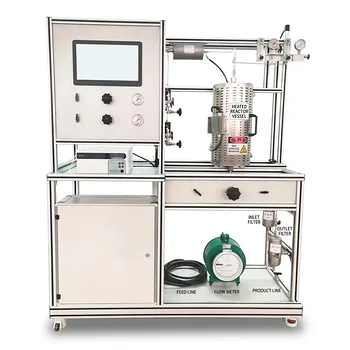
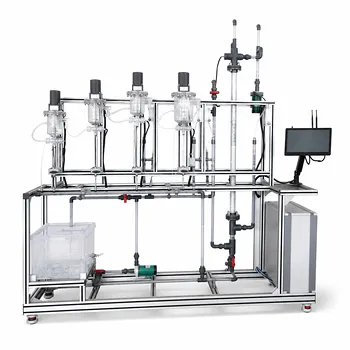
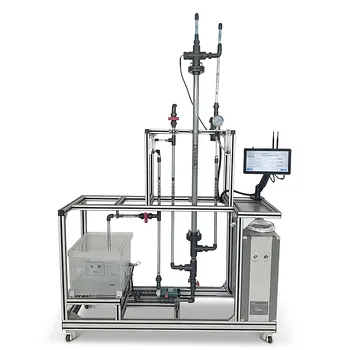
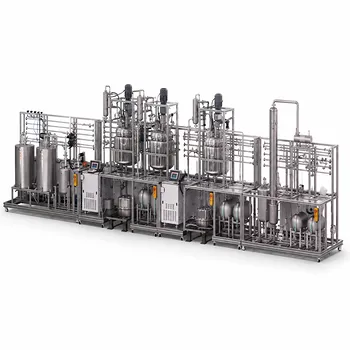
Are you looking to bridge the gap between pilot plant data and full-scale production? LABPARK provides state-of-the-art Educational and Vocational Unit Operations Pilot Plants in chemical engineering, bioprocess & biotech, and environmental & water treatment.
Designed specifically for universities, research institutes, and enterprises, our advanced pilot systems enable precise data collection, kinetic modeling, and calorimetric testing to ensure safety and scalability.
Contact LABPARK today to discover how our customizable pilot plant solutions can elevate your research, training, and scale-up reliability!
Related Products
- Fixed Bed Gas Solid Catalytic Reaction Educational Pilot Plant
- Multi-Reactor Educational Pilot Plant for Reaction Engineering Unit Operations
- Fixed-Bed Chemical Reaction and Gas Dust Tar Removal Unit Operations Pilot Plant
- Residence Time Distribution and Reactor Flow Characteristics Determination Educational Pilot Plant
- Tubular Reactor Flow Characteristics Determination Educational Unit Operations Pilot Plant
People Also Ask
- How do reactor pilot plants safely study gas-solid reactions? Master kinetics with thermal & flow control.
- How does the Mears criterion evaluate transport resistance? Key Guide to Intrinsic Kinetics
- Why is a multibed configuration necessary for exothermic reactions? Optimize your pilot plant trajectory.
- Fluidized vs. Fixed Bed Reactors: Comparing Heat & Complexity in Pilot Plants
- How is the friction factor determined for fixed-bed pilot plants? Select the best pressure drop correlation.