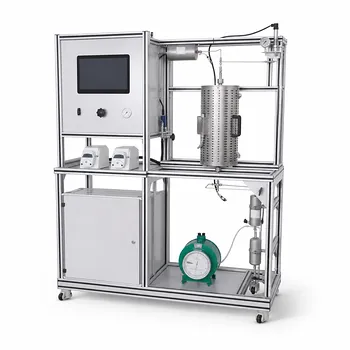
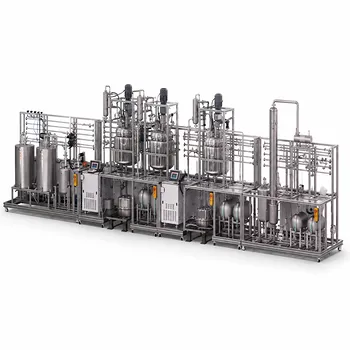
The numerical management of parameter estimation and sensitivity analysis in chemical reactor pilot plants centers on a powerful computational synergy: reusing the Jacobian matrix from the reactor state equations to efficiently solve the sensitivity equations. This approach, grounded in implicit integration techniques, drastically reduces memory and computational time. By coupling the solution of the main differential equations with their sensitivities, engineers can pinpoint which kinetic or operational parameters most influence reactor behavior, directing limited pilot-plant resources to the variables that truly matter.
Pilot-plant reactor modeling is computationally demanding, but the most effective numerical strategy turns a potential burden into an advantage. Because the linear sensitivity equations share the same coefficient matrix as the implicit integration of the state equations, one Jacobian factorization serves both tasks simultaneously, enabling rapid, gradient-based parameter estimation and targeted experimental design.
The Mechanics of Sensitivity-Driven Parameter Estimation
Defining the Sensitivity Function
At its core, a sensitivity function ( z_k(t) ) quantifies how a reactor state variable ( y ) (like concentration or temperature) changes with respect to a model parameter ( p_k ) (like a rate constant). For each parameter of interest, one set of linear differential equations is derived. If you have ( M ) unknown parameters, you end up with ( M ) additional linear systems to solve alongside the original, nonlinear state equations. Without a clever numerical strategy, this would multiply the computational load, making real-time pilot-plant analysis slow and unwieldy.
The Computational Advantage: Reusing the Jacobian
The decisive numerical insight is that all ( M ) sensitivity equation sets share an identical Jacobian matrix with the implicit time-stepping of the state equations. When you apply an implicit method like Gear’s method to the reactor model, you’ve already computed and decomposed this Jacobian at each time step. You can then solve each linear sensitivity system by simply performing forward and backward substitutions—no extra expensive matrix factorization required. This effectively turns the overhead of added sensitivity equations from a multiplicative cost into a modest additive one, preserving step-length control and storage efficiency.
Why Implicit Methods Are the Framework of Choice
Implicit integrators, such as Gear’s method, are especially suited because they excel at handling the stiffness common in chemical kinetics (where fast and slow reactions coexist). The same Jacobian that stabilizes the stiff integration also becomes the coefficient matrix for the sensitivity equations. This dual-purpose nature makes implicit formulations the preferred backbone for numerically managing parameter estimation in pilot-scale reactors. It allows researchers to compute accurate sensitivity coefficients quickly, even when dealing with highly nonlinear reaction networks.
From Numerical Efficiency to Pilot Plant Insight
Focusing Experimental Runs on High-Impact Parameters
Pilot plant trials are resource-intensive, so the true value of this numerical management shines in experimental design. By computing parametric sensitivity profiles over time, you can identify which parameters—say, a specific activation energy or mass transfer coefficient—have the greatest impact on product yield at critical moments. Rather than varying every input across dozens of runs, you concentrate on the handful of high-sensitivity parameters. This dramatically simplifies the calibration process and ensures that the computational model faithfully mirrors the physical pilot plant.
Bridging to Economic Viability
Sensitivity analysis also connects the reactor’s physical behavior to business decision-making. The same mathematical framework can be extended to economic parameters—raw material costs, product prices, operating volume, capital investment. For example, by adding discounted cash flow rate of return (DCFRR) or net present value (NPV) as output variables, a single Jacobian-driven sensitivity sweep can reveal how a ±20% shift in raw material costs compares to a similar shift in product pricing. This integration teaches engineers to view pilot-plant data not merely as a scientific exercise but as the foundation for industrial profitability.
Understanding the Trade-offs and Limitations
The Cost of Assumptions and Linearity
The numerical elegance of reusing the Jacobian relies on solving linearized sensitivity equations. In highly nonlinear reaction regimes—especially near ignition points or phase transitions—these linear approximations can break down, under- or over-estimating parameter influence. You must validate that the operating window remains within a locally linearizable range, otherwise the derived sensitivities may mislead experimental prioritization.
Computational Overhead and Model Fidelity
Even with the Jacobian reuse, the initial implicit integration still demands robust initial guesses and can struggle if the kinetic model is misspecified. Adding economic sensitivity variables further increases the dimensionality of the system. While only one matrix factorization is needed, the forward/backward substitutions for many parameters can still become a bottleneck if hundreds of sensitivities are tracked simultaneously. Therefore, a pragmatic balance must be struck between model fidelity and computational tractability, often by screening parameters with a preliminary sensitivity analysis first.
Making the Right Choice for Your Pilot Study
How you deploy these numerical tools depends entirely on your primary objective. Align your approach with the goal that matters most.
- If your primary focus is rapid kinetic calibration: Rely on the implicit Jacobian-reuse strategy to quickly generate sensitivity profiles, then limit your pilot runs to the 3–5 most influential rate constants identified.
- If your primary focus is economic risk assessment: Extend the state-sensitivity framework to include financial outputs like NPV or DCFRR, and then stress-test the economically high-sensitivity variables (e.g., raw material costs, product price) within your pilot’s data collection plan.
- If your primary focus is safe operating window definition: Use transient sensitivity analysis to detect which operating variables (feed flow rate, heating duty) most sharply affect temperature or pressure, and set your pilot-plant constraint boundaries based on their sensitivity peaks.
- If your primary focus is educational or scale-up insight: Run parallel sensitivity studies on physical transport coefficients and kinetic parameters to demonstrate how rate-limiting steps shift from chemistry to mixing as volume increases.
Turning numerical efficiency into decisive pilot-plant action is the difference between merely running a simulation and truly understanding your reactor’s behavior.
Summary Table:
| Pilot Study Focus | Key Numerical Strategy | Main Benefit |
|---|---|---|
| Kinetic Calibration | Jacobian-reuse sensitivity profiling | Identifies the top 3–5 most influential rate constants quickly. |
| Economic Risk Assessment | State-sensitivity with NPV / DCFRR integration | Evaluates the financial impact of raw material and product price shifts. |
| Safe Operating Window | Transient sensitivity analysis | Pinpoints operational constraints like temperature and pressure peaks. |
| Scale-up & Education | Parallel physical and kinetic sensitivity | Demonstrates shifts in rate-limiting steps as reactor volume increases. |
Accelerate Your Chemical Engineering Research with LABPARK
Are you looking to bridge the gap between numerical simulation and physical pilot plant operations? LABPARK provides premium Educational and Vocational Unit Operations Pilot Plants in chemical engineering, bioprocess & biotech, and environmental & water treatment.
Designed specifically for universities, research institutes, and enterprises, our pilot plants enable researchers and students to validate complex reactor models, refine parameter estimations, and conduct hands-on sensitivity analysis with industrial-grade equipment.
Ready to elevate your laboratory capabilities? Contact our engineering experts today to find the perfect pilot plant solution for your institution.
Related Products
- Fixed-Bed Chemical Reaction and Gas Dust Tar Removal Unit Operations Pilot Plant
- 100L Continuous Loop Hydrogenation Educational Unit Operations Pilot Plant
- Tubular Reactor Flow Characteristics Determination Educational Unit Operations Pilot Plant
- Multi-Reactor Educational Pilot Plant for Reaction Engineering Unit Operations
- Methane Cracking Educational Unit Operations Pilot Plant
People Also Ask
- When to transition from PID to adaptive control in pilot plants? Key process indicators.
- How do deviations in estimating latent heat impact pilot plant thermal systems? Avoid hardware mis-sizing.
- Why Compare Predicted and Experimental Excess Enthalpy? Key to Accurate Pilot Plant Scale-up
- Why Use PTFE & Hastelloy in Chemical Pilot Plants? Prevent Corrosion & Ensure Safety
- How to study gasification in pilot plants? Compare exit gas composition & efficiency