Knowledge Chemical Engineering Education How is differential pressure measurement utilized in fluidized-bed reactor pilot plants? Ensure Process Stability
Author avatar

Tech Team · LABPARK

Updated 1 month ago

How is differential pressure measurement utilized in fluidized-bed reactor pilot plants? Ensure Process Stability


Differential pressure measurement acts as the direct, real-time indicator of bed stability. In a fluidized-bed reactor pilot plant, strategically placed differential pressure sensors monitor the pressure drop across the reactor bed. This data is critical because it tells you if the solid catalyst powder is suspended correctly in the gas stream. A stable, normal pressure drop confirms proper fluidization, while deviations serve as an early warning for process-threatening failures like channeling or blowout.

The core insight is that differential pressure is the reactor's vital signs. It transforms an invisible, chaotic gas-solid system into a clear, quantifiable metric. More than just a number, it is a predictive tool that detects hidden mechanical faults—like sintering or caking—long before they cause a catastrophic failure, enabling safe scale-up and accurate research.

The Signal-to-Weight Principle: What You Are Actually Measuring

The key to understanding this application is knowing that the pressure drop directly relates to the weight of solids being supported by the gas.

The Pressure Drop Profile

As gas flows upward through a bed of fine catalyst particles, it experiences frictional resistance. By measuring the difference between the pressure at the bottom and at the top of the bed, you get a total pressure drop value.

Relating DP to Bed Dynamics

When the bed is properly fluidized, the drag force from the gas perfectly counterbalances the weight of the particles. At this stable operating point, the measured pressure drop is essentially a direct reading of the solids holdup. This allows operators to "weigh" the floating bed continuously.

Decoding the Signals: From Stable State to Process Failure

The true value of a differential pressure sensor lies in its ability to reveal what is happening inside an opaque vessel. Engineers use it to identify distinct failure modes immediately.

The Stable Fluidization Baseline

A consistent, normal pressure drop indicates that particles are uniformly suspended, behaving like a liquid. This is the only regime where efficient heat transfer and mass transfer occur safely.

The Low Pressure Drop Warning

A sudden or gradual drop in pressure is a critical alarm. It indicates that the gas is finding a path of lower resistance, which typically means catalyst settling or channeling. In channeling, the gas bypasses most of the catalyst bed by boring a hole through it, destroying contact efficiency and creating a dangerous safety hazard by allowing unreacted gas to escape.

The High Pressure Drop Danger

Conversely, a pressure drop that spikes beyond the static head of the solids is an immediate warning of impending plugging or blowout. This often happens when particles become sticky, causing a bridge or a dense slug that the gas must push against. If the pressure overcomes the structural integrity of the bed, it can eject the entire inventory of valuable catalyst.

Detecting Physical Faults

Deviations in the DP signature are often the only way to detect catalyst caking, sintering, or distributor plate clogging while online. A sintered clump at the bottom changes the flow resistance, creating a distorted pressure profile that pinpoints the blockage location before the reactor is opened.

The Critical Risks of Ignoring DP Anomalies

Treating abnormal differential pressure data as mere instrument noise ignores the cascading physics of failure.

Freeboard Overheating and Runaway Reactions

When channeling occurs, jets of unreacted gas can bypass the main fluidized bed and emerge into the freeboard space. These gases react with entrained catalyst particles above the dense bed. Because the freeboard lacks the excellent heat transfer capacity of the dense fluidized region, this reaction can cause severe, localized temperature excursions. The resulting hotspots can deactivate catalysts and damage the reactor's metal structure, a consequence fully predictable by watching the DP trend.

Long-Term Catalyst Loss and Erosion

Persistent high-pressure operation near the blowout limit slowly sheds fine catalyst particles into downstream equipment, plugging filters and wasting valuable material. Differential pressure monitoring allows you to set an interlock to shut off the gas supply before the bed expands into the entrainment zone.

Understanding the Trade-offs and Practical Limitations

While indispensable, differential pressure measurement is not a perfect spatial map. You must account for its blind spots.

An Averaged Signal, Not a Visual Image

A single DP cell across the entire bed provides a global "average" health check, but it can miss a narrow, localized crack of channeling until it becomes severe. In pilot-scale studies, arrays of multiple sensors are often installed at different depths to create a pressure profile, which offers better diagnostic resolution.

The Calibration Drift Risk

Bridging of fine powder inside the pressure impulse lines can dampen or delay the signal, masking real fluctuations. A "silent flatline" in the data is often a sign of a plugged sensing line, not a perfectly stable bed. This requires diligent preventative maintenance.

How to Apply This to Your Pilot Plant Operation

The way you interpret and react to the DP signal should be tailored to your specific experimental goal within the pilot plant.

  • If your primary focus is studying reaction kinetics: Use the DP signal to validate fluidization quality. Only accept kinetic data generated during periods of stable, normal pressure drop to ensure your mass transfer calculations are valid.
  • If your primary focus is catalyst testing: Monitor DP trends over hours or days. A gradual upward drift indicates particle aggregation or sintering, alerting you that the catalyst's physical properties are degrading under reaction conditions.
  • If your primary focus is safety and scale-up: Configure hard-wired safety interlocks to the DP transmitter. If the pressure drop deviates outside a predetermined safe window, automatically cut the reactant flow to prevent catalyst blowout or freeboard overheating.

Mastering the differential pressure signal transforms a pilot plant from a simple test rig into a finely tuned scientific instrument that clearly articulates its internal health.

Summary Table:

DP Signal State What It Indicates Potential Process Risk Recommended Operator Action
Stable / Constant Uniform particle suspension None (Optimal operation) Proceed with data collection
Sudden Drop Gas channeling / Catalyst settling Loss of reaction efficiency; hotspots Inspect gas velocity; check distributor
High Spike Bed plugging / Impending blowout Catalyst loss; reactor damage Trigger safety interlock; cut reactant flow
Silent Flatline Plugged sensing lines Undetected process failures Purge impulse lines; check sensor drift

Optimize Your Chemical Engineering Research and Training with LABPARK

Achieving precise process monitoring and safety in fluidized-bed operations requires high-quality pilot systems. LABPARK provides premium Educational and Vocational Unit Operations Pilot Plants in chemical engineering, bioprocess & biotech, and environmental & water treatment. Specifically designed for universities, research institutes, and enterprises, our systems offer:

  • Accurate Process Monitoring: Equipped with precise instrumentation (including differential pressure sensors) to track bed dynamics in real-time.
  • Safe & Reliable Operation: Built-in safety interlocks and robust designs to prevent catalyst blowout and thermal runaway.
  • Hands-on Learning & Scale-up: Perfect for training future engineers and validating kinetic models under realistic conditions.

Ready to elevate your laboratory capabilities? Contact LABPARK today to discuss your pilot plant requirements!

Related Products

People Also Ask

Related Products

Fluidized Bed Gas Solid Catalytic Reaction Educational Pilot Plant

Fluidized Bed Gas Solid Catalytic Reaction Educational Pilot Plant

Our educational fluidized bed gas-solid catalytic reaction pilot plant is ideal for chemical engineering labs. Students study fluidization dynamics, catalyst evaluation, and process control hands-on. Features include a customizable reactor, touchscreen HMI, and safety interlocks for safe, curriculum-aligned experiments.

Educational Unit Operations Pilot Plant for Intraparticle Diffusion Effective Factor Measurement

Educational Unit Operations Pilot Plant for Intraparticle Diffusion Effective Factor Measurement

Designed for chemical engineering university labs, this pilot plant allows hands-on determination of catalyst particle intraparticle diffusion effective factors and gas-solid reaction kinetics using a fixed-bed tubular reactor with industrial touchscreen control, bridging theory and practical reactor design.

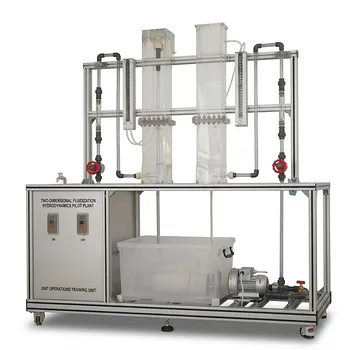
Two-Dimensional Fluidization Hydrodynamics Educational Pilot Plant for Unit Operations Training

Two-Dimensional Fluidization Hydrodynamics Educational Pilot Plant for Unit Operations Training

Explore gas-solid and liquid-solid fluidization hydrodynamics with our transparent 2D educational pilot plant. Ideal for chemical engineering unit operations labs, it demonstrates fixed to fluidized bed regimes, measures pressure drop, and integrates QR-code digital learning for enhanced student training.

Bernoulli Equation Demonstration Unit Operations Pilot Plant

Bernoulli Equation Demonstration Unit Operations Pilot Plant

Laboratory pilot plant for Bernoulli's equation demonstration with transparent PVC pipes, 23 piezometer tubes for pressure measurement, and hands-on experiments. Designed for engineering education to study energy conservation, hydraulic grade line, and localized losses in fluid steady-flow systems.

Multi Functional Catalytic Reaction and Reactor Evaluation Educational Unit Operations Pilot Plant

Multi Functional Catalytic Reaction and Reactor Evaluation Educational Unit Operations Pilot Plant

Bench-scale educational pilot plant for catalytic reaction and reactor evaluation, integrating fixed bed, fluidized bed, and stirred tank reactors. Students compare reactor designs, evaluate catalysts, and study reaction kinetics and hydrodynamics. Perfect for unit operations labs in chemical engineering curricula.

Multi-Reactor Educational Pilot Plant for Reaction Engineering Unit Operations

Multi-Reactor Educational Pilot Plant for Reaction Engineering Unit Operations

Integrated bench-scale educational pilot plant for chemical engineering teaching featuring fixed bed fluidized bed and stirred tank reactors with web-based digital twin controls and safety interlocks for hands-on unit operations and reaction engineering comparative studies in one compact system.

Orifice and Venturi Flowmeter Calibration Educational Pilot Plant for Fluid Mechanics Laboratory

Orifice and Venturi Flowmeter Calibration Educational Pilot Plant for Fluid Mechanics Laboratory

Enhance fluid dynamics education with the Orifice and Venturi Flowmeter Calibration Educational Unit Operations Pilot Plant, featuring transparent orifice and Venturi meters, industrial sensors, touchscreen interface for real-time data analysis and automatic coefficient calculations in engineering student laboratories.

Methanol Synthesis and Catalyst Performance Evaluation Educational Unit Operations Pilot Plant

Methanol Synthesis and Catalyst Performance Evaluation Educational Unit Operations Pilot Plant

Bench-scale methanol synthesis and catalyst evaluation educational pilot plant for chemical engineering labs to study catalytic kinetics, high-pressure operations, process control, and unit operations under realistic conditions with industrial safety features, precision gas delivery, data acquisition, and intelligent monitoring.

Two Phase Flow Pattern Velocity Resistance Measurement Educational Pilot Plant

Two Phase Flow Pattern Velocity Resistance Measurement Educational Pilot Plant

Benchtop educational pilot plant for university labs studying gas-liquid two-phase flow patterns, velocity, and resistance across circular, square, and rectangular conduits. Features 15.6-inch touchscreen, 5G connectivity, differential pressure sensors, safe water-air operation. Supports chemical engineering curricula.

Constant Pressure Filtration Educational Unit Operations Pilot Plant

Constant Pressure Filtration Educational Unit Operations Pilot Plant

Hands-on educational pilot plant for constant pressure filtration. Classic plate and frame filter press allows students to study kinetics, determine specific cake resistance, perform cake washing and evaluate washing rates. Ideal for chemical engineering curriculum. Mobile, customizable, safety-compliant design.

Centrifugal Pump Performance and Orifice Flowmeter Calibration Educational Pilot Plant

Centrifugal Pump Performance and Orifice Flowmeter Calibration Educational Pilot Plant

This versatile educational pilot plant enables engineering students to conduct centrifugal pump performance tests, orifice flowmeter calibration, and fluid mechanics experiments using a transparent flow loop, industrial HMI, and 3D virtual simulation for a comprehensive hands-on learning experience.

Fixed Bed Gas Solid Catalytic Reaction Educational Pilot Plant

Fixed Bed Gas Solid Catalytic Reaction Educational Pilot Plant

Fixed-bed gas-solid catalytic reaction unit operations pilot plant for chemical engineering education. Features split-furnace, mass flow controllers, PID control, safety interlocks. Ideal for heterogeneous catalysis, reactor dynamics, catalyst evaluation studies. Fully customizable configurations for university laboratories and academic research.

Fixed-Bed Chemical Reaction and Gas Dust Tar Removal Unit Operations Pilot Plant

Fixed-Bed Chemical Reaction and Gas Dust Tar Removal Unit Operations Pilot Plant

Integrated educational pilot plant for studying catalytic gas-solid reactions and downstream gas purification. Features dual fixed-bed reactor, three-stage heating, and touchscreen control for hands-on engineering training. Ideal for chemical and environmental engineering curricula.

Comprehensive Fluid Mechanics Educational Unit Operations Pilot Plant

Comprehensive Fluid Mechanics Educational Unit Operations Pilot Plant

Hands-on fluid mechanics pilot plant for engineering education covering over 13 principles including pipe flow, minor losses, flowmeter calibration, and pump performance with industrial-grade components, smooth and rough piping, venturi and orifice flowmeters, and centrifugal pump testing and analysis.

Dual-Mode Rectification Pilot Plant for Practical Training Unit Operations

Dual-Mode Rectification Pilot Plant for Practical Training Unit Operations

Industrial-scale dual-mode rectification pilot plant for chemical engineering practical training. Features real-material and simulated-material operation modes, sieve-plate column with sight glasses for visual observation of hydrodynamics, and customizable SCADA control for safe, hands-on learning of unit operations and mass transfer.

Micro-Scale Gas-Solid Catalytic Reaction Educational Pilot Plant

Micro-Scale Gas-Solid Catalytic Reaction Educational Pilot Plant

Explore heterogeneous catalysis with this micro-scale gas-solid catalytic reaction educational pilot plant. Designed for university labs, it enables hands-on study of reaction kinetics and transport phenomena in a benchtop packed bed reactor with high-precision flow control and touchscreen automation.

Residence Time Distribution and Reactor Flow Characteristics Determination Educational Pilot Plant

Residence Time Distribution and Reactor Flow Characteristics Determination Educational Pilot Plant

This versatile educational pilot plant is designed for comprehensive study of residence time distribution and reactor flow characteristics, featuring multiple CSTRs in series, a tubular reactor, variable recycle loop, and automated real-time data acquisition, perfect for hands-on chemical engineering education.

Gas Phase Mixing and Residence Time Distribution Determination Educational Unit Operations Pilot Plant

Gas Phase Mixing and Residence Time Distribution Determination Educational Unit Operations Pilot Plant

Integrated lab system for gas-phase mixing and RTD determination. Supports pulse and step tracer methods with dual CSTR and PFR reactors, industrial components, and PC data logging. Provides hands-on study of non-ideal flow and reactor behavior for university students.

Tubular Reactor Flow Characteristics Determination Educational Unit Operations Pilot Plant

Tubular Reactor Flow Characteristics Determination Educational Unit Operations Pilot Plant

Educational pilot plant for investigating tubular reactor flow characteristics and residence time distribution Features adjustable recycle for plug flow and backmixing studies industrial touchscreen interface and real-time data acquisition Ideal for chemical engineering unit operations laboratory training and education

High-Gravity Emulsification and Mass Transfer Educational Pilot Plant

High-Gravity Emulsification and Mass Transfer Educational Pilot Plant

This integrated educational pilot plant utilizes rotating packed bed technology to demonstrate high-gravity emulsification and mass transfer, providing engineering students with hands-on experience in process intensification and unit operations through a modular, customizable design with digital monitoring.


Leave Your Message