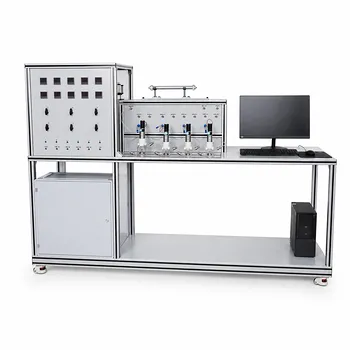
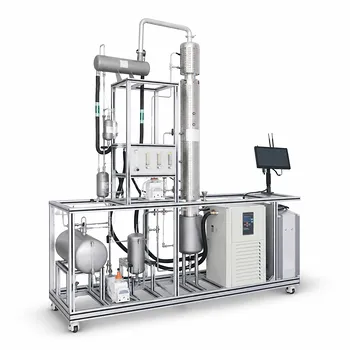
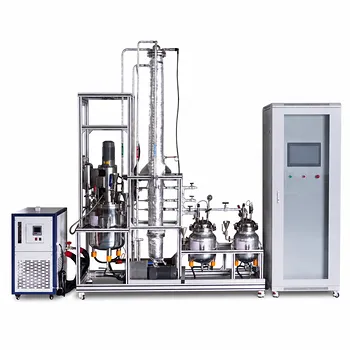
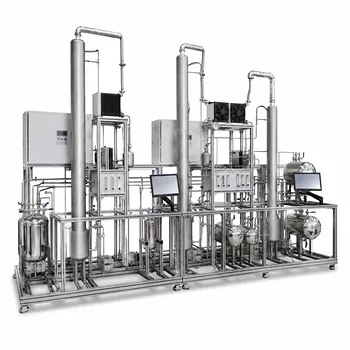
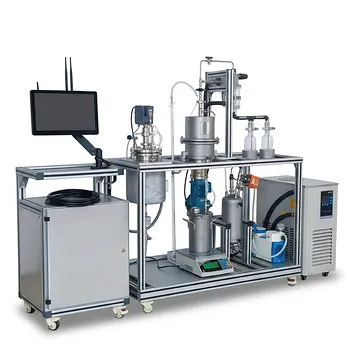
Boosting esterification yield past equilibrium limits requires a precisely integrated closed-loop system. The configuration centers on a continuous stirred tank reactor (CSTR) fitted with a fractionating column and a downstream pervaporation (PV) unit. In practice, the fractionating column continuously strips water and ethanol from the reacting mixture—the ethanol stream is then dehydrated by the pervaporation membrane, and the purified alcohol is recycled directly back into the CSTR to sustain the reaction without wasting solvent.
To defeat the thermodynamic ceiling of esterification, a CSTR-distillation-pervaporation hybrid continuously removes both reaction products. Distillation strips the volatile water‑ethanol mixture; a hydrophilic pervaporation membrane selectively removes the water, letting dry ethanol return to the tank—shifting equilibrium and raising conversion far beyond what a standalone reactor can achieve.
The Core Configuration
The physical layout is straightforward but carefully orchestrated. A CSTR holds the reaction mass (acid, alcohol, catalyst), and a side-stream or overhead vapor line feeds a fractionating column.
The Fractionating Column’s Role
The column operates like a distillation unit tuned to the reaction’s volatile by‑products. It continuously removes both water and ethanol from the reactor environment, preventing them from accumulating and slowing the forward esterification.
The Pervaporation Polishing Step
The column’s overhead vapor is a water‑ethanol mixture. Instead of condensing and discarding it, the stream is sent to a hydrophilic pervaporation membrane module (often PVA/PES composite). Water selectively permeates through the membrane, and the dehydrated ethanol retentate is recycled to the CSTR.
Closed‑Loop Solvent Management
This recycle loop is what makes the system “green” and economically attractive. Ethanol acts both as a reactant and as an azeotropic water‑removal agent; recovering it via pervaporation avoids constant solvent makeup and minimizes waste.
Why a Hybrid System Is Necessary
Esterification is an equilibrium‑limited reaction. In a simple batch or CSTR, water produced by the reaction builds up and rapidly halts conversion—often below 75%. Physical removal of water is the only way to push past that barrier.
Le Chatelier in Practice
By continually extracting water (and, in this case, excess ethanol), the system shifts the equilibrium forward according to Le Chatelier’s principle. The result is a conversion boost that can exceed 90%, as seen when acetic or succinic acid is esterified.
The Ethanol–Water Azeotrope Problem
Simple distillation cannot break the ethanol–water azeotrope at ambient pressures. Pervaporation solves this by bypassing vapor‑liquid equilibrium, allowing selective water removal without boiling the entire overhead stream again. This is why distillation alone would limit conversion—you’d lose ethanol as part of the azeotrope.
Process Intensification in Pilot Plants
The configuration demonstrates reactive separation—the marriage of reaction and separation in one loop. For pilot‑scale educational or bioprocess research, it teaches advanced process intensification: simultaneous reaction, distillation, and membrane separation that cuts energy use and boosts throughput.
Understanding the Mechanism in Detail
The Reaction: Succinic Acid to Diethyl Succinate
In the primary reference’s example, bioprocess‑derived succinic acid is esterified with ethanol. As diethyl succinate and water form, the mixture is continuously vaporized into the fractionating column.
Inside the Column
Trays or packing provide intimate contact, enriching the vapor in the lower‑boiling water–ethanol mixture. The bottom product, rich in ester, stays in the reactor loop. The overhead vapor is a near‑azeotropic ethanol–water mixture—still containing valuable ethanol.
Membrane Dehydration
The vapor permeates a hydrophilic membrane. Water molecules dissolve into the membrane and diffuse rapidly, while ethanol is largely rejected. The dry ethanol stream, now >99% pure, is condensed and returned to the CSTR. This continuous recycling ensures the alcohol‑to‑acid ratio stays high without diluting the reaction.
Practical Conversion Gains
Reference data shows a similar pervaporation‑assisted system lifted butyric acid conversion from 71.6% to nearly 93%. For succinate esters, the same principle applies: water removal by membrane breaks the equilibrium limit.
Understanding the Trade-offs
Membrane Fouling and Lifetime
The pervasive issue is fouling. Even minute amounts of high‑boiling organics or polymers can coat the membrane, reducing water flux. Regular cleaning or guard beds before the module is often necessary.
Energy Demand
While pervaporation avoids vaporizing the entire retentate, the vacuum pump and condenser on the permeate side still consume significant energy. The distillation column’s reboiler also adds heat duty. However, the integrated heat management (using reaction heat for distillation) can partially offset this.
Capital Complexity
Adding a column and membrane skid to a pilot‑scale CSTR raises capital cost and control complexity. Temperature, pressure, and reflux ratios must be tightly coordinated to avoid flooding the membrane or starving the reactor.
Sensitivity to Water Content
Pervaporation flux drops as the feed becomes drier. Designers must balance the column’s overhead composition to stay within a range where the membrane remains efficient—typically 5–20% water.
Making the Right Choice for Your Process
Your decision to adopt this hybrid configuration depends on your specific goals: maximizing conversion, minimizing waste, or demonstrating advanced process intensification.
- If your primary focus is maximizing conversion: Prioritize the membrane’s water removal capacity. Ensure the column’s overhead quality is tuned to deliver a water content that keeps the pervaporation module in its high‑flux region. This will push ester yields well past 90%.
- If your primary focus is reducing solvent waste and life‑cycle cost: The closed‑loop ethanol recycle is indispensable. Even a smaller membrane area can be justified by the savings from not purchasing and disposing of fresh ethanol.
- If your primary focus is educational demonstration or research: This configuration is a powerful teaching tool. Coupling a CSTR, distillation, and pervaporation in a single pilot plant shows students how hybrid processes break thermodynamic barriers—ideal for curriculum on green chemistry and process intensification.
- If your primary focus is process simplicity: Start with azeotropic distillation (using an entrainer) if membrane maintenance is a concern. The hybrid approach is superior in solvent recovery, but an entrainer-based system can be easier to operate in the short term.
Ultimately, the CSTR-distillation-pervaporation hybrid turns the pesky water byproduct into a lever for complete conversion, illustrating in a single pilot‑plant loop exactly how intelligent separation design rewrites the rules of equilibrium.
Summary Table:
| System Component | Key Function | Main Advantage | Primary Challenge |
|---|---|---|---|
| CSTR | Holds reactants (acid, alcohol, catalyst) | Continuous, stirred reaction environment | Heat management & control |
| Fractionating Column | Strips water & ethanol from reaction | Shifts equilibrium forward (Le Chatelier) | Column flooding risk |
| Pervaporation Module | Selectively removes water via membrane | Bypasses ethanol-water azeotrope | Membrane fouling & lifetime |
| Recycle Loop | Returns dehydrated ethanol to CSTR | Reduces solvent waste & operating costs | High system complexity |
Optimize Your Bioprocess Operations with LABPARK
Are you looking to demonstrate advanced process intensification or scale up your esterification reactions? LABPARK provides state-of-the-art Educational and Vocational Unit Operations Pilot Plants in chemical engineering, bioprocess & biotech, and environmental & water treatment.
Designed specifically for universities, research institutes, and enterprises, our customizable pilot systems help you bridge the gap between theory and industrial practice.
Contact our engineering experts today to find the perfect configuration for your research or training lab!
Related Products
- Multi-Stage Stirred Tanks in Series Residence Time Distribution and Mixing Performance Determination Educational Pilot Plant
- Residence Time Distribution and Reactor Flow Characteristics Determination Educational Pilot Plant
- Gas Phase Mixing and Residence Time Distribution Determination Educational Unit Operations Pilot Plant
- Continuous Sieve-Plate Distillation Pilot Plant for Unit Operations Laboratory Education
- Continuous Batch Extractive Distillation Educational Pilot Plant
People Also Ask
- How does MRF model impeller rotation in CFD? Key Boundary Conditions Explained
- How can a CSTR pilot plant demonstrate reactor staging? Visualize volume savings.
- How does steady-state multiplicity affect the operation and safety of exothermic reactions within a CSTR pilot plant? - Guide
- What parameters to monitor transitioning from Batch to CSTR? Master Pilot Plant Setup
- Why is temperature regulation via a cooling jacket a critical feature in CSTR pilot plants used for laboratory training?