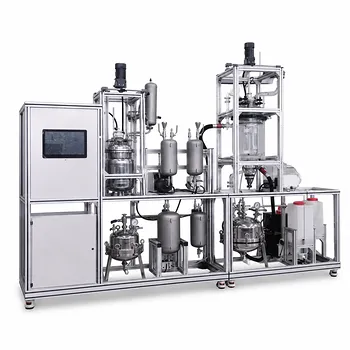
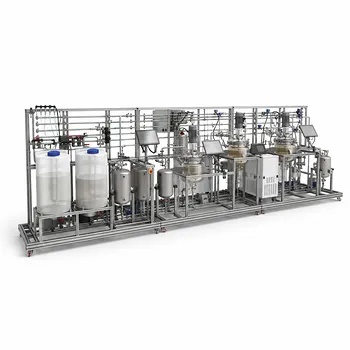
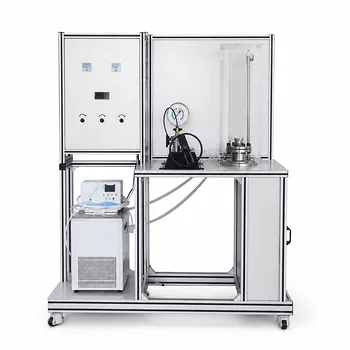
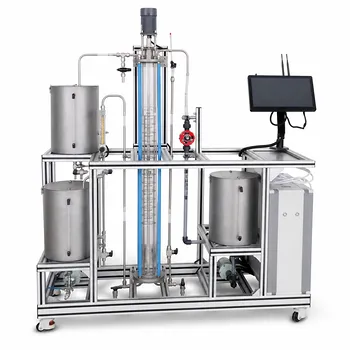
A Chemical Exposure Index (CEI) is applied to a unit operations pilot plant by methodically calculating the downwind hazard zone from a hypothetical toxic release, using accurate plant layout drawings, chemical toxicity data, and air dispersion modeling. This assessment is not a one-time compliance check but a predictive and comparative planning tool. It translates the complex interaction between a chemical's toxic properties, the plant's physical design, and a release scenario into a single, actionable radius of consequence, enabling you to layer in safety measures before a single drop of chemical is processed.
Pilot plants are inherently about exploring the unknown, which makes them uniquely hazardous. A CEI cuts through the uncertainty by quantifying "how far is far enough" during the design phase. It provides a systematic, evidence-based method to calculate exposure radii for equipment spacing and emergency planning, but you must recognize its core limitation: it assesses the hazard of the design, not the risk of the human operating it.
The Purpose of a CEI in a Pilot Plant Context
A pilot plant is a bridge between a laboratory beaker and a full-scale factory. It’s where theoretical chemistry meets physical reality, often for the first time. This means the hazards are less predictable than in established production.
Designing for the "First Time" Scenario
Unlike a production plant with established operating history, a pilot plant’s purpose is to generate that data. The CEI provides a pre-emptive safety envelope. It tells you the worst-case footprint of a toxic cloud if something goes wrong before you have the benefit of operational experience.
Quantifying the Safety Margin
The CEI replaces vague terms like "dangerous" with a concrete distance in meters or feet. This distance dictates everything from control room placement to the location of evacuation assembly points and off-site emergency notification zones. It gives a hard number to inform a "layers of protection" strategy.
The Essential Process: A Three-Phase Application
Applying a CEI to a pilot plant requires a structured, data-driven approach. It moves from gathering foundational information to running a model and, finally, interpreting the results to improve safety.
Phase 1: Gathering the Foundational Data
You cannot run a model without a complete and accurate inventory of what can leak and how toxic it is. This begins with the plant's blueprint.
- Accurate Plant Plans and Flowsheets are Your Starting Point. The process starts with a simplified but dimensionally accurate flowsheet. You need the exact geographic arrangement of all containment vessels, the routing and length of piping networks, and a complete inventory of the maximum quantity of each chemical present in the system. A sketch on a whiteboard won't work.
- Chemical and Toxicological Data Defines the Threat. This is the heart of the index. You must compile critical physical properties—such as boiling point, vapor pressure, and density—that dictate how a liquid becomes an airborne plume. Most critically, you need reliable toxicity metrics. This includes Emergency Response Planning Guidelines (ERPG) levels, or failing that, LC50 and LD50 data. The CEI’s output is only as credible as the toxicity figures you input.
Phase 2: Modeling a Plausible Worst-Case Scenario
With the data in hand, you conduct a source and dispersion analysis. The primary reference explicitly states this is where you calculate "the airborne quantity of chemical release scenarios to determine the risk zone."
- Define the Release Source. You must model specific, credible failure points such as a ruptured hose, a failed relief device, or a leak from a pump seal. The model calculates the rate at which the chemical becomes airborne, its temperature, and its vapor cloud formation.
- Calculate the Downwind Hazard Distance. The core output is the distance the plume travels downwind until its concentration falls below a toxic threshold (like the ERPG-3 limit). This is your hazard zone. It tells you if an elevated control room is inside the footprint or if a neighboring pilot-scale reactor would be engulfed.
Phase 3: Translating the Data into Safety Design
The final step closes the loop by using the calculated hazard radius to design controls, not just to draw circles on a plot plan. This directly aligns with the primary reference's goal: to "design engineering controls."
- Engineering Control Design. The calculated risk zone directly informs specifications for your engineering safeguards. The size and placement of emergency scrubber systems are validated against the release rate. The required flow rates for ventilation and air change frequencies in the lab are tuned to prevent a hazardous accumulation, and your emergency response plans are built around a timeline derived from this dispersion data, not guesswork.
- Equipment Spacing and Layout. The CEI's hazard distance provides a defensible rationale for equipment siting. It creates a "keep-out" radius between high-inventory toxic vessels and occupied areas, helping you physically protect operators and essential infrastructure.
Understanding the Trade-offs and Limitations
A CEI is a powerful compass, but it’s not a GPS. Relying on it exclusively creates a dangerous illusion of safety. The supplementary references are explicit about this critical shortcoming.
What a CEI Doesn't See
The methodology is, by design, focused on a piece of equipment failing. Index-based assessments are highly effective at identifying hazards related to equipment design and material storage. Their greatest advantage—being systematic and straightforward—is also their central weakness.
- The Human Factor Blind Spot. Pilot plants are run by students, researchers, and operators who are often learning. These assessments are not effective at identifying hazards from incorrect human operations or improper procedures. A CEI can assess a valve's potential to leak, but it cannot predict that an operator will inadvertently open the wrong valve during a shift change.
- The Procedural Gap. The index won’t flag risks from an unexpected operational deviation, such as a runaway reaction caused by a slightly incorrect catalyst charge. A CEI assumes a static inventory; it doesn't model the dynamic chaos of a process gone wrong. Pilot plant training must supplement these indices with rigorous standard operating procedures (SOPs).
The Need for a Broader Safety Management System
The CEI is best viewed as one tool within the five-step safety risk assessment framework for pilot plants: Risk Identification, Analysis, Evaluation, Control, and Reporting. After the CEI helps with risk analysis, you must bring in other methodologies to complete the picture. As the supplementary references suggest, a What-If analysis or a Hazard and Operability Study (HAZOP) can probe for the procedural errors that the CEI ignores, while a Layer of Protection Analysis (LOPA) can quantify if your emergency stop buttons and containment bunds are reliable enough to offset a toxic release frequency.
Making the Right Choice for Your Pilot Plant Goal
Your goal dictates how aggressively you apply the CEI and which supplementary analyses are non-negotiable. Use the bulleted guide below to determine your primary focus.
- If your primary focus is early-stage equipment procurement and layout: Use the CEI to compare a few design configurations. Calculate the hazard radius for different vessel sizes or chemical inventories. This allows you to select a layout that minimizes the inherent hazard from the start, before any equipment is bolted to the floor.
- If your primary focus is protecting students and researchers in an academic lab: Use the CEI as your foundational, non-negotiable screening tool to establish safe spacing and ventilation needs, but dedicate equal resources to rigorous SOP development and competency checks that directly address the index's human-factor blind spot.
- If your primary focus is meeting a broader safety analysis requirement for a new process: Integrate the CEI output directly into your Process Hazard Analysis (PHA). The CEI quantifies the "what" and "how far," which provides the critical input for a HAZOP team to then explore the "how" of procedural errors that could lead to that very release.
A Chemical Exposure Index is not the end of your safety analysis; it is its most empirical beginning, providing the hard data needed to design safety into the plant and clear the way for a meaningful discussion about the human systems that govern its operation.
Summary Table:
| CEI Application Phase | Key Focus Area | Deliverable / Safety Impact |
|---|---|---|
| Phase 1: Data Gathering | Collect plant flowsheets, chemical physical properties, and toxicity data (ERPG). | Establishes the foundational chemical hazard inventory. |
| Phase 2: Plausible Modeling | Simulate release scenarios (e.g., pipe rupture) & calculate downwind plume travel. | Quantifies the physical footprint of the hazard zone. |
| Phase 3: Safety Design | Size emergency scrubbers, plan ventilation, and establish safe equipment spacing. | Translates dispersion calculations into physical layout controls. |
| Crucial Limitation | Identify human errors, catalyst runaway risks, or operational procedural mistakes. | Must be paired with HAZOP/LOPA to cover human factors. |
Design a Safer, High-Performance Pilot Plant with LABPARK
Transitioning from lab scale to pilot scale requires precise engineering and rigorous safety planning. At LABPARK, we design and manufacture high-quality Educational and Vocational Unit Operations Pilot Plants in chemical engineering, bioprocess & biotech, and environmental & water treatment.
We help universities, research institutes, and enterprises build pilot systems that prioritize operator safety, simplify hazard assessments, and ensure reliable scale-up data.
Ready to elevate your research and training facility safely?
👉 Contact LABPARK today to discuss your project requirements!
Related Products
- Multi-Functional Special Distillation Educational Pilot Plant
- Multi Functional Catalytic Reaction and Reactor Evaluation Educational Unit Operations Pilot Plant
- Gallium and Indium Selective Extraction Educational Pilot Plant
- General Purpose Cosmetics Production Unit Operations Training Pilot Plant
- Carbon Dioxide PVT Curve Determination Educational Unit Operations Pilot Plant
People Also Ask
- Why does simple distillation yield higher efficiency than flash distillation? Key thermodynamic differences.
- How does double temperature difference control improve distillation pilot plants? Stabilize purity.
- How to Estimate Distillation Pilot Plant Tray Efficiency? O'Connell's Correlation Guide
- How to Verify Distillation Boundary Lines & Composition Regions with Pilot Plants
- How Batch vs Continuous Configuration Affects Distillation Pilot Plant Versatility & Footprint