Ignoring vapor-phase non-idealities like acid dimerization is one of the fastest ways to turn a carefully planned pilot plant campaign into a scale-up nightmare.
When polar carboxylic acids are present, molecules do not behave as independent, ideal-gas entities. They pair up through strong hydrogen bonds, forming dimers that dramatically reduce the mixture’s effective vapor pressure. In a pilot-plant distillation or absorption column, this directly distorts the vapor-liquid equilibrium (VLE) predictions that underpin every design calculation—from theoretical stages and reflux ratio to heat duties. Models that neglect this behavior produce unreliable pilot data, corrupting the very scale-up factors the facility exists to generate.
The core issue is that vapor-phase association of carboxylic acids reduces fugacity coefficients far below unity, even at low pressures. This makes the ideal-gas assumption useless. Without a model that explicitly accounts for dimerization, your pilot plant will generate data that either forces wasteful over-design or, worse, leads to an industrial column that never meets its purity or capacity targets.
The Hidden Driver of Non-Ideal Vapor Behavior
Why Carboxylic Acids Don’t Play by the Rules
Carboxylic acids—acetic, propionic, and their homologues—form strong intermolecular hydrogen bonds.
In the vapor phase, these bonds create stable dimers that effectively act as a new, less volatile chemical species.
As a result, the fugacity coefficient of the monomer drops well below 1.0, even at atmospheric pressure and temperatures up to 140°C.
An equilibrium mixture of monomer and dimer exerts a lower total pressure than an ideal gas would, meaning the acid is “held back” in the liquid phase more than simple volatility (Raoult’s law) would suggest.
The Direct Cascade from VLE to Column Design
All distillation sizing hinges on accurately knowing the relative volatility (α) between key components.
When acid dimerization is ignored, vapor-phase compositions are calculated incorrectly: the model predicts the acid is more volatile than it really is.
This error cascades through every design decision:
- Number of theoretical stages: A small error in α can produce a 33% or greater deviation in tray count, as seen in close-boiling systems.
- Reflux ratio and energy consumption: The operator may set an incorrectly high reflux to compensate, wasting steam and cooling water.
- Feed tray location: A shifted composition profile puts the feed point at the wrong height, limiting achievable separation.
The pilot plant then becomes a validation of a flawed model, not a predictive tool for industrial scale.
The Cost of Getting It Wrong in Pilot Plants
Over-Design: The Traditional, Expensive Bandage
Historically, designers used shortcut methods (Fenske–Underwood–Gilliland) and then simply added extra stages, oversized reboilers, and increased reflux to be safe.
This brute-force approach hides the thermodynamic ignorance but destroys the pilot plant’s purpose: to optimize an economic, right-sized industrial unit.
A pilot column that operates with a design safety factor of 50% tells you nothing about the true minimum energy requirement.
Worse, it can mask phenomena like azeotrope formation or pinch points that may appear under real, tighter conditions.
Lost Fidelity in Scale-Up
Capital cost of a separation column varies roughly with (ln α)^-1.
Near difficult regions—low relative volatility, azeotropes, or infinite dilution—a small error in α balloons into a large capital estimation error.
When your pilot plant is supposed to deliver the α value used for final design, ignoring vapor-phase dimerization means the fundamental data you feed to Aspen or gPROMS is physically erroneous.
The result: an industrial column that is either grossly oversized or, more dangerously, undersized and unable to meet specification.
The Thermodynamic Toolkit You Must Use
Moving Beyond Ideal Gas and Simple Activity Models
Standard activity-coefficient models (Wilson, NRTL, UNIQUAC) can handle liquid-phase non-idealities well.
But they become dangerous if the vapor phase is still treated as ideal.
To capture dimerization, you must couple a liquid-phase model with a vapor-phase association correction.
One widely used approach is the Kretschmer–Wiebe method, which introduces a dimerization equilibrium constant (K) and solves for the true monomer/dimer composition in the vapor.
Alternatively, equations of state modified for association—such as the Soave–Redlich–Kwong (SRK) or Peng–Robinson (PR) framed with Hayden–O’Connell correlation—correct the fugacity coefficients directly.
These models change the VLE envelope so that the acid’s apparent volatility drops.
In the pilot plant, this means the measured overhead and bottoms compositions will suddenly match simulation, and the observed temperature profile will align with the stage-by-stage calculation.
Selecting the Right Model for Your Pilot Plant
For binary systems with a carboxylic acid and a non-associating solvent (like propionic acid + methyl isobutyl ketone), incorporating chemical theory into the VLE calculation is non-negotiable.
Even at 1 atm, the error in K-values without dimer correction can exceed 20–40% for the acid component.
For multicomponent mixtures or systems that also exhibit azeotropes (e.g., acid + water + ester), the interaction is hierarchical.
You must first account for dimerization, then overlay the activity-coefficient model—otherwise the azeotrope’s composition and temperature will be mispredicted by several degrees and mass percent.
Understanding the Trade-offs
Model Complexity vs. Operational Simplicity
Advanced association models require pure-component dimerization constants and binary interaction parameters that are not always available in default databanks.
Regressing these parameters from pilot-plant data itself adds a layer of experimental burden and can confuse students or early-stage researchers.
There is a real temptation to use a simpler “pseudo-ideal” approach and then fudge the reflux ratio until the column works.
This practice, while expedient, produces pilot data that are specific to that particular column’s hydraulics and cannot be reliably reused for a different column diameter or tray type.
The Trap of Misinterpreting Experimental Data
When a pilot column unexpectedly achieves higher purity, a novice might conclude the thermodynamic model was “too conservative.”
In reality, the column may be benefiting from fortuitous dimerization that reduced vapor loading, or from liquid-phase association effects not present at full scale.
Conversely, a column that fails to meet spec under ideal-gas assumptions may be written off as mechanically flawed, when the only flaw was in the thermodynamic framework.
Understanding that dimerization is physically happening—and must be modeled—prevents you from chasing non-existent equipment problems.
Making the Right Choice for Your Pilot Plant Campaign
Your approach must hinge on the specific goal of the run and the nature of the mixture.
- If your primary focus is generating VLE data for process simulation: Use a model that explicitly incorporates vapor-phase association, such as Hayden–O’Connell with Wilson or NRTL. Validate the model’s dimerization constant against literature or separate headspace measurements. Never accept the default ideal-gas assumption in your process simulator.
- If your primary focus is demonstrating a separation in a teaching plant: Explicitly simulate the system with and without dimerization correction. Show the difference in predicted stage count and reflux ratio. This creates a powerful pedagogical moment that builds intuition about non-ideal thermodynamics.
- If your primary focus is troubleshooting a pilot column that won’t meet spec: Immediately check whether your VLE model accounts for acid dimerization. A quick switch to a corrected fugacity model often resolves mismatches between measured and simulated composition profiles.
- If your primary focus is scale-up economics: Obtain the most accurate α possible by fitting pilot-plant data to an association-corrected model. This minimizes the (ln α)^-1 cost penalty and ensures the final column is neither over- nor under-designed.
Precision in thermodynamics is not an academic luxury in the pilot plant—it is the difference between a scalable, profitable process and an expensive experiment that misleads the entire design team. Account for the dimer, and your column will tell you the truth.
Summary Table:
| Design Parameter / Impact | Ideal Gas Model (Ignored Dimerization) | Association-Corrected Model (HOC, etc.) |
|---|---|---|
| Relative Volatility ($\alpha$) | Overestimated (predicts acid is more volatile) | Accurately predicted (accounts for lower volatility) |
| Theoretical Stage Count | Underdesigned (potential 33%+ error in tray count) | Right-sized for actual separation requirements |
| Reflux Ratio & Energy | Incorrectly set, leading to wasted steam/water | Optimized for maximum efficiency and utility savings |
| Scale-Up Reliability | High risk of undersized/oversized industrial columns | High fidelity; accurate translation to commercial scale |
Optimize Your Process Scale-Up with LABPARK
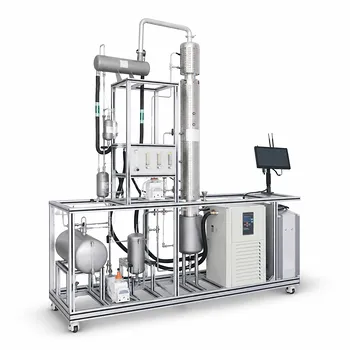
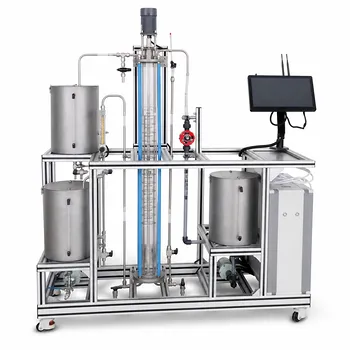
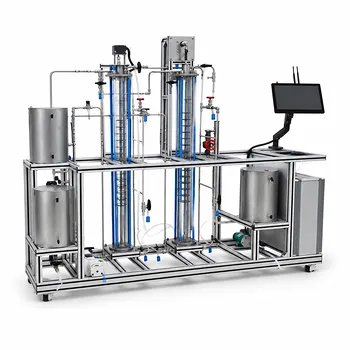
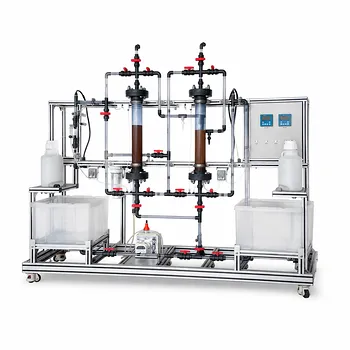
Bridging the gap between thermodynamic theory and industrial reality requires precise, reliable physical equipment. LABPARK provides advanced Educational and Vocational Unit Operations Pilot Plants in chemical engineering, bioprocess & biotech, and environmental & water treatment. Designed specifically for universities, research institutes, and enterprises, our pilot plants help you accurately validate VLE models, avoid costly over-design, and prepare students and researchers for real-world engineering challenges.
Ready to elevate your lab's capabilities? Contact our engineering experts today to find the perfect pilot plant solution for your facility!
Related Products
- Continuous Sieve-Plate Distillation Pilot Plant for Unit Operations Laboratory Education
- Multi-Functional Special Distillation Educational Pilot Plant
- Multi-Modal Distillation Unit Operations Training Pilot Plant
- Continuous Batch Extractive Distillation Educational Pilot Plant
- Dual-Mode Rectification Pilot Plant for Practical Training Unit Operations
People Also Ask
- How does catalyst water concentration affect distillation pilot plant design? Key separation train choices.
- What are the primary reflux ratio control strategies? Master Distillation Unit Operations
- Why is vacuum operation capability an essential feature for a distillation unit operations pilot plant? Unlock Efficiency
- How to select the right activity coefficient model (Wilson, NRTL, UNIQUAC) for distillation pilot plants?
- How can real-time carbon number prediction improve distillation pilot plants? Optimize control.