The short answer is that increased viscosity fundamentally alters the breakage mechanism. In a low-viscosity dispersed phase, droplet breakup is primarily a contest between turbulent shear and interfacial tension. When viscosity rises significantly, the droplet’s own internal resistance to deformation becomes the dominant stabilizing force. The external turbulent stress must now overcome the sum of both the interfacial tension stress and the internal viscous stress of the droplet.
The key insight for any chemical engineer scaling up a pilot reactor is this: For a high-viscosity dispersed phase, droplet breakage is not just harder—it requires a different energetic justification. You are no longer just stretching a droplet; you are mechanically deforming a viscous elastic body, which fundamentally changes the power requirements and the most effective mixer design.
The Established Mechanism: Low-Viscosity Droplet Breakage
In standard, low-viscosity liquid-liquid pilot operations, the physics are well-defined and predictable.
The Balancing Act of Shear and Tension
When the dispersed phase has negligible viscosity, the droplet’s stability hinges almost entirely on its interfacial tension. This force tries to maintain the smallest possible surface area.
Breakage occurs when the local turbulent eddies in the continuous phase generate enough kinetic energy. These fluctuating pressure differences must exceed the Laplace pressure that holds the drop together. It’s a straightforward energy balance.
The Pilot Reactor Implication
For these systems, mixing is relatively simple. The primary driver is the power per unit volume. High-speed impellers, properly baffled to convert swirling into turbulence, are your standard toolkit.
The goal is simply to generate a sufficient energy dissipation rate to overcome surface forces.
The High-Viscosity Mechanistic Shift: The Viscous Resistance Model
The entire operational logic changes once the dispersed phase becomes highly viscous. The droplet stops behaving like a liquid bag and starts behaving like a deformable, but stubbornly coherent, solid.
The Additive Stabilizing Forces
This is the critical concept for pilot-plant operation: Internal viscous stress acts as a secondary, and often dominant, stabilizing mechanism. A viscous drop resists the elongation required for breakage.
To pinch a droplet in two, the external turbulent stress (the disrupting force) must now fight a two-front war. It must satisfy both the interfacial tension force and the internal viscous resistance generated as the droplet changes shape. Ignoring the viscous term in your calculations will lead to a significant overestimation of droplet breakage.
The Direct Link to Impeller Speed and Shear
This has massive implications for your agitation system. The turbulent eddies must be smaller and more energetic to concentrate enough stress on a single droplet.
In a pilot reactor, this doesn’t just mean turning up the RPM. It means the impeller must produce high local shear rates. The energy must be targeted, because viscous dissipation within the droplet absorbs a huge portion of the energy before breakage can occur.
Understanding the Trade-offs and Practical Pitfalls
Applying the wrong mixing approach for a viscous dispersed phase in a pilot plant doesn't just reduce efficiency—it can actively defeat your unit operation. Several design choices become critical variables.
The Baffling Dilemma
Standard baffles are fantastic for boosting turbulence in low-viscosity systems. However, in high-viscosity mixing, they can create quiescent, poorly mixed zones where viscous material simply sits and stalls.
Close-clearance impellers (like anchor or helical designs) are often the correct choice here. Notably, these designs are rarely used with wall baffles, as the impeller itself sweeps the vessel, destroying bulk swirl without creating dead zones. Installing baffles with these impellers can drastically increase power draw without a proportional mixing benefit.
The Non-Newtonian Complication
Your pilot reactor might not just be dealing with a high-viscosity Newtonian fluid. Processes like polymerization often involve non-Newtonian rheology, where viscosity changes with shear rate.
This invalidates standard mixing equations instantly. An impeller spinning at high speed might locally shear-thin the fluid at the blade tip, while the bulk of the reactor remains unmixed and highly viscous. You cannot assume a single viscosity value for the entire vessel when modeling droplet breakage.
The Temperature Trap
Heating the system to lower viscosity is a common, but dangerous, tactic. The supplementary concept from oil-water separation applies directly here, especially for heavy oils.
While adding heat reduces the viscous resistance to droplet breakage, it can simultaneously reduce the density difference between your two liquid phases. This makes the subsequent separation stage notoriously difficult. In a pilot setup, you must map both the viscosity-temperature curve and the density-temperature curve to find the true process optimum, not just a lower viscosity.
Making the Right Choice for Your Pilot Reactor Goal
To effectively manage droplet breakage, you must align your operation with the physical reality of your dispersed phase.
- If your primary focus is breaking a low-viscosity dispersion under 5,000 cP: A high-speed impeller with wall baffles is your optimal path. Design your power input around overcoming the interfacial tension, using standard turbulent mixing correlations.
- If your primary focus is breaking a high-viscosity dispersion: You must re-target your energy. Switch to a close-clearance impeller to apply the high local shear needed, and recalculate your energy balance to account for the additive internal viscous stress resisting deformation.
- If your primary focus is a heat-sensitive or density-critical high-viscosity system: Prove the viability of mechanical mixing at the target temperature before relying on heating to lower viscosity. A pilot trial is essential to confirm you aren't solving a mixing problem by creating a separation one.
Ultimately, the droplet’s own viscosity redefines the challenge from a simple one-dimensional force balance to a complex rheological operation, demanding that your pilot reactor’s design and energy input match the physics inside every single drop.
Summary Table:
| Parameter | Low-Viscosity Dispersed Phase | High-Viscosity Dispersed Phase |
|---|---|---|
| Stabilizing Force | Interfacial tension (Laplace pressure) | Interfacial tension + Internal viscous stress |
| Breakage Mechanism | Turbulent shear deformation | Mechanical deformation of visco-elastic body |
| Recommended Impeller | High-speed impellers (with baffles) | Close-clearance impellers (anchor, helical, no baffles) |
| Key Energy Driver | Power per unit volume | Targeted high local shear |
Scale Up Your Liquid-Liquid Mixing Processes with Confidence
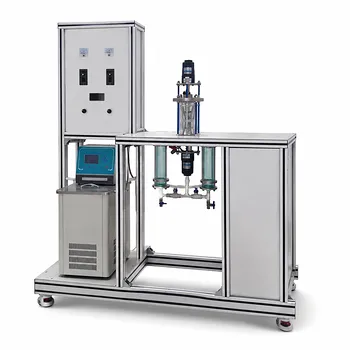
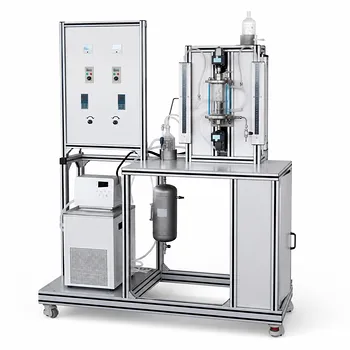
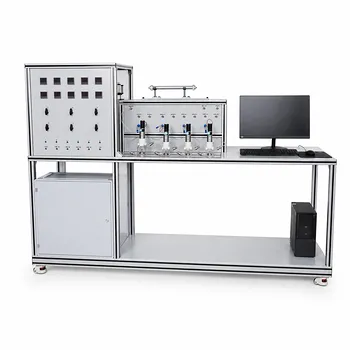
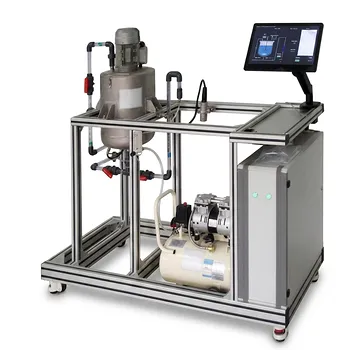
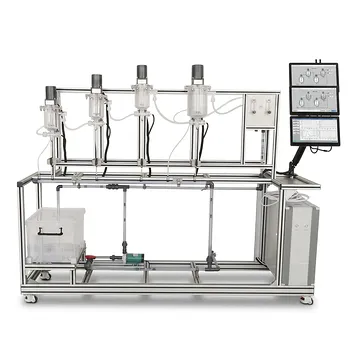
Optimizing droplet breakage for complex, high-viscosity fluids requires precise reactor design and control. LABPARK provides advanced Educational and Vocational Unit Operations Pilot Plants in chemical engineering, bioprocess & biotech, and environmental & water treatment.
We help universities, research institutes, and enterprises bridge the gap between theory and industrial scale-up by offering:
- Flexible Reactor Configurations: Easily test and compare close-clearance and high-speed impeller setups.
- Robust Process Control: Monitor and adjust shear rates, temperature, and power consumption with high accuracy.
- Hands-on Training & Research Platforms: Designed to meet rigorous academic curricula and industrial R&D requirements.
Ready to optimize your pilot operations and mixing efficiency? Contact us today to find the perfect pilot plant solution!
Related Products
- Comprehensive Liquid-Liquid Extraction Pilot Plant for Engineering Education
- Ternary Liquid-Liquid Equilibrium Educational Pilot Plant
- Fixed Bed Gas Solid Catalytic Reaction Educational Pilot Plant
- Multi-Reactor Educational Pilot Plant for Reaction Engineering Unit Operations
- Ethyl Acetate Synthesis Unit Operations Pilot Plant for Practical Training
People Also Ask
- How do pilot plants differentiate physical vs chemical extraction? Enhance Chemical Engineering Training
- How are ternary phase diagrams and LLE data applied in extraction experiments? Optimize Pilot Plant Scale-up
- In a liquid-liquid extraction pilot plant, how is a ternary-phase diagram utilized to determine solvent feed requirements?
- How to Validate BIPs for LLE Pilot Plants? Steps to Align Simulations with Reality
- How Do Selectivity & Distribution Coefficients Influence LLE Pilot Plant Solvent Choice?