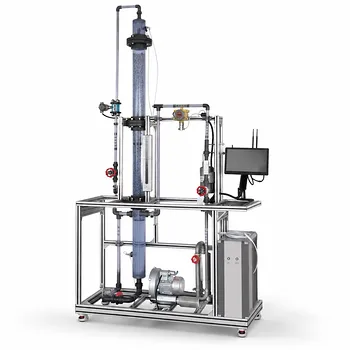
For students and researchers exploring immobilized biocatalysts, the choice of bioreactor can make or break an experiment. A Magnetically Fluidized Bed (MFB) reactor directly answers the core challenge: it prevents the physical destruction of fragile carrier beads, avoids lethal shear stress from impellers, and delivers the precise, stable environment needed to run continuous enzymatic or fermentation processes successfully.
The central insight is that an MFB reactor uses a magnetic field to gently suspend bio-carriers, eliminating the compaction and shear forces that plague traditional systems. This transforms a frustrating, failure-prone lesson into a reliable, data-rich exploration of immobilized cell and enzyme kinetics, making it an ideal teaching and research tool.
Why Traditional Reactors Fail Immobilized Bioprocesses
The value of an MFB reactor comes into sharp focus when we look at what goes wrong in fixed-bed and stirred-tank designs. Immobilized enzymes or cells are often encapsulated in delicate carriers—like alginate-chitosan beads—that cannot withstand the mechanical abuse they receive in standard pilot-plant equipment.
The Crushing Problem in Fixed Beds
In a packed column, the weight of the bed itself compresses these fragile beads over time. The soft biopolymer spheres deform, merge, and eventually clog the flow path, causing bed blockage and a dangerous pressure buildup. This not only halts the experiment but also teaches students the wrong lesson: that continuous immobilized processes are inherently unreliable.
The Shear Damage Trap in Stirred Tanks
Alternatively, a stirred-tank reactor swaps compaction for an equally damaging force: mechanical shear. The impeller blades tear cell walls and strip adsorbed enzymes from their supports. For an undergraduate lab, this means that after hours of careful preparation, the biological activity is literally shredded away, leaving only the frustrating need to troubleshoot a dead process.
How the MFB Reactor Solves These Challenges
An MFB bioreactor changes the physical environment entirely. By embedding a magnetic core into the bio-carrier beads and applying an external magnetic field, you can levitate and fluidize the particles without any moving parts or heavy bed compression.
Gentle, Non-Invasive Suspension
The magnetic field keeps each carrier bead in a loose, dancing suspension. There is no weight of a full bed pressing down, so carrier crushing is eliminated. There are no impeller tips to collide with cells, so shear damage is non-existent. Students can now observe that a continuous immobilized-cell fermentation can, in fact, run stably for extended periods—a fundamental lesson that was previously almost impossible to demonstrate.
Superior Mass Transfer Without the Sacrifice
Traditional thinking says you must choose between gentle handling and good mixing. The MFB refutes that trade-off. The steady, uniform fluidization creates excellent solid-liquid contact, eliminating the stagnant zones and channeling that limit nutrient delivery in fixed beds. This high mass-transfer efficiency directly supports healthier cells and more accurate kinetic measurements.
Unmatched Thermal and pH Homogeneity
The magnetic stabilization eliminates hot spots and local concentration gradients. Combined with external heating jackets and pH probes, this gives researchers near-ideal isothermal operation and precise environmental control. For an immobilized enzyme reaction that is exquisitely sensitive to pH, this uniformity means that every single bead in the reactor sees the same optimal conditions, removing a major source of data scatter.
Integrating MFB into a Pilot Plant Curriculum
Deploying this technology in a university pilot plant extends its benefits far beyond a single successful experiment. It becomes a platform for teaching advanced bioprocess concepts that are often left to theory.
A True Continuous-Process Learning Lab
Because the MFB reactor avoids blockages and activity loss, students can finally run real, long-duration continuous fermentations. They learn how to manage feed rates, harvest product streams, and achieve a steady-state metabolism—skills that are essential for industrial biotechnology but rarely practiced outside of sterile, single-use plastic systems.
A Model for Advanced Transport Phenomena
From a chemical engineering standpoint, the reactor is a living textbook example. The magnetic field stabilizes fluidization in a way that defies normal gravitational settling, allowing students to study the delicate balance between magnetic, drag, and buoyant forces. It illustrates how to decouple solids retention from fluid velocity, a concept with powerful implications for any catalyst-based process.
Understanding the Trade-offs and Practical Considerations
No reactor is a universal solution. The MFB’s benefits come with their own set of considerations that an objective technical advisor must highlight.
The Requirement for Magnetizable Carriers
The most immediate practical challenge is the carrier material itself. You must synthesize or purchase beads with a superparamagnetic core (like iron oxide nanoparticles) coated in the bio-friendly polymer. This introduces an upstream preparation step and an additional cost. However, for teaching and research, this is often seen as a valuable hands-on module in material science and encapsulation technique—not a deal-breaker.
Handling Attrition and Long-Term Stability
While magnetic suspension is gentle, particle-particle collisions can still cause slow attrition of the carrier coating over very long runs. This is markedly less severe than in a stirred tank, but researchers investigating catalyst longevity or precious metal-doped cells must factor it in. For a typical two-week university practical, this effect is negligible.
Making the Right Choice for Your Educational or Research Goal
The decision to include an MFB reactor in a pilot plant should be driven by what you most need your students or researchers to learn and achieve.
- If your primary focus is teaching robust continuous bioprocessing: An MFB reactor is your best option. It replaces the unreliability of packed beds with a system that actually works, allowing students to focus on metabolic and kinetic principles rather than troubleshooting mechanical failures.
- If your primary focus is research into immobilized enzyme kinetics: The MFB’s uniform temperature and mass-transfer environment minimizes experimental noise, giving you cleaner data to fit kinetic models and truly understand your catalyst’s intrinsic behavior.
- If your primary focus is advanced reactor engineering demonstrations: The ability to visualize fluidization stabilized by an invisible field makes the MFB a uniquely powerful pedagogical tool for fluid dynamics, transport phenomena, and process control.
- If your primary focus is minimizing upfront material complexity: A simplified fixed-bed or a very low-shear stirred design might seem more straightforward, but be prepared for the associated failure modes. Only choose this path if your curriculum prioritizes teaching the challenges of traditional systems over demonstrating a working solution.
An MFB reactor does not just make a reaction possible—it makes the underlying science visible, turning a stubborn operational problem into a captivating educational moment.
Summary Table:
| Reactor Type | Shear Stress | Bed Compression | Mass Transfer | Ideal For |
|---|---|---|---|---|
| Packed Bed | Low | High (Risk of clogging) | Moderate (Channeling) | Rigid, robust catalysts |
| Stirred Tank | High (Damages carriers) | None | High | Soluble enzymes & robust cells |
| MFB Reactor | Very Low (Gentle suspension) | None | Excellent (Uniform) | Delicate immobilized cells & enzymes |
Elevate Your Bioprocess Lab with LABPARK
LABPARK provides state-of-the-art Educational and Vocational Unit Operations Pilot Plants in chemical engineering, bioprocess & biotech, and environmental & water treatment for universities, research institutes, and enterprises.
Whether you are teaching advanced transport phenomena or conducting cutting-edge immobilized cell research, our custom pilot plants deliver the precision, stability, and reliability your lab needs.
Ready to enhance your teaching and research capabilities? Contact LABPARK today to discuss your pilot plant requirements!
Related Products
- Multi-Reactor Educational Pilot Plant for Reaction Engineering Unit Operations
- Multi Functional Catalytic Reaction and Reactor Evaluation Educational Unit Operations Pilot Plant
- Fluidized Bed Gas Solid Catalytic Reaction Educational Pilot Plant
- Micro-Scale Gas-Solid Catalytic Reaction Educational Pilot Plant
- Fixed Bed Gas Solid Catalytic Reaction Educational Pilot Plant
People Also Ask
- How do reactor pilot plants define QbD design space? Master chemical process scale-up.
- When configuring a reactor unit operations pilot plant for highly exothermic reactions, how to prevent thermal runaway?
- How do metal ion-catalyzed reaction mechanisms inform chemical engineering pilot plant design? From kinetics to scale-up
- What role do educational pilot plants play in scaling green chemistry? Bridging the Lab-to-Industry Gap
- What are the barriers to process intensification & how do pilot plants help?