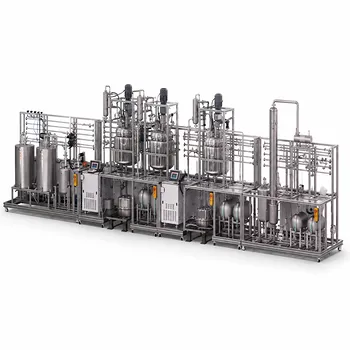
The classification of a pilot plant system as open, closed, or isolated is not a textbook label—it is the decisive factor that determines how you measure, control, and optimize every single process. Whether you are operating a continuous water filtration unit or a batch chemical reactor, the system’s boundary with its surroundings dictates which mass and energy flows you must monitor, which balance equations you apply, and where you place your sensors to guarantee both safety and performance. Without this clarity, your data is meaningless and your control strategy is built on sand.
The thermodynamic identity of each unit operation defines the rules of engagement for monitoring and control. Open systems demand flow-based enthalpy balances and dynamic sensor networks; closed systems rely on internal energy changes and precise heat measurement; isolated systems are an idealized guide for insulation and storage that remind us that every real plant leaks energy.
The System Boundary: Your Operational Foundation
Open Systems: The Realm of Continuous Flow
Open systems exchange both mass and energy across their boundaries. This describes the majority of continuous unit operations in chemical engineering and water treatment pilot plants—distillation columns, continuous stirred-tank reactors (CSTRs), absorbers, and membrane filtration skids.
In these units, feedstock enters and product leaves continuously. Heat is added or removed through jackets, and work is transmitted by pumps or compressors. Monitoring must capture dynamic flow rates, inlet/outlet temperatures, and composition changes in real time. Every sensor is chosen to quantify a specific crossing of the boundary—be it a mass flow meter or a thermocouple on the feed line.
Closed Systems: Mastering the Batch Cycle
A closed system exchanges energy but not mass. This is the classic batch reactor during its reaction phase, or a sealed mixing tank where heat is applied while no material enters or leaves.
Here, the focus shifts entirely to internal energy accumulation and heat transfer. The vessel wall becomes the critical boundary. As an operator, you need to measure jacket temperature, internal temperature profile, and pressure, but you need not track influent or effluent streams. The objective is to track the state of a fixed inventory, ensuring the reaction proceeds safely to completion.
Isolated Systems: The Practical Ideal
An isolated system exchanges neither mass nor energy. True isolation is impossible in a working pilot plant, but it serves as a powerful benchmark. A heavily insulated thermal storage vessel or a Dewar flask approximates this condition, teaching you what thermal efficiency could be if all losses were eliminated.
By comparing the behavior of your well-insulated tank to the isolated ideal, you can calculate heat loss rates and validate insulation performance. It’s a diagnostic tool, not a permanent operating state.
From Classification to Monitoring: Choosing the Right Instrumentation
Sensor Selection Guided by Thermodynamic State
The system type dictates which physical quantities are primary and where sensors must be placed. In an open continuous distillation column, you must install differential pressure transmitters across trays, thermocouples at multiple stages, and a reflux flow meter—all to capture the mass and energy flows that define separation efficiency.
In a closed batch reactor, the emphasis shifts to internal temperature homogeneity and heat transfer. You might use a multipoint thermocouple assembly and a jacket flow meter, but you do not spend capital on inlet composition analyzers that would see zero flow.
The Role of Process Analytical Instruments
Process analyzers fall into four categories—physical property, electrochemical, combustion, and spectroscopic—and their deployment must match the thermodynamic class. An open wastewater filtration pilot plant will likely require online turbidity (physical property) and pH (electrochemical) probes on both the feed and permeate lines to validate mass removal efficiency across the boundary.
In a closed batch chemical reaction, you might rely on spectroscopic probes (like Raman) immersed in the vessel to monitor species concentration in real time, avoiding the need to extract samples that would violate the closed mass boundary. The system classification thus directly influences the analytical dimension you must prioritize.
Using Thermodynamic Databanks to Predict Behavior
Before you even install a sensor, you can predict the energy requirements of your pilot plant using thermodynamic databanks. These tools store standard enthalpy of formation (ΔfH°), standard entropy (S°), and temperature-dependent heat capacities (Cp = A + BT + CT² + DT⁻²).
For an open reactor at constant pressure, you integrate Cp data to calculate enthalpy changes (ΔH) and plan the cooling duty. For a closed batch vessel, you compute internal energy changes (ΔU) using Cv. This predictive step is essential to size utilities and avoid thermal runaway before your first experiment.
The Calculation Engine: Mass and Energy Balances
Closed System Balances: Tracking Internal Energy (Q = ΔU)
When no mass crosses the boundary, the first law simplifies: heat added to the system equals the change in internal energy (Q = ΔU). For a constant-volume batch reactor, ΔU is calculated by integrating the constant-volume heat capacity (Cv) over the temperature change.
This focuses your monitoring on heat transfer calibration. If your sensor data shows a ΔT that doesn’t match the calculated Q, you’ve identified a heat loss problem or a miscalibrated heater. The closed system assumption makes these diagnostics brutally clear.
Open System Balances: The Enthalpy Perspective (Q = ΔH)
Open systems operating at steady state and constant pressure move to enthalpy balances. The heat added equals the change in enthalpy (Q = ΔH = n·ΔĤ), which integrates the constant-pressure heat capacity (Cp) across inlet and outlet streams.
This means your monitoring system must log flow rates, pressures, and temperatures at all entry and exit points simultaneously. Any imbalance in the enthalpy calculation immediately signals a leak, an unaccounted side reaction, or a faulty flow meter—direct root causes that you can investigate.
Bridging the Gap with Maxwell Relations
Properties like entropy (S) and internal energy (U) cannot be directly measured by off-the-shelf sensors. Maxwell relations bridge this gap by expressing these non-measurable properties in terms of pressure (P), temperature (T), and volume (V).
When you operate a compressor, a reactor, or a distillation column, you apply these relationships to compute entropy changes and confirm that your process is not approaching an unsafe operational spinodal limit. This mathematical bridge turns raw sensor data into a full thermodynamic audit.
Understanding the Trade-offs
The Cost of Precision
Classifying every sub-system accurately is demanding. You might need two sets of sensors and safety logics for a process that switches from a closed heating phase to an open draining phase. The capital cost and training complexity increase. Always weigh whether an analytical boundary is operationally distinct before imposing a separate control strategy.
The Danger of Perfect Isolation
Treating a real vessel as an isolated system can be dangerous. If you ignore minor heat leaks because “it’s almost adiabatic,” you risk under-sizing relief systems or overestimating thermal efficiency. Use the isolated ideal only as a baseline for deviation analysis, never as a design assumption for safety-critical equipment.
Measurement vs. Inference
Over-reliance on thermodynamic databanks and Maxwell relations can mask sensor drift or model inaccuracies. Always cross-validate computed enthalpy changes with at least one direct physical measurement, such as a calorimetric heat balance, to catch errors before they propagate into control decisions.
Making the Right Choice for Your Goal
- If your primary focus is process efficiency and utility sizing: Treat every continuous unit as an open system and build rigorous enthalpy balances around Cp integration and flow measurements. The accuracy of your cooling water and steam demand predictions depends on it.
- If your primary focus is safety and runaway prevention: Identify every closed vessel and apply internal energy tracking with redundant temperature sensors. The Q = ΔU relationship is your simplest and most robust alarm trigger.
- If your primary focus is research and fundamental understanding: Exploit Maxwell relations and phase stability criteria to probe the limits of your process. Map out the spinodal surface and use real-time data to visualize where your system sits between stable and unstable states.
When you honor the boundary, the boundary reveals the truth—your pilot plant transforms from a collection of equipment into a transparent, controllable, and profoundly informative system.
Summary Table:
| System Type | Mass Exchange? | Energy Exchange? | Key Monitoring Focus | Pilot Plant Examples |
|---|---|---|---|---|
| Open | Yes | Yes | Dynamic flow rates, inlet/outlet enthalpy | Distillation columns, CSTRs, membrane skids |
| Closed | No | Yes | Internal energy (Q = ΔU), pressure, temp | Batch reactors, sealed mixing vessels |
| Isolated | No | No | Heat loss rates, insulation diagnostics | Dewar flasks, thermal storage vessels |
Elevate Your Practical Training and Research with LABPARK
Applying thermodynamic principles to physical systems requires precise, reliable equipment. LABPARK designs and manufactures premium Educational and Vocational Unit Operations Pilot Plants tailored for universities, research institutes, and enterprises.
Whether your focus is chemical engineering, bioprocess & biotech, or environmental & water treatment, our systems are engineered to deliver accurate sensor data for flawless mass and energy balance validation.
Ready to optimize your laboratory setup? Contact LABPARK today to discuss your custom project requirements!
Related Products
- Natural Product Extraction Unit Operations Training Pilot Plant
- Fixed-Bed Chemical Reaction and Gas Dust Tar Removal Unit Operations Pilot Plant
- Ethyl Acetate Synthesis Unit Operations Pilot Plant for Practical Training
- Methanol Synthesis and Catalyst Performance Evaluation Educational Unit Operations Pilot Plant
- Electrolytic Hydrogen Production Educational Unit Operations Pilot Plant
People Also Ask
- How to Demo Solubility Sensitivity in SFE Pilot Plants? Practical Thermodynamics
- How do pilot plants differentiate physical vs chemical extraction? Enhance Chemical Engineering Training
- How are HTU and NTU applied to determine extraction column height? Guide to Pilot Plant Scaling
- Why use step disturbance in pilot plants? Master process control dynamic response.
- Why use split-plot designs in pilot plants instead of CRD? Optimize process parameters effectively.