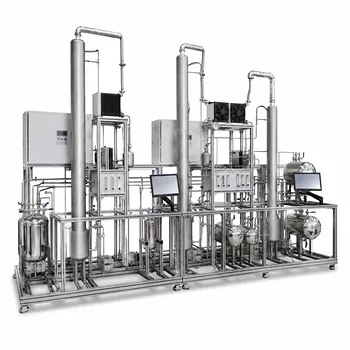
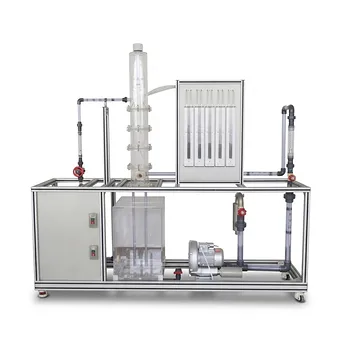
The non-uniform temperature dependence of activity coefficients directly alters a distillation column's core operational parameter, relative volatility. For systems like the ethanol/n-octane mixture, a temperature increase of just 30°C can slash the activity coefficient of ethanol in half, while barely changing that of n-octane. This asymmetrical shift doesn't just tweak the math; it fundamentally changes how easily components separate, dictating everything from the minimum energy input to the physical height of the column needed in an educational pilot plant.
Understanding the temperature dependence of activity coefficients in non-ideal mixtures like alcohols and hydrocarbons is the critical bridge between abstract thermodynamic theory and the tangible, often counter-intuitive, operational reality of a pilot-scale distillation column. The core impact is a dramatic, temperature-driven shift in relative volatility, which dictates separation ease, energy costs, and is rooted in the breakdown of strong hydrogen-bond networks.
How Temperature Governs Separation Efficiency in Non-Ideal Mixtures
The conventional wisdom that "higher temperature makes separation easier" is dangerously incomplete for alcohol-hydrocarbon mixtures. For these systems, temperature changes the fundamental nature of molecular interactions in the liquid phase.
The Thermodynamic Root: Activity Coefficients and Real-World Behavior
An activity coefficient is a correction factor for non-ideality. In an ideal mixture, molecules interact uniformly, but an alcohol molecule in a sea of hydrocarbons behaves very differently.
Ethanol molecules, left to themselves, form a strong, organized network of hydrogen bonds. When mixed with an inert hydrocarbon like n-octane, these bonds are disrupted. This creates a high-energy, unhappy state, leading to a high activity coefficient and a strong desire for the alcohol to escape into the vapor phase.
The Asymmetrical Response to Heat
Heating the mixture injects kinetic energy that violently breaks these lingering hydrogen bonds. The structured ethanol clusters shatter, making the liquid phase a less hostile environment for the alcohol.
This causes the ethanol's activity coefficient to plummet rapidly with rising temperature. The non-polar hydrocarbon, which only experiences weak van der Waals forces, has no such structure to break. Its activity coefficient therefore responds sluggishly to the same temperature change. The consequence is a significant compression of relative volatility as the column gets hotter.
Translating Molecular Shifts into Pilot Plant Design and Operation
This thermodynamic principle doesn't stay in a textbook. It manifests as real physical constraints and operational choices in a pilot plant.
The Direct Link to Relative Volatility and Reflux Ratio
Relative volatility is the numerical expression of separation ease. A high value means components are easy to separate. The asymmetrical drop in activity coefficients directly shrinks this value, making separation fundamentally harder.
A lower relative volatility is a direct command to the operator: the reflux ratio must increase. To achieve the same product purity with a less efficient separation, a much larger portion of the condensed overhead vapor must be returned to the column as liquid reflux. This directly translates to higher energy consumption and a larger heating duty in the reboiler.
The Impact on Column Height and Stage Requirements
The difficulty of separation is measured in theoretical stages. A "stage" represents a single equilibrium step where vapor and liquid compositions move closer to the target.
When reduced activity coefficients make the target separation more difficult, the number of equilibrium stages must increase. In an educational pilot plant, this is physically fixed by the packed height or the number of trays. Operating at a temperature profile that inadvertently lowers relative volatility can cause a column to suddenly fail its separation goal, a powerful lesson for students on the difference between a theoretical model and a real, non-ideal system.
Why This Effect is Amplified in Alcohol-Hydrocarbon Systems
This dramatic temperature dependence is not universal. It is a specific, predictable consequence of molecular structure.
The key distinction is between the strong, directional hydrogen bonds of alcohols and the weak, transient dispersion forces in hydrocarbons. Unlike a simpler Margules or Van Laar equation might predict, the behavior of these systems requires more sophisticated local-composition models like Wilson, NRTL, or UNIQUAC to map the activity coefficient's severe temperature sensitivity accurately. Using an overly simple model in a pilot plant’s design simulation will lead to a column that fails to perform as expected in the lab.
Understanding the Trade-offs in Pilot Plant Operation
Manipulating temperature is not a free lever for control. Every adjustment in the column's thermal profile creates a chain of events with distinct trade-offs.
- The Purity vs. Energy Trap: Raising the pressure to increase temperature might seem beneficial for a specific VLE shift, but it brings the boiling points of all components closer together. The resulting drop in relative volatility forces a much higher reflux ratio, exploding energy costs.
- The Risk of Thermal Degradation: The high-boiling component in the reboiler is subjected to the column’s highest temperature for the longest time. In an educational setting with heat-sensitive alcohols or hydrocarbons, pushing the bottom temperature too high to chase a favorable volatility shift can lead to chemical decomposition and a failed experiment.
- Non-Uniform Column Performance: A temperature profile is a gradient. The dramatic VLE shift occurs at the specific elevation where the temperature breaks the hydrogen bonds. This means the top and bottom sections of the column may operate with vastly different effective relative volatilities, a concept students must grasp to avoid misdiagnosing poor separation as tray flooding or weeping.
How to Apply This to Your Educational Pilot Plant
The operational strategy for a distillation column must directly follow from the specific separation goal. The temperature dependence of activity coefficients makes a one-size-fits-all approach impossible.
- If your primary focus is maximizing product purity: Profile the column to keep the primary separation zone at a temperature that maximizes relative volatility. For alcohol-hydrocarbon mixtures, this often means a colder profile at the top of the column where the activity coefficient ratio is most favorable. Prepare for a much higher reflux ratio as the bottom temperature inevitably rises.
- If your primary focus is minimizing energy consumption: Operate at a lower reflux ratio, but accept an unavoidable trade-off in product purity. Use a model like NRTL to find the exact point of diminishing returns, where increased energy input yields negligible gains in separation due to the collapsing activity coefficient advantage.
- If your primary focus is demonstrating a clear thermodynamic principle: Intentionally vary the column’s pressure. By measuring the new temperature profile and the resulting change in separation efficiency, students can directly observe the asymmetrical impact on alcohol activity coefficients and witness a key principle of non-ideal VLE in absolute clarity.
Mastering a pilot plant means seeing temperature not as a simple boiler setting, but as the primary control knob for managing the complex, non-ideal molecular world inside the column.
Summary Table:
| Operational Parameter | Thermodynamic Cause | Impact on Distillation Column | Operator Adjustment |
|---|---|---|---|
| Relative Volatility | Plummets as temperature rises (alcohol H-bonds break) | Separation becomes fundamentally harder | Increase reflux ratio |
| Column Height | Reduced separation efficiency per stage | Column may fail to meet purity goals | Design for higher equilibrium stage counts |
| Energy Consumption | Lower volatility requires higher reflux | Increased reboiler heating duty | Optimize thermal profile using NRTL models |
| Product Purity | Temperature gradient shifts VLE non-uniformly | Uneven separation efficiency across column | Maintain colder profile at the top of the column |
Bring Thermodynamic Theory to Life with LABPARK
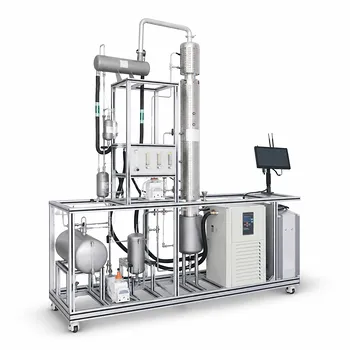
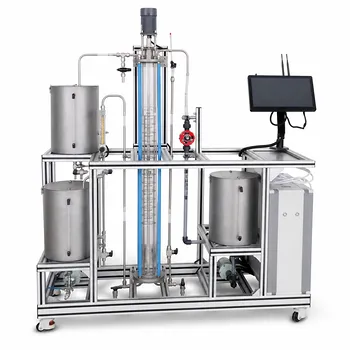
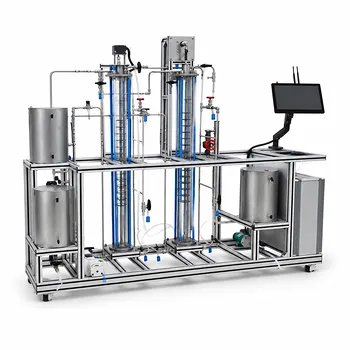
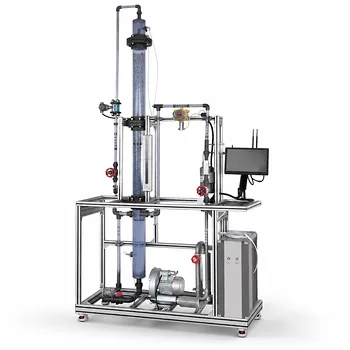
Bridging the gap between complex thermodynamic equations and physical plant operation requires high-precision equipment. LABPARK designs and manufactures state-of-the-art Educational and Vocational Unit Operations Pilot Plants in chemical engineering, bioprocess & biotech, and environmental & water treatment.
Our advanced distillation systems allow universities, research institutes, and enterprises to accurately demonstrate non-ideal VLE behavior, control temperature profiles, and prepare students for real-world chemical engineering challenges.
Ready to upgrade your laboratory capabilities? Contact LABPARK today to request a quote or discuss your custom pilot plant requirements!
Related Products
- Continuous Sieve-Plate Distillation Pilot Plant for Unit Operations Laboratory Education
- Multi-Functional Special Distillation Educational Pilot Plant
- Multi-Modal Distillation Unit Operations Training Pilot Plant
- Continuous Batch Extractive Distillation Educational Pilot Plant
- Dual-Mode Rectification Pilot Plant for Practical Training Unit Operations
People Also Ask
- What are the primary reflux ratio control strategies? Master Distillation Unit Operations
- Why is vacuum operation capability an essential feature for a distillation unit operations pilot plant? Unlock Efficiency
- How to select the right activity coefficient model (Wilson, NRTL, UNIQUAC) for distillation pilot plants?
- How does catalyst water concentration affect distillation pilot plant design? Key separation train choices.
- How can real-time carbon number prediction improve distillation pilot plants? Optimize control.