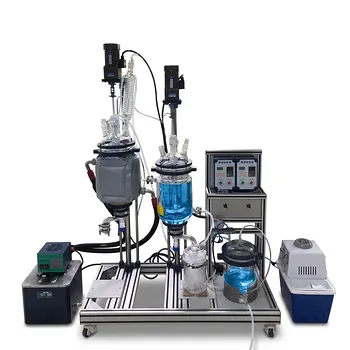
The link is both fundamental and practical.
Studying the lattice energy and crystal structures of ionic compounds like NaCl directly shapes how we configure crystallization pilot plants and design their curriculum for chemical engineering education. These microscopic properties dictate solubility, crystal hardness, and the most appropriate crystallization mode—allowing educators to create safe, predictable experiments that teach students to connect thermodynamic theory to real equipment selection, process control, and product quality analysis.
The thermodynamic stability encoded in lattice energy serves as a blueprint for pilot plant design. By anchoring the curriculum around a well-characterized model system like NaCl, educators can demonstrate core crystallization principles—supersaturation, nucleation, crystal growth, and polymorph control—while mirroring authentic industrial decision-making.
From Microscopic Bonding to Pilot Plant Configuration
How Lattice Energy Dictates Solubility and Crystallization Modes
Lattice energy directly determines a compound’s solubility profile. Salts with lower lattice energy, such as sodium chloride (787 kJ/mol), dissolve readily in water and recrystallize predictably upon cooling or evaporation.
This makes them ideal for teaching cooling and evaporative crystallization—the two most common industrial methods. Students can map solubility curves, calculate yields, and then physically run the process, seeing how the theoretical energy barriers translate into practical operating parameters like cooling ramp rates and residence time.
By contrast, compounds with high lattice energy (e.g., MgO at 3791 kJ/mol) require specialized solvents or very high temperatures. Introducing such materials later in the curriculum helps students appreciate why different crystallization modes—antisolvent, reactive, or high‑temperature melt crystallization—are chosen depending on the target compound’s bonding strength.
Crystal Hardness and Equipment Material Selection
Lattice energy correlates strongly with crystal hardness. NaCl has a Mohs hardness of only 2.5, making it gentle on piping and pumps. Harder crystals like magnesium oxide (hardness 6.5) demand entirely different pilot plant materials.
This is a crucial design lesson. A curriculum that starts with NaCl allows students to first focus on process dynamics without worrying about premature equipment failure. As they progress to harder, more abrasive materials, the pilot plant must be reconfigured with wear‑resistant valves, pumps, and slurry lines—exactly the kind of equipment trade‑off practicing engineers face when scaling up.
Crystal Structure Analysis and Process Control
Bragg’s law ($2d \sin\theta = n\lambda$) links X-ray diffraction patterns to the crystal lattice spacing. In a pilot plant, this means students can verify whether they have produced the desired polymorph of NaCl or any other crystalline product.
Monitoring crystal structure in real time teaches that process parameters—agitation speed, cooling rate, seeding strategy—directly influence polymorphism. This bridges solid‑state physics and process control: students learn that a subtle change in lattice arrangement can alter dissolution rate and stability, just as with active pharmaceutical ingredients. The pilot plant thereby becomes a platform for quality‑by‑design training.
Designing an Educationally Comprehensive Curriculum
Choosing the Right Model System: Why NaCl Works
NaCl’s moderate lattice energy strikes a balance between safety, predictability, and industrial relevance. Its cubic, face‑centered lattice is simple to characterize via XRD, and its dissolution/crystallization kinetics are well documented.
Educators can use NaCl‑based experiments to teach all four classical crystallization modes—cooling, evaporative, anti‑solvent, and even reactive—without introducing hazardous solvents or extreme conditions. This builds a solid conceptual foundation before students tackle more complex compounds.
Mapping Crystal Properties to Crystallizer Types
A well‑equipped educational pilot plant should expose students to multiple crystallizer configurations, each linked to specific crystal properties.
For NaCl‑scale experiments, a tank crystallizer offers the simplest batch paradigm, perfect for demonstrating nucleation and growth curves. Later, an OSLO (mother liquor circulation) crystallizer can show how fluidization produces uniform, large crystals—exactly the technology used industrially for NaCl. Meanwhile, a scraped surface crystallizer can be introduced when dealing with high‑viscosity organic crystals, highlighting the impact of heat‑transfer surface fouling, a concept rooted in crystal habit and growth kinetics.
Integrating Transport Phenomena with Crystal Growth
Crystallization is a mass‑ and heat‑transfer operation. Observing this in a pilot plant—with flow meters, thermocouples, and transparent vessels—makes the principles of momentum, heat, and mass transport tangible.
Students can alter stirring speeds to see how boundary layer thickness affects growth rate, or change cooling jacket temperatures to visualize supersaturation profiles. The microscopic lattice energy then provides the thermodynamic context: why larger lattice energies demand more energy input to overcome the solid‑state binding, an insight that connects directly to equipment specification and cost.
Understanding the Educational Trade-offs
No single model system teaches everything. Relying too heavily on NaCl risks creating a curriculum that glosses over polymorph complexity, corrosive environments, or high‑temperature safety protocols.
Ionic crystals with ultra‑high lattice energies are often excluded from academic pilot plants due to cost and safety. Yet they are common in the metallurgical and ceramics industries. Educators must therefore clearly articulate what is and is not demonstrated by a given set of experiments, and consider adding supplementary modules or simulation exercises to fill the gaps.
Additionally, while crystal hardness data (Mohs scale) are useful, wear in industrial equipment depends also on particle shape and slurry velocity—facets that require more advanced rheological characterization. A balanced curriculum will acknowledge these limits while using the pilot plant as a springboard to discuss industrial realities.
Making the Right Choice for Your Educational Goals
Based on the principles above, the configuration and curriculum of your crystallization pilot plant can be tailored to the specific learning outcomes you want to achieve.
- If your primary focus is teaching fundamental crystallization kinetics and mass transfer: Start with a tank or OSLO crystallizer using NaCl. Its moderate lattice energy ensures safe, reproducible experiments, and the simple cubic lattice makes solute behavior intuitive.
- If your primary focus is equipment design and material selection: Introduce a scraped‑surface or draft‑tube crystallizer later in the curriculum, and use harder crystalline compounds (or model slurries) to demonstrate wear and fouling. Explicitly link lattice energy to pump and valve metallurgy.
- If your primary focus is pharmaceutical or specialty chemical production: Integrate a benchtop XRD instrument and design experiments around polymorphism. Use Bragg’s law to teach how cooling rate and solvent choice alter the resulting crystal structure of both ionic and molecular crystals.
When the curriculum is built this way, the study of lattice energy and crystal structures becomes not a separate theoretical topic but the very language students use to configure, operate, and optimize the pilot plant—exactly as they will in industry.
Summary Table:
| Crystal Property | Plant Configuration Impact | Curriculum Application |
|---|---|---|
| Lattice Energy | Dictates crystallization mode selection (cooling, evaporative, or anti-solvent). | Teaches thermodynamic solubility limits and mass/heat transfer calculations. |
| Crystal Hardness | Drives metallurgy and material selection for pumps, valves, and piping. | Demonstrates equipment wear, fouling, and real-world scale-up challenges. |
| Lattice Structure | Requires real-time monitoring tools (e.g., XRD) and precise cooling loops. | Connects process parameters to polymorphism, crystal growth, and quality control. |
Bring Industrial Crystallization Theory to Life with LABPARK
Bridge the gap between solid-state chemistry and practical process engineering. LABPARK provides state-of-the-art Educational and Vocational Unit Operations Pilot Plants in chemical engineering, bioprocess & biotech, and environmental & water treatment for universities, research institutes, and enterprises.
Whether you want to build a foundational curriculum around NaCl solubility or demonstrate advanced process control and wear-resistant equipment design, our custom pilot plant solutions are tailored to meet your educational goals.
Contact us today to configure the perfect pilot plant for your institution!
Related Products
- Multi Functional Membrane Crystallization Educational Unit Operations Pilot Plant
- Potassium Salt Thermal Dissolution and Crystallization Separation Educational Unit Operations Pilot Plant
- Multi-Modal Distillation Unit Operations Training Pilot Plant
- Dual-Mode Rectification Pilot Plant for Practical Training Unit Operations
- Multi-Reactor Educational Pilot Plant for Reaction Engineering Unit Operations
People Also Ask
- Why is precise temperature control critical in crystallization pilot plants? Key to Scale-Up Success
- Control Crystallization Pilot Plant Secondary Nucleation: 4 Key Adjustments
- What key factors should be considered when configuring a crystallization unit operations pilot plant?
- How Crystal vs Amorphous Solids Guide Crystallization Pilot Plant Objectives
- What are the benefits of integrating online PAT tools like ATR-FTIR into crystallization unit operations pilot plants?