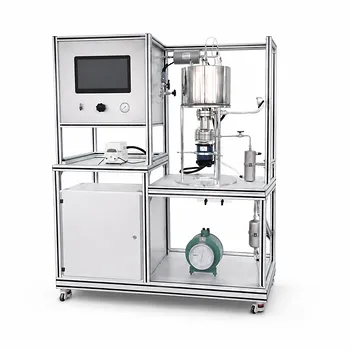
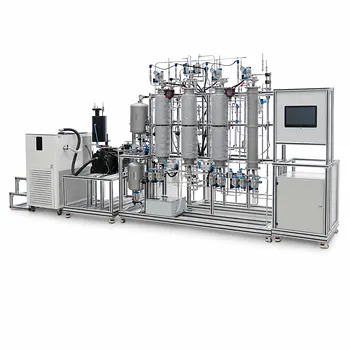
High‑temperature removal of condensation byproducts is the primary lever for controlling molecular weight in step‑growth pilot plants. The evaporation of water, glycol, or similar small molecules directly shifts the equilibrium forward, pushing the fractional conversion of functional groups as close to unity as possible. Without this continuous extraction, the reaction would stall at a low degree of polymerization, producing oligomers rather than high‑molecular‑weight polymer.
Balanced understanding for the pilot‑plant environment:
The removal of byproducts at elevated temperatures is essential to drive the equilibrium toward high molecular weight, but the same heat that enables that extraction also promotes reversible interchange reactions. These side reactions reshape the molecular weight distribution into a predictable “most probable” form. True process control therefore lies in mastering both the mass‑transfer‑driven equilibrium shift and the kinetic consequences of prolonged high‑temperature exposure.
The Thermodynamic Imperative: Why Byproduct Removal Dictates Chain Length
Step‑growth polymerizations are equilibrium‑limited reactions. Whether you are making polyester or polyamide, the formation of each new bond releases a small molecule that must be removed to prevent the reverse reaction.
The Carothers Equation and the Need for Near‑Complete Conversion
The number‑average degree of polymerization ( X̅ₙ ) follows a simple rule: X̅ₙ = 1 / (1‑p), where p is the extent of reaction. High molecular weight only appears when p exceeds 0.99. Even a tiny amount of residual byproduct reduces p enough to cap the average chain length at a few hundred repeat units.
Le Chatelier’s Principle in a Stirred Tank
Removing the condensation byproduct at high temperature forces the equilibrium to the right. The pilot reactor acts like a chemical “vacuum cleaner” that continuously sucks water or glycol out of the melt, making the forward esterification or amidation thermodynamically irreversible. The deeper the vacuum and the hotter the melt, the further the equilibrium shifts, and the higher the molecular weight climbs.
The Kinetic Reality of High‑Temperature Operation
Driving the reaction at 250 °C or above is not a free lunch. The same thermal energy that helps byproduct evaporation also activates unwanted rearrangement chemistry.
Interchange Reactions Rewrite the Distribution
Transesterification in polyesters and transamidation in polyamides become significant at typical pilot‑plant temperatures. These reactions randomly cleave existing chains and re‑link them, erasing any memory of the starting stoichiometry. The result is a “most probable” molecular weight distribution, characterised by a dispersity near 2.0, regardless of the initial chain length distribution.
The Double‑Edged Sword of Reversibility
The primary reference makes a critical point: high temperature promotes both the desirable forward reaction and the undesirable reverse and interchange reactions. While you push equilibrium forward by byproduct removal, you simultaneously enable chain scrambling. The final polymer’s average molecular weight is determined by the conversion you sustain, but its distribution shape is dictated by the extent of these interchange processes.
Engineering the Pilot Plant for Molecular Weight Control
A training pilot plant must translate these fundamental principles into hardware and procedures that students and researchers can manipulate.
Vacuum and Condensation Systems Are the Real Controllers
Efficient vacuum pumps (often reaching 100 Pa or lower), cold traps, and condenser units are not accessories—they are the primary molecular weight control elements. The rate at which byproducts are condensed and removed determines the effective vapour‑liquid equilibrium, directly influencing the melt viscosity and the speed at which conversion approaches unity.
Mass Transfer Limitations Become Visible
In a well‑instrumented pilot plant, students observe how mass transfer limitations—stagnant film thickness, agitation speed, and vapour space temperature—create a bottleneck. Molecular weight then becomes a function not just of chemistry but of unit‑operation efficiency. The same chemistry can yield vastly different molecular weights in a poorly stripped reactor versus one with optimised gas‑liquid separation.
Dosing Systems Enable Independent Control
Supplementary references highlight that monofunctional chain stoppers (e.g., acetic acid in polyamide synthesis) offer a second, independent handle. By precisely metering a chain terminator, you can set a predetermined average molecular weight at high conversion, decoupling chain length from the perfection of byproduct removal. This is invaluable for training because it turns a thermodynamic‑only problem into a straightforward stoichiometric exercise.
Understanding the Trade‑offs in Pilot‑Plant Operation
Objective process control requires acknowledging the downsides and practical limits.
High Temperature Alone Cannot Guarantee a Narrow Distribution
If your target application demands a narrow molecular weight distribution, reliance on high‑temperature byproduct removal alone will disappoint. Interchange reactions will broaden the distribution to the most probable form. You must either accept that dispersity, limit the thermal history, or use post‑polymerisation techniques.
Thermal Degradation Sets an Upper Ceiling
Prolonged exposure above 280‑300 °C can cause discolouration, gel formation, or backbone scission. The pilot plant must balance the rate of byproduct removal against the risk of thermal damage. Efficient stripping at a slightly lower temperature often yields a better polymer than brute‑force overheating.
The Most Probable Distribution Is Not Always a Weakness
For many polymer processing methods, a dispersity of ~2 is perfectly acceptable. In these cases, the “uncontrolled” redistribution caused by interchange reactions actually stabilises the molecular weight profile, making the product more predictable. The pilot plant can be tuned to deliberately exploit this behaviour when uniformity is the goal.
How to Apply This to Your Pilot‑Plant Learning Goals
Each training objective demands a different emphasis on hardware and operational strategy. Here are the most common scenarios.
- If your primary focus is demonstrating equilibrium shift: Prioritise a reactor with deep vacuum capability, high‑efficiency condensers, and real‑time viscosity monitoring. Let students map molecular weight growth against time and system pressure, making Le Chatelier tangible.
- If your primary focus is controlling the molecular weight distribution: Equip the pilot plant with precise dosing pumps and multiple feed inlets. Use chain stoppers or controlled interchange time to teach how the distribution shape can be tailored independently of conversion.
- If your primary focus is scale‑up readiness: Operate under deliberately non‑ideal mixing and mass‑transfer conditions. Measure the impact of agitation rate, vapour take‑off design, and condensation temperature to show how pilot‑plant data can be translated to production reactors.
Mastering the interplay of temperature, vacuum, and residence time transforms a simple polycondensation run into a powerful, hands‑on lesson in both polymer chemistry and chemical engineering fundamentals.
Summary Table:
| Control Element | Process Mechanism | Direct Impact on Molecular Weight |
|---|---|---|
| Vacuum & Condensation | Removes volatile byproducts (water, glycol) to shift chemical equilibrium. | Drives fractional conversion (p) near 1.0, maximizing chain length. |
| High Temperature | Increases reaction rates but also promotes reversible interchange reactions. | Broadens molecular weight distribution to the "most probable" form (dispersity ~2.0). |
| Chain Stoppers | Monofunctional monomer dosing to terminate chain growth at a set point. | Decouples average molecular weight control from absolute byproduct removal. |
| Agitation & Mass Transfer | Breaks surface tension and reduces boundary film thickness. | Prevents diffusion bottlenecks, ensuring consistent polymerization kinetics. |
Enhance Your Engineering Curriculum with LABPARK
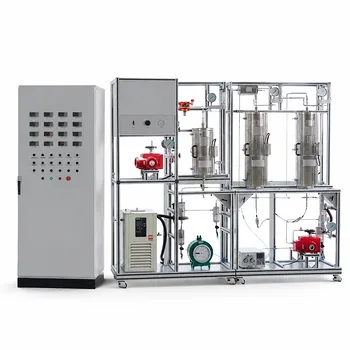
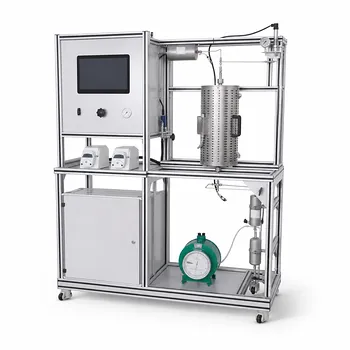
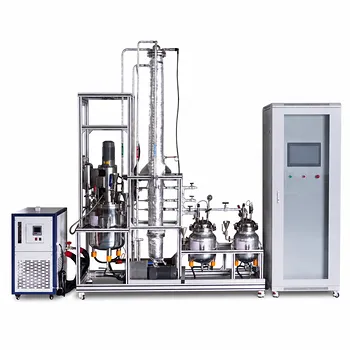
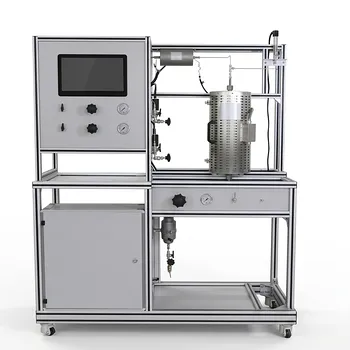
Bridge the gap between theoretical polymer chemistry and hands-on industrial practice. LABPARK designs and manufactures premium Educational and Vocational Unit Operations Pilot Plants specializing in chemical engineering, bioprocess & biotech, and environmental & water treatment.
Tailored for universities, research institutes, and enterprises, our advanced pilot-scale reactors allow students to safely master critical concepts like vacuum control, mass transfer limitations, and stoichiometric dosing.
Ready to upgrade your laboratory capabilities? Contact the LABPARK experts today to discuss your training goals!
Related Products
- Polymerization Granulation and Pellet Processing Educational Unit Operations Pilot Plant
- Ethyl Acetate Synthesis Unit Operations Pilot Plant for Practical Training
- Bio-fermentation Ethanol Production Practical Training Unit Operations Pilot Plant
- Methanol Synthesis and Catalyst Performance Evaluation Educational Unit Operations Pilot Plant
- Crude Benzene Hydrogenation Educational Unit Operations Pilot Plant
People Also Ask
- How do educational unit operations pilot plants address safety and waste management when scaling up?
- How do educational unit operations pilot plants bridge theory and design? Bridge the Engineering Gap
- Why Compare Predicted and Experimental Excess Enthalpy? Key to Accurate Pilot Plant Scale-up
- When to transition from PID to adaptive control in pilot plants? Key process indicators.
- How to study gasification in pilot plants? Compare exit gas composition & efficiency