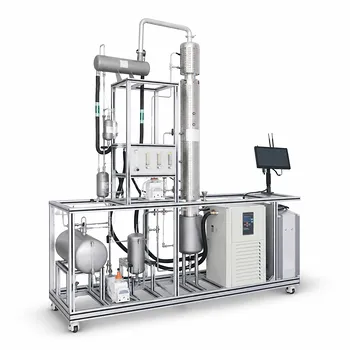
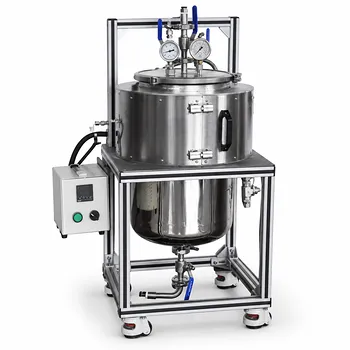
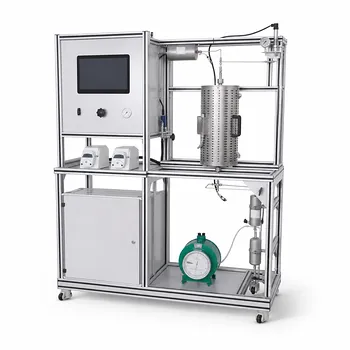
The exponential sensitivity of vapor pressure to temperature is the single most important physical relationship governing the design of every distillation and evaporation pilot plant. This principle, formalized by the Clausius-Clapeyron equation, dictates that even a minor change in operating temperature causes a dramatic, non-linear change in a liquid’s vapor pressure. In practice, this means a pilot plant’s entire design strategy—from the selection of vacuum pumps to the sizing of condensers—is a direct exercise in managing this fundamental thermodynamic sensitivity to achieve a desired separation while handling heat-sensitive materials or minimizing energy waste.
The core challenge in pilot plant design is not just knowing that vapor pressure increases with temperature, but acting on the fact that it does so exponentially. This relationship forces a critical engineering compromise: using vacuum to enable low-temperature distillation for product quality versus managing the increased capital and operational complexity that comes with it. A pilot plant’s purpose is to find the optimal and scalable balance point between these two forces.
Decoding the Thermodynamic Lever
The Clausius-Clapeyron equation, which states that the logarithm of vapor pressure is inversely proportional to absolute temperature, is your primary lever for controlling a separation process.
From Fundamental Equation to Practical Control
The equation inherently links two controllable process variables: pressure and temperature. In a pilot plant, you are physically manipulating the external pressure to control the boiling point. Applying a vacuum fundamentally lowers the temperature at which a liquid boils, a direct consequence of this logarithmic relationship. A modest reduction in operating pressure yields a substantial reduction in boiling point, a high-leverage effect that defines the operating window for an entire class of compounds.
The Antoine Equation: The Engineer’s Practical Tool
While Clausius-Clapeyron provides the theoretical foundation, the Antoine equation is the practical workhorse. It uses empirical constants (A, B, C) to accurately model vapor pressure for a vast library of substances. In a pilot plant, this is not an academic exercise; an engineer uses the Antoine coefficients to precisely calculate the bubble point and dew point of a multi-component mixture. These calculated temperatures become the set points for the column's control system, defining the exact temperature profile needed to keep the system in the vapor-liquid coexistence region without flooding or causing excessive degradation.
Translating Thermodynamics into Hardware Design
The exponential temperature-vapor pressure relationship directly sizes the critical hardware components of a pilot plant and dictates its operational strategy.
Sizing the Vacuum System for Heat-Sensitive Separations
The most direct application of this relationship is determining the required vacuum level. For a heat-sensitive specialty chemical or pharmaceutical intermediate, thermal degradation is a function of both temperature and time. Unless the system pressure is lowered to allow boiling at a safe temperature, the product will be destroyed before separation occurs. The Clausius-Clapeyron principle directly calculates the target operating pressure, which defines the specifications for the entire vacuum subsystem, from the pump’s ultimate pressure to the tightness requirements of the entire vessel train.
Calculating Thermal Loads for the Reboiler and Condenser
The energy balance is an equally direct consequence. The latent heat of vaporization is the energy required to break intermolecular forces—a quantity that changes with the boiling temperature. Operating under vacuum changes the boiling temperature, altering the required reboiler duty. The condenser must then remove this equivalent energy. The exponential relationship dictates that a design change to lower the boiling point by just 10°C might require a disproportionately large (and costly) condenser due to the lower condensing temperature and a smaller driving force for heat transfer. An undersized condenser will force the operator into a higher-than-optimal operating pressure, potentially damaging the product.
Understanding the Trade-offs: The Precision vs. Over-Design Dilemma
The pilot plant’s role is to navigate the inherent conflict between thermodynamic precision and robust, scalable design. Historically, engineers used short-cut methods that introduced significant imprecision, leading to intentional over-design.
The Cost of Imperfect VLE Data
When vapor-liquid equilibrium (VLE) data is uncertain, the safest engineering response is over-design. This manifests as columns with extra stages, larger-diameter shells, and oversized reboilers and condensers to allow for higher-than-needed reflux ratios. For a pilot plant used for scale-up studies, this approach is dangerous. An over-designed pilot column masks poor thermodynamic predictions with brute-force hardware, providing non-representative data and leading to an under-designed, failing full-scale plant. The pilot plant’s data must be accurate enough to expose the true separation difficulty, not compensate for it.
The Challenge of Non-Ideal Behavior and Model Validation
Ideal gas behavior is an assumption, not a reality for many industrial mixtures. Polar molecules, organic acids, and water-alcohol mixtures deviate significantly from simple models due to hydrogen bonding and other molecular interactions. A pilot plant’s critical value is to be the physical arbiter that validates or refutes the chosen thermodynamic model. A carefully designed experiment uses the measured component distribution across the column to back-calculate the true activity coefficients, closing the loop between molecular-level prediction and macro-scale performance and revealing whether the chosen Wagner, NRTL, or UNIQUAC model is correct.
Making the Right Choice for Your Pilot Plant Goal
Your application of the Clausius-Clapeyron relationship depends entirely on the pilot plant’s primary objective. The design must be tuned to the outcome you seek.
- If your primary focus is developing a process for a heat-sensitive pharmaceutical: You must start the design by using the Antoine equation to define the maximum allowable operating temperature, which directly dictates the absolute pressure required from the vacuum system. The vacuum system is the primary design element, and all other vessels are sized for that low-pressure, low-vapor-density condition.
- If your primary focus is generating data for scale-up: Your pilot plant must be rigorously instrumented and designed to avoid the trap of over-design. The goal is to capture accurate VLE data and pressure drop profiles that quantify true separation difficulty, so the full-scale design is based on real physics, not a conservative safety margin that would make the business case unprofitable.
- If your primary focus is education and demonstrating thermodynamic principles: Your operating plan should be built around a pure-component test and a binary mixture with well-known Antoine constants. Have students compare the theoretical bubble and dew points against the measured column profile, then introduce a known non-ideal mixture to visually and statistically demonstrate the pure failure of Raoult’s Law and the necessity of more complex models.
The exponential link between temperature and vapor pressure is not just a line in a textbook. It is the invisible physical law that your pilot plant hardware must obey, and your experimental strategy must exploit, to turn raw data into a viable industrial process.
Summary Table:
| Design Element | Clausius-Clapeyron Influence | Practical Impact |
|---|---|---|
| Vacuum System | Dictates operating pressure to lower boiling point | Prevents thermal degradation of heat-sensitive products |
| Heat Exchangers | Alters boiling temp & latent heat of vaporization | Sizes reboiler/condenser capacity & heat transfer area |
| Column Sizing | Affects vapor density and equilibrium stages | Prevents column flooding; ensures accurate scale-up data |
Ready to master thermodynamic scale-up? LABPARK provides premium Educational and Vocational Unit Operations Pilot Plants in chemical engineering, bioprocess & biotech, and environmental & water treatment. Designed for universities, research institutes, and enterprises, our pilot plants ensure precise data validation and hardware reliability. Contact our experts today to discuss your custom pilot plant needs!
Related Products
- Multi-Modal Distillation Unit Operations Training Pilot Plant
- Continuous Sieve-Plate Distillation Pilot Plant for Unit Operations Laboratory Education
- Green Anhydrous Ethanol Purification Extractive Distillation Unit Operations Training Pilot Plant
- Dual-Mode Rectification Pilot Plant for Practical Training Unit Operations
- Multi Functional Membrane Crystallization Educational Unit Operations Pilot Plant
People Also Ask
- How can energy balance equations for condensers & reboilers be validated experimentally? Guide
- What are the primary reflux ratio control strategies? Master Distillation Unit Operations
- Why is vacuum operation capability an essential feature for a distillation unit operations pilot plant? Unlock Efficiency
- How does catalyst water concentration affect distillation pilot plant design? Key separation train choices.
- How can real-time carbon number prediction improve distillation pilot plants? Optimize control.