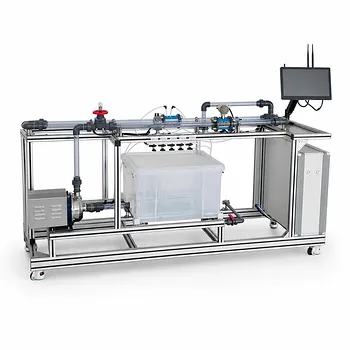
The material balance ratio between cake and filtrate volumes is a direct, non-negotiable link between your feed slurry and the physical limits of your pilot filter. This relationship converts the solids content and porosity of your feed into a simple volume ratio that governs how much cake accumulates for each liter of filtrate produced. By knowing this ratio, you can prevent the cake from completely blocking the filtration chamber and correctly size the filter area for your desired batch volume. In short, it gives you a first-principles handle on both pilot plant design and safe daily operation.
The volume ratio (v = V_c/V = \phi / (1 - \epsilon - \phi)) is your key to safe pilot plant operation. It takes the solid volume fraction of the feed ((\phi)) and the cake voidage ((\epsilon)) and turns them into an actionable physical limit. This defines the maximum filtrate you can collect before the cake fills the available space, ensuring you avoid mechanical damage and plan discharge cycles with confidence.
The Direct Link Between Feed Slurry and Cake Buildup
The Governing Material Balance Equation
The core of the relationship is a simple mass balance on the solids. The ratio of wet cake volume ((V_c)) to filtrate volume ((V)) is given by (v = \phi / (1 - \epsilon - \phi)). Here, (\phi) is the volume fraction of solids in the feed slurry, and (\epsilon) is the porosity — the void space in the packed cake that remains filled with liquid.
This equation doesn't involve time, pressure, or filtration rate. It is a purely geometric consequence of the fact that all solids entering the filter must end up in the cake, and the cake retains a fixed amount of liquid between the particles. Knowing (v) lets you instantly predict how much solid volume you will accumulate once you collect a certain amount of filtrate.
From Volume Ratio to Actual Cake Thickness
The real engineering value emerges when you apply the ratio to a filter with a known filtration area. The average thickness of the growing cake is (L = v V / A), where (A) is the filter area and (V) is the total filtrate collected up to that moment. This linear relationship is the cornerstone for sizing and operating any pilot-scale dead-end filter.
Because the filter chamber has a fixed physical depth, you now have a direct way to translate a measured filtrate volume into a cake thickness. The operation becomes predictable: every liter of filtrate adds a known increment to the cake layer, regardless of how fast the liquid passes through.
Sizing a Pilot Filter Using the Material Balance
Determining Maximum Filtrate Volume Per Cycle
Every pilot filter press or leaf test cell has a maximum allowable cake thickness ((L_{max})) beyond which the cake can block the inlet, wedge against the frame, or exceed the ram stroke. By rearranging the thickness equation, you determine the maximum filtrate volume you can process in a single cycle: (V_{max} = L_{max} A / v).
This is a critical safety and design limit. It tells you exactly how much slurry you can dewater before you must stop filtration and discharge the cake. Without this calculation, you risk overfilling the chamber and damaging the equipment or compromising the experiment.
Calculating Required Filtration Area
If you already know the batch volume you need to process per shift — for example, the filtrate you must collect to meet a campaign target — you can size the filter area directly. The necessary area is (A = v V_{batch} / L_{max}). This single equation connects your feed properties, target throughput, and mechanical constraints into a straightforward design decision.
It prevents the common mistake of selecting a filter that is too small, forcing operators to interrupt cycles prematurely, or one that is unnecessarily large. The material balance ensures that the chosen pilot unit will physically accommodate the expected cake volume over a complete batch.
Operating the Pilot Plant Within Safe Limits
Preventing Mechanical Blockage
In a running pilot plant, operators can use (v) to implement a simple but robust operational control. By continuously monitoring the cumulative filtrate volume, they compare it to the pre-calculated (V_{max}). The moment the volume reaches that threshold, the cycle must end and cake discharge must begin.
This rule is independent of pressure, flux decline, or any other real-time fluctuation. It acts as a hard safety interlock, preventing a thick cake from jamming the filter leaves or splitting the frames. It is especially valuable during student-run experiments, where direct visual inspection of cake thickness may not be possible.
Integrating With Cycle Time and Discharge Planning
Knowing the maximum filtrate volume per cycle lets you plan the entire operational rhythm. You can predict how many cycles are needed to process a given slurry batch and schedule cake washing, drying, and discharge steps accordingly. The material balance provides the first half of the cycle logic; the filtration rate (from specific cake resistance and medium resistance) then tells you how long each cycle will take.
This integration makes pilot plant campaigns reproducible and safe, even when working with unfamiliar feed slurries. The geometry-based limit avoids the pitfalls of relying solely on flux curves, which can mislead when the cake becomes unexpectedly thick.
Understanding the Trade-offs
The Hidden Assumption of Constant Cake Voidage
The simple (v) relationship assumes that the cake voidage (\epsilon) remains constant throughout filtration. In reality, many industrial cakes are compressible. As applied pressure increases, the solid particles pack more tightly, reducing (\epsilon) and thereby changing (v). A cake that might seem safe at low pressure can become denser and thinner at higher pressure — but more importantly, the volume ratio (v) decreases, meaning you produce less filtrate per unit cake volume.
If you do not account for this, you may overestimate the amount of filtrate you can collect before reaching (L_{max}), leading to undersized filtration cycles at high pressures. Always measure (\phi) and (\epsilon) under the same operating pressure and slurry conditions you plan to use.
When This Simple Model Isn’t Enough
The material balance only answers the “how much cake” question. It does not tell you how fast the cake will build, or whether a pressure increase will help or hurt. For that, you need the supplementary concepts of specific cake resistance and cake compressibility. These dictate how flux responds to pressure and when a further increase can collapse the cake structure and actually shut down flow.
Moreover, the model assumes a uniform cake layer across the entire area. In real pilot plants, uneven flow distribution or preferential settling can create localized thick spots that trigger blocking earlier than predicted. For critical equipment, a safety factor of 15–20 % on (L_{max}) is prudent.
Making the Right Choice for Your Pilot Plant Goal
Your use of the material balance relationship depends on what you are trying to achieve in the pilot facility.
- If your primary focus is sizing a new pilot filter: Use carefully measured values of (\phi) and (\epsilon) to calculate (v), then select a filtration area that keeps the expected cake thickness within 70–80 % of the chamber limit for your maximum planned filtrate volume.
- If your primary focus is safe daily operation: Establish a clear filtrate volume cut-off point (V_{max} = L_{max} A / v) for each batch, and enforce it as a non-negotiable cycle stop, regardless of the instantaneous flux or time elapsed.
- If your primary focus is process scale-up: Always measure the slurry’s solid fraction and the cake voidage under the exact pressure and temperature of the pilot run, because a change in compressibility will alter (v) and lead to incorrect predictions at commercial scale.
- If your primary focus is training operators: Begin every sizing exercise with the material balance. It gives students a tangible, geometric intuition for why thicker cakes cannot be ignored, and it grounds the more abstract rate equations in the physical reality of the filter.
Anchoring your filter’s physical constraints to the feed properties through this single ratio gives you a reliable, first-principles grip on both design and day-to-day pilot plant safety.
Summary Table:
| Parameter / Equation | Formula / Symbol | Practical Significance in Pilot Plants |
|---|---|---|
| Volume Ratio | $v = \phi / (1 - \epsilon - \phi)$ | Translates feed solids and voidage into a volumetric buildup ratio. |
| Cake Thickness | $L = v V / A$ | Estimates physical cake accumulation based on collected filtrate. |
| Max Filtrate Volume | $V_{max} = L_{max} A / v$ | Sets the hard safety limit to stop the cycle before chamber blockage. |
| Required Filter Area | $A = v V_{batch} / L_{max}$ | Used to size the pilot filter to fit a specific target batch volume. |
Optimize Your Process Scale-Up and Training with LABPARK
Are you looking to equip your laboratory with reliable process equipment? LABPARK provides state-of-the-art Educational and Vocational Unit Operations Pilot Plants in chemical engineering, bioprocess & biotech, and environmental & water treatment. Designed specifically for universities, research institutes, and enterprises, our systems ensure students and researchers master critical principles like filtration material balance, scale-up sizing, and safe operation.
Let us help you select the ideal pilot system for your lab. Contact the LABPARK team today for expert consultation and a customized quote!
Related Products
- Hot Filtration Educational Unit Operations Pilot Plant Laboratory System
- Constant Pressure Filtration Educational Unit Operations Pilot Plant
- Ultrafiltration Membrane Separation Educational Pilot Plant
- Multifunctional Membrane Separation Educational Pilot Plant with Ultrafiltration, Nanofiltration, Reverse Osmosis
- Hollow Fiber Ultrafiltration Membrane Separation Educational Pilot Plant
People Also Ask
- How to Determine Specific Cake (r) & Filter Medium (Rm) Resistance Using Filtration Pilot Plant Data
- How can researchers identify and resolve filter medium blinding? Optimize Your Pilot Plant Runs
- How to select solid-liquid separation equipment for pilot plants? A Step-by-Step Guide
- Why Demo Constant-Rate to Constant-Pressure Filtration on a Pilot Plant? Key Practical Insights
- How do Buchner funnels & leaf filters differ in filtration scale-up? Key Differences Explained