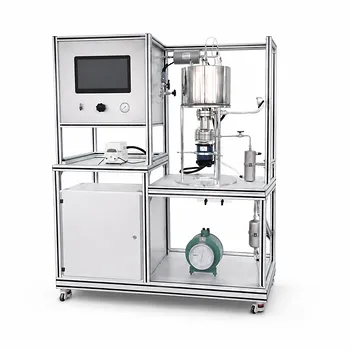
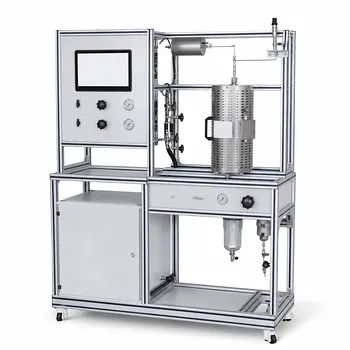
When you integrate microreactor technology into your pilot plant, you are not just shrinking equipment—you are buying certainty. The technology directly assists in determining kinetic parameters by physically stripping away the transport limitations that normally obscure intrinsic reaction rates. This creates a "gradient-free" environment where the measured reaction rate is the true chemical rate, free from the corrupting influences of heat and mass transfer.
The fundamental challenge in kinetic studies is that most observed data is a composite of the true reaction rate and physical transport resistances. The defining advantage of a microreactor is its ability to make those physical resistances mathematically negligible, allowing researchers and students to observe the unadulterated chemical kinetics with a precision that is practically impossible in conventional batch reactors.
The Physics of Perfect Kinetic Measurement
The struggle with traditional pilot plant reactors, like batch or CSTR setups, is that they force you to solve two problems simultaneously: the physics of mixing and the chemistry of the reaction. Microreactors change this by making the physics a non-factor from the start.
Eliminating the Hidden Variable of Heat Transfer
For any non-isothermal reaction, temperature is the primary dictator of the rate constant (k). A temperature gradient inside your reactor creates a range of rate constants, rendering your integrated data an average of many different reactions, not a single kinetic parameter.
Microreactors achieve isothermal operation almost instantly. Their extremely small channel dimensions create a high surface-area-to-volume ratio that couples with excellent heat transfer coefficients. This ensures that even highly exothermic reactions release heat without creating localized hot spots. The result is a single, known temperature for every molecule at every moment, transforming the Arrhenius equation from a complex model into a direct, solvable relationship.
Dismantling the Barrier of Mass Transfer
A reaction rate is only meaningful if the concentration you think you have is the concentration at the catalyst active site or in the bulk fluid. In large catalyst pellets or viscous fluids, internal pore diffusion and external film resistance mean the core of your process is starved of reactants.
The primary reference confirms that microreactors eliminate both internal and external mass gradients. The use of small catalyst particles and narrow channels ensures the diffusion path length is vanishingly short. The measured bulk concentration accurately reflects the concentration driving the reaction, allowing for a direct and valid analytical solution of the rate equation.
Translating Precision Data into Parameters
The data a microreactor produces is fundamentally superior, but it's the application of this data to kinetic models that completes the task. The modular nature of these continuous systems gives researchers a unique degree of control.
Unfolding the Time Domain with Residence Time Control
In a batch system, time is a tracked variable. In a continuous microreactor, time is an engineered variable defined as residence time. By precisely controlling the volumetric flow rate through a fixed microchannel volume, you can dial in a specific reaction time with sub-second accuracy. This enables the collection of highly dense and reproducible concentration-against-space-time data sets, which are perfect for both integral and differential methods of analysis. The modular "circuit board" design of pilot plants mentioned in the supplementary references allows users to easily insert analytical sensors at different points along the reaction path, effectively sampling the entire kinetic profile in a single, steady-state experiment.
Operating Beyond Conventional Safety Limits
Some of the most important kinetic parameters belong to reactions that are dangerous to study conventionally. Fast, exothermic reactions often required cryogenic cooling to -60°C in batch vessels to maintain control, a condition that introduces a massive temperature gradient and complicates the energetics.
Microreactors allow these same reactions to be run safely at ambient temperature due to superior heat removal. This is a critical advantage for kinetic studies. It lets you gather data for hazardous chemistries across a wider, more industrially relevant temperature window without the energy cost and complexity of cryogenic utilities, leading to more robust activation energy ((E_a)) calculations.
Understanding the Trade-offs
While a microreactor provides unmatched kinetic clarity, it is a specific tool with inherent limitations that a researcher must navigate.
- You cannot see internal physical phenomena: A microreactor's strength is its elimination of transport gradients, but this means you cannot use it to study how those gradients would affect a process at scale. The data tells you the perfect reaction, not the imperfect reality of a large tank.
- The data demands a model: The high-quality concentration-time curves from a continuous flow system often require a transition in thinking from simple batch integration. You are correlating concentration with residence time, and errors in measuring precise flow rates directly translate to errors in your calculated rate constant (k).
- Managing uncertainty with global methods: As the supplementary references imply, kinetic calibration is an iterative process. The precise data from a microreactor can still be part of a poorly defined model. When initial parameter estimates are unknown, relying on a simple local sensitivity analysis can anchor your work to a wrong starting point. Using a Global Sensitivity Analysis (GSA) approach—sampling from a full range of possible parameter bounds—is critical to identify which rate constants actually control the reactor's output before you trust a numerical calibration.
Making the Right Choice for Your Experimental Goal
Your objective in the pilot plant dictates how you leverage microreactor technology. The integration is not just about better data; it's about smarter, faster, and safer kinetic research.
- If your primary focus is discovering intrinsic mechanism and kinetics: Use the microreactor as your gold standard. Its ability to deliver gradient-free, isothermal data provides the cleanest possible validation of your proposed reaction mechanism and the most reliable activation energy.
- If your primary focus is studying hazardous or highly exothermic chemistries: A microreactor pilot plant is non-negotiable. It replaces the need for costly and complex cryogenic systems while providing a far larger safe-operating window to gather the kinetic data required for process safety design.
- If your primary focus is vocational training for modern continuous manufacturing: The microreactor pilot plant is the ideal pedagogical tool, as it provides a hands-on platform to teach residence time distribution, steady-state kinetics, and the principles of process intensification, a skill set entirely distinct from traditional batch chemistry.
The power of the microreactor in a pilot plant is that it transforms kinetic analysis from a problem of inference, where you are guessing what transport might be doing, to a problem of direct observation, where you can be confident the chemistry is speaking for itself.
Summary Table:
| Feature | Conventional Reactors (Batch/CSTR) | Microreactor Pilot Plants |
|---|---|---|
| Heat Transfer | Thermal gradients, localized hot spots | Isothermal operation, high surface-to-volume ratio |
| Mass Transfer | Diffusion limitations, concentration gradients | Negligible resistance, gradient-free environment |
| Reaction Time | Tracked temporally (time-dependent) | Engineered precisely via residence time control |
| Safety & Range | Hazardous for fast, exothermic reactions | Safe operation at ambient temperatures for hazards |
Elevate Your Chemical Engineering Lab with LABPARK
Are you looking to bridge the gap between theoretical kinetics and hands-on industrial application?
LABPARK provides state-of-the-art Educational and Vocational Unit Operations Pilot Plants in chemical engineering, bioprocess & biotech, and environmental & water treatment. Tailored for universities, research institutes, and enterprises, our modular systems allow students and researchers to master microreactor technology, eliminate transport limitations, and achieve unparalleled experimental precision safely.
Ready to upgrade your research and training capabilities? Contact LABPARK today to discuss your custom pilot plant configuration!
Related Products
- Micro-Scale Gas-Solid Catalytic Reaction Educational Pilot Plant
- Multi-Reactor Educational Pilot Plant for Reaction Engineering Unit Operations
- Multi Functional Catalytic Reaction and Reactor Evaluation Educational Unit Operations Pilot Plant
- Residence Time Distribution and Reactor Flow Characteristics Determination Educational Pilot Plant
- Multi-Stage Stirred Tanks in Series Residence Time Distribution and Mixing Performance Determination Educational Pilot Plant
People Also Ask
- Why is a multibed configuration necessary for exothermic reactions? Optimize your pilot plant trajectory.
- Fluidized vs. Fixed Bed Reactors: Comparing Heat & Complexity in Pilot Plants
- Why is thermal management a major challenge in methane oxidative coupling? Reactor Solutions for Pilot Plants
- How does the Mears criterion evaluate transport resistance? Key Guide to Intrinsic Kinetics
- How do reactor pilot plants safely study gas-solid reactions? Master kinetics with thermal & flow control.