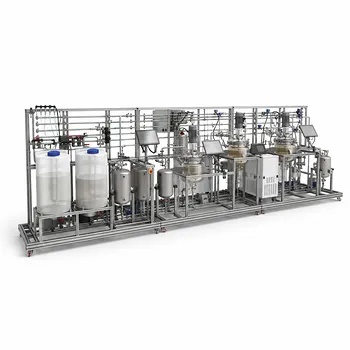
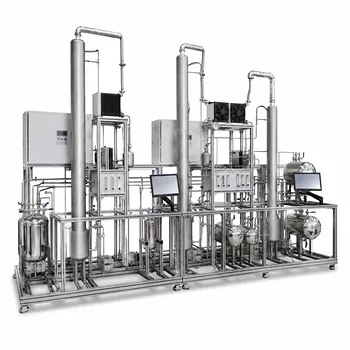
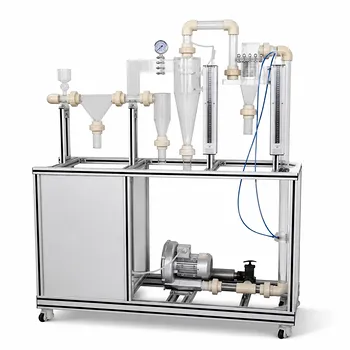
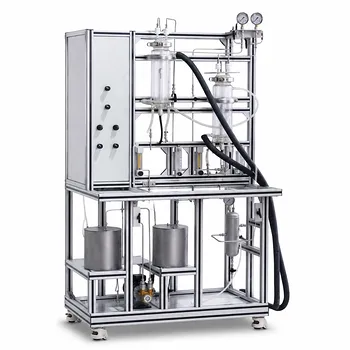
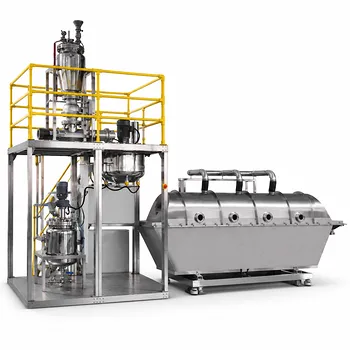
The interplay between crystallization and filtration creates a coupled dynamic, not a simple linear sequence. In pilot-scale chemical process development, the integration of these two unit operations profoundly affects overall cycle time because crystallization conditions dictate the physical properties of the solids that filtration must then handle. A crystallization step that rapidly generates fine particles will drastically slow down the subsequent filtration, while a slower crystallization yielding large, well-formed crystals can accelerate filtration, potentially reducing the total combined batch time even though the first step takes longer. This non-linear relationship demands that researchers evaluate the two steps together as a single, integrated system to truly optimize cycle time.
The core challenge in integrated crystallization-filtration is a fundamental time trade-off: faster crystallization produces small, high-resistance particles that choke the filter, while slower crystallization builds larger, easily filtered crystals but extends upstream time. The optimal total cycle time emerges only when you analyze these steps as a combined, interdependent system and experimentally tune variables like cooling rate, seeding strategy, and solvent choice to balance the two.
Understanding the Crystallization-Filtration Feedback Loop
The Particle Size Conduit
The physical link between crystallization and filtration is the particle size distribution and morphology of the solids generated. Crystallization kinetics directly control these properties. Rapid cooling or high supersaturation triggers spontaneous nucleation, producing a large population of fine, often needle-like crystals with a high specific surface area. These particles pack tightly on the filter medium, creating a cake with low porosity and extremely high specific cake resistance—values like 6.9 × 10¹⁰ m/kg are typical for such fines. In contrast, slow, controlled cooling or the use of seeded crystallization promotes crystal growth over nucleation, yielding larger, thicker, rod-like crystals. Their lower aspect ratio forms a porous cake with a resistance an order of magnitude lower (e.g., 9.0 × 10⁹ m/kg), allowing filtrate to pass through much more rapidly.
How Particle Properties Translate to Filtration Time
The filtration half of the cycle is governed by Darcy’s law-based equations where filtrate flux is inversely proportional to cake resistance. A high-resistance cake formed from fine particles demands either significantly longer filtration times or higher pressure differentials to achieve the same liquid removal. The situation worsens if the solvent has a high kinematic viscosity, like isopropyl alcohol (IPA), which further reduces flow rate compared to a low-viscosity solvent like tert-butyl methyl ether (TBME). Thus, a crystallization that finishes in 30 minutes can easily add an hour of filtration, whereas a two-hour crystallization might finish filtering in just 15 minutes. That asymmetry is why total cycle time can be minimized by the slower crystal growth step.
Why a Pilot-Scale, Integrated Approach Is Essential
Breaking the Siloed Optimization Mindset
Conventional process development often optimizes unit operations in isolation—a reaction chemist focuses on yield, a crystallization engineer on purity, and a filtration specialist on throughput. However, the upstream downstream dependency means that a locally optimal crystallization (fastest cooling rate for throughput) can devastate overall production rate by creating a filtration bottleneck. Pilot plants that physically integrate these steps force researchers to confront the entire process chain. By running complete batch cycles, they can directly measure the combined crystallization-plus-filtration time and identify the true bottleneck.
Hands-On Parameter Manipulation
Unit operations pilot plants provide a platform to manipulate and measure the critical variables. Students and engineers can adjust cooling rates, seeding mass, agitation intensity, and solvent composition in the crystallizer, then immediately observe the impact on filter cake buildup, pressure drop, and final filtrate volume over time. This physical simulation reveals non-ideal behaviors—like fouling of heat transfer surfaces that extends crystallization time or blinding of the filter medium that progressively slows filtration run after run—that are difficult to predict from first principles alone. Understanding and managing such variabilities, including those introduced by operator technique or raw material purity, is precisely what vocational pilot plant training addresses.
Understanding the Trade-offs
Rapid Nucleation vs. Slow Growth
The most direct trade-off is between crystallization speed and filtration speed. Rapid nucleation minimizes crystallizer occupancy but maximizes specific cake resistance, shifting the time burden downstream. Conversely, growing large crystals through a long, controlled cooling profile comes with its own risks: potential impurity inclusion, batch-to-batch inconsistency if seeding is not precise, and increased energy costs to maintain precise low-temperature gradients. There is a clear sweet spot where the sum of crystallization time and filtration time reaches a minimum, and that sweet spot depends on the specific chemistry, solvent, and equipment capabilities.
Solvent Selection: More Than Just Solubility
Solvent choice adds another dimension. A solvent that provides excellent crystal yield might have a high viscosity, causing painfully slow filtration (e.g., IPA vs. TBME). Switching to a lower-viscosity solvent can slash filtration time even if the crystallization itself takes slightly longer due to altered solubility. This trade-off extends to safety, cost, and downstream drying requirements, all of which contribute to total non-productive time in the cycle.
Seeding Strategy as a Process Lever
Seeded crystallization is a powerful middle ground. By introducing a small amount of well-characterized seed crystals, you can suppress spontaneous nucleation and direct growth onto existing particles, producing larger, more uniform crystals without requiring an extremely slow cooling rate. While this adds operational complexity (seed preparation, precise addition timing), the reduction in specific cake resistance—often by a factor of 5-10—can dramatically shorten filtration, improve yield consistency, and reduce overall cycle time variability. The trade-off is the added capital and operational control needed to implement reliable seeding at pilot scale.
Making the Right Choice for Your Pilot Process Goal
The optimal integrated cycle time strategy is not one-size-fits-all. Your choice must align with the primary objective of your pilot-scale study or manufacturing campaign.
- If your primary focus is maximizing overall throughput (kg/day): Prioritize the combined crystallization-plus-filtration time. Experiment with slower cooling rates and seeded crystallizations to generate large, easily filtered crystals, and select low-viscosity solvents if chemically feasible. Do not be afraid to lengthen the crystallization step if it slashes filtration time by a greater amount.
- If your primary focus is achieving a strict particle size distribution for formulation: Control crystallization supersaturation and seeding meticulously to hit the target size, even if it pushes the total cycle time up. Then, mitigate filtration losses by optimizing pressure differentials and filter media to handle the resulting cake resistance, rather than sacrificing crystal quality for speed.
- If your primary focus is training operators on process variability: Use the integrated pilot plant to deliberately perturb crystallization parameters (cooling ramp, seeding amount) and record the downstream effects on filtration time and cake consistency. This builds the intuition needed to troubleshoot real production deviations, like a sudden increase in cycle time caused by a fouled heat exchanger or a missed seed addition.
- If your primary focus is exploring a novel solvent or continuous process: Run small-scale integrated tests early to identify whether the solvent’s viscosity or the crystallizer’s hydrodynamics will create a filtration bottleneck. Early data on cake resistance can prevent a costly scale-up surprise where a seemingly fast reaction step is followed by an impossibly slow isolation.
Mastering the integration of crystallization and filtration turns the trade-off into a tunable process lever. By shifting from isolated thinking to a holistic, experimentally validated picture of your cycle time, you transform a potential bottleneck into a reliable, optimized operation.
Summary Table:
| Crystallization Strategy | Particle Size & Morphology | Specific Cake Resistance | Filtration Speed | Overall Cycle Time Impact |
|---|---|---|---|---|
| Rapid Nucleation (Fast cooling) | Small, fine particles | High (e.g., ~6.9 × 10¹⁰ m/kg) | Very slow (Choked filter) | Long (Filtration bottleneck) |
| Slow Growth (Controlled cooling) | Large, thick crystals | Low (e.g., ~9.0 × 10⁹ m/kg) | Rapid | Shorter (Balanced process) |
| Seeded Crystallization | Uniform, larger crystals | Low (Reduced by 5-10x) | Fast | Optimized & consistent |
Optimize Unit Operations with LABPARK
Bridge the gap between theory and industrial practice. LABPARK provides premium Educational and Vocational Unit Operations Pilot Plants in chemical engineering, bioprocess & biotech, and environmental & water treatment for universities, research institutes, and enterprises.
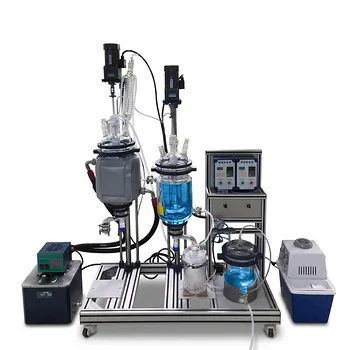
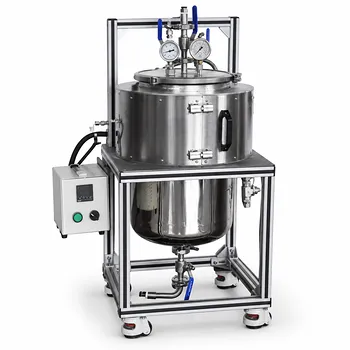
Our integrated crystallization and filtration pilot plants empower students and researchers to physically manipulate process variables—such as cooling rates, seeding strategies, and pressure differentials—to visualize and resolve real-world bottlenecks in cycle time.
Bring hands-on engineering excellence to your facility. Contact LABPARK today to discover the perfect pilot plant solution for your lab!
Related Products
- Multi Functional Membrane Crystallization Educational Unit Operations Pilot Plant
- Potassium Salt Thermal Dissolution and Crystallization Separation Educational Unit Operations Pilot Plant
- Constant Pressure Filtration Educational Unit Operations Pilot Plant
- Hot Filtration Educational Unit Operations Pilot Plant Laboratory System
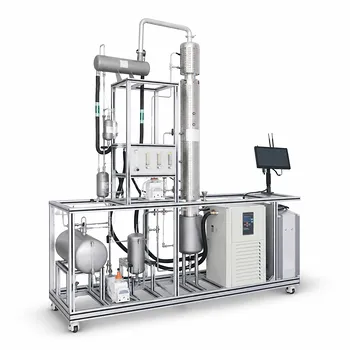
- Continuous Sieve-Plate Distillation Pilot Plant for Unit Operations Laboratory Education
People Also Ask
- Control Crystallization Pilot Plant Secondary Nucleation: 4 Key Adjustments
- Why is precise temperature control critical in crystallization pilot plants? Key to Scale-Up Success
- What key factors should be considered when configuring a crystallization unit operations pilot plant?
- What are the benefits of integrating online PAT tools like ATR-FTIR into crystallization unit operations pilot plants?
- How to use crystallization pilot plant agitation speed to identify diffusion vs reaction growth?