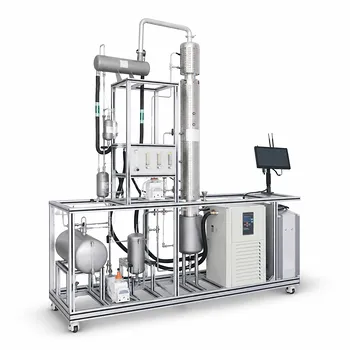
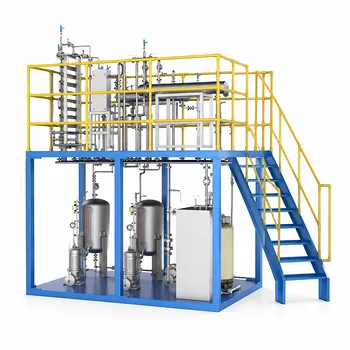
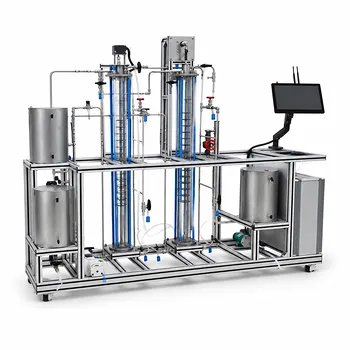
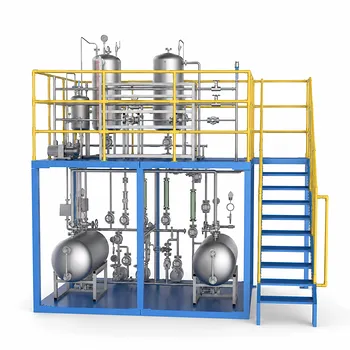
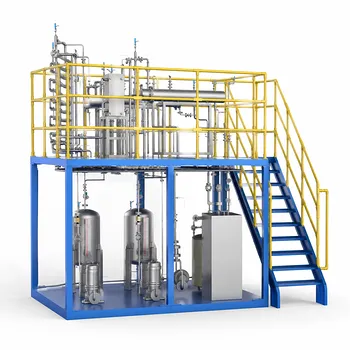
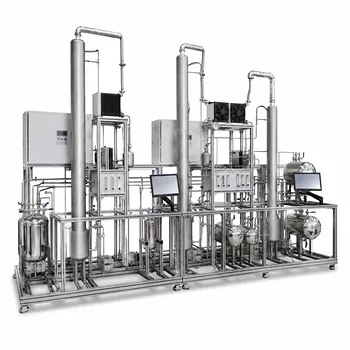
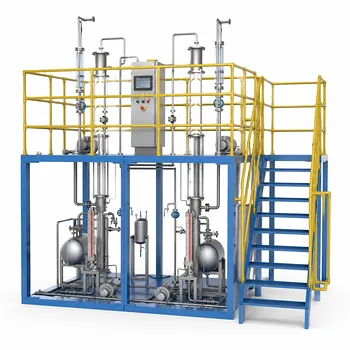
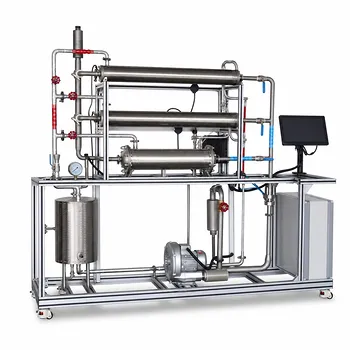
A distillation column heat pump turns waste heat into process heat—a perfect demonstration of energy conservation.
Integrating a mechanical vapor recompression heat pump into a distillation pilot plant captures low-grade thermal energy from the overhead condenser and upgrades it to supply the bottom reboiler. This setup lets students directly calculate the Coefficient of Performance (COPh), observe how close-boiling separations maximize efficiency, and quantify the dramatic reduction in external steam and cooling water consumption.
The integration of a heat pump into a distillation pilot plant provides a tangible, measurable demonstration that energy conservation in chemical processes isn’t just theoretical. By upgrading waste heat with a small amount of compressor work, students see firsthand how a narrow temperature lift and careful system design can slash utility needs and embody the fundamental thermodynamic limits of real-world efficiency.
The Core Energy Conservation Principle: Upgrading Waste Heat
The pilot plant physically closes the thermal loop between condenser and reboiler, making energy conservation intuitive.
From Condenser to Reboiler: Closing the Thermal Loop
A conventional distillation column rejects all condensation heat to cooling water and demands fresh steam for boiling.
The heat pump intercepts this flow: it captures the low-pressure overhead vapor’s latent heat, compresses it to a higher temperature, and delivers it straight to the reboiler.
The result is a single closed energy cycle where the only external input is compressor work.
Students immediately see that waste heat is not worthless—it is merely at an unusable temperature until upgraded.
The Coefficient of Performance as a Teaching Tool
With sensors measuring compressor power and the thermal duty delivered to the reboiler, students calculate the real-time Coefficient of Performance (COPh).
This metric—defined as useful heat output divided by compressor work input—provides a direct, numeric measure of the system’s energy efficiency.
A CoPh of 5, for example, tells the student that for every 1 kW of electrical work, 5 kW of heat are moved into the process.
That stark comparison with a simple electric reboiler instantly demonstrates the multiplying effect of a heat pump on energy conservation.
Why Close-Boiling Mixtures Are the Ideal Case Study
When the temperature difference between the top and bottom of the column is small—as with close-boiling compounds—the compressor’s lift is minimal.
The CoPh soars because the compressor does not need to raise the refrigerant temperature very far.
This gives students an elegantly measurable engineering lesson: operating within a narrow temperature range maximizes energy efficiency.
It directly links thermodynamic fundamentals (the Carnot principle) to process design choices and shows why heat pumps are preferentially applied to separations like propylene/propane or ethylbenzene/xylene.
Bringing Thermodynamic Theory to Life
The pilot plant transforms abstract equations into actionable data, reinforcing energy conservation fundamentals.
Visualizing the Carnot Limit in a Real Process
A heat pump operates between two temperature reservoirs, making it an ideal real-world analogue of a reversed heat engine.
Students can measure the cold reservoir (condenser temperature) and hot reservoir (reboiler temperature) and compare the actual CoPh to the theoretical Carnot limit.
The inevitable efficiency gap drives home the Kelvin‑Planck statement’s lesson: some energy must always be rejected, preventing 100% thermal efficiency.
By analyzing this gap, students see how design choices—like approach temperatures and compressor isentropic efficiency—directly impact conservation outcomes.
Energy Balances and Real-Time Data Collection
Pilot plants equipped with flow, temperature, and pressure sensors allow students to perform full enthalpy balances around the column.
They can measure the energy entering via the feed and compressor, compare it with the energy leaving in the product streams, and confirm that the energy accumulation is balanced by the heat pump’s shifted thermal load.
This hands-on verification of the energy accumulation equation (ΔE = Ein – Eout) cements a core conservation principle in a way textbooks cannot.
When students see a near-zero energy accumulation after accounting for all streams, they trust that energy conservation is not merely an assumption—it is a measurable reality.
Beyond the Single Column: Relating to Pinch Analysis and Process Integration
The heat pump pilot column is a microcosm of plant-wide heat integration.
Students can extend their observations by calculating the pinch point of the column’s internal heat flows and seeing how the heat pump shifts the grand composite curve.
This connects the single unit to broad methodologies like pinch analysis, where matching hot and cold streams minimizes total utility demand.
The pilot plant thus illustrates that energy conservation is a system-level strategy, not an isolated piece of equipment.
Understanding the Trade-offs
While educationally powerful, a heat pump distillation pilot plant comes with real-world constraints that must be confronted.
The Capital Cost vs. Operating Savings Dilemma
A compressor and the associated heat exchangers add significant capital expense.
Students learn that energy conservation is always an economic decision: the operating savings from reduced steam and cooling water must justify the installation cost.
This forces them to perform life-cycle analyses and not simply chase efficiency numbers in isolation.
Contamination Risks with Process Fluid Cycles
When the process stream itself serves as the working fluid, high system sealing is required to prevent contamination by lubricants or external refrigerant.
Students must evaluate whether the efficiency gain of direct compression outweighs the risk of product quality issues, teaching process safety and reliability as integral to sustainable design.
The Narrow Operating Window Challenge
The heat pump’s efficiency collapses if the column’s temperature profile drifts—for example, due to a wider boiling point range in the feed.
This teaches that energy conservation strategies are sensitive to operating context and not universally applicable; students must learn to identify when a heat pump is the right tool and when a multi-effect or simple heat integration scheme is more appropriate.
Making the Most of a Heat Pump Distillation Pilot Plant
The educational value of the setup depends on aligning the experiments with learning objectives.
- If your primary focus is teaching energy efficiency fundamentals: Center exercises on CoPh measurement and the effect of compressor speed. Let students directly quantify how a small work input multiplies into process heat delivery, building a visceral intuition for conservation.
- If your primary focus is advanced process design: Add a variable reflux ratio controller and have students map the interplay between energy consumption, separation quality, and the approach to minimum reflux. This shows how conservative design margins directly inflate utility demand.
- If your primary focus is hands-on measurement and validation: Require full enthalpy balances and pinch calculations. Combine the column’s real-time data with spreadsheet models so students can reconcile theory and experiment, reinforcing that energy conservation is both a physical law and an engineering target.
A well-designed heat pump distillation pilot plant does more than demonstrate a technology—it equips students with the critical thinking needed to make energy-conscious decisions throughout their careers.
Summary Table:
| Key Concept | Practical Application | Educational Value |
|---|---|---|
| Upgrading Waste Heat | Capturing overhead vapor heat to power the reboiler | Demonstrates thermal loop closure and waste heat recovery. |
| Coefficient of Performance (COPh) | Measuring compressor work vs. heat delivered | Quantifies energy efficiency multipliers in real time. |
| Thermodynamic Limits | Comparing actual COPh to the Carnot limit | Visualizes the Second Law and system losses hands-on. |
| Process Integration | Pinch analysis and grand composite curve adjustments | Teaches system-level energy reduction strategies. |
| Economic Trade-offs | Balancing compressor capital costs against utility savings | Introduces practical lifecycle cost analysis. |
Elevate Chemical Engineering Education with LABPARK
Bring complex thermodynamic and energy conservation principles to life in your laboratory. LABPARK provides premium Educational and Vocational Unit Operations Pilot Plants in chemical engineering, bioprocess & biotech, and environmental & water treatment.
Engineered specifically for universities, research institutes, and enterprises, our pilot plants bridge the gap between theoretical calculations and real-world industrial operations, giving students and researchers the tools to master energy integration, process control, and sustainable design.
Ready to transform your laboratory training? Contact LABPARK today to explore our custom pilot plant solutions.
Related Products
- Continuous Sieve-Plate Distillation Pilot Plant for Unit Operations Laboratory Education
- Multi-Modal Distillation Unit Operations Training Pilot Plant
- Dual-Mode Rectification Pilot Plant for Practical Training Unit Operations
- Multi-Functional Special Distillation Educational Pilot Plant
- Three-Tube Heat Transfer Educational Pilot Plant for Unit Operations Training
People Also Ask
- How does catalyst water concentration affect distillation pilot plant design? Key separation train choices.
- How can real-time carbon number prediction improve distillation pilot plants? Optimize control.
- Why is vacuum operation capability an essential feature for a distillation unit operations pilot plant? Unlock Efficiency
- What are the primary reflux ratio control strategies? Master Distillation Unit Operations
- How to select the right activity coefficient model (Wilson, NRTL, UNIQUAC) for distillation pilot plants?