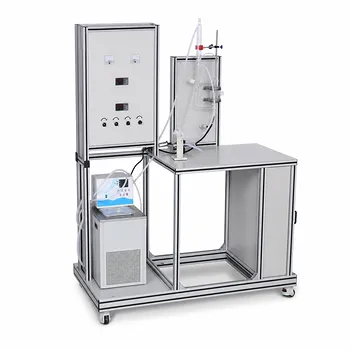
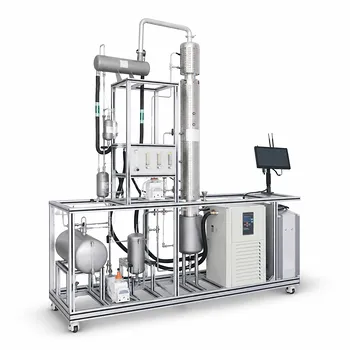
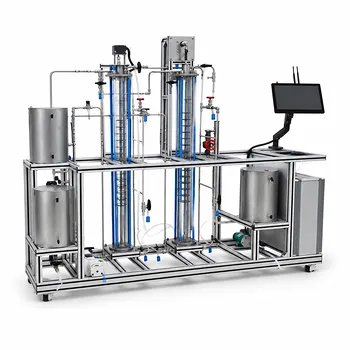
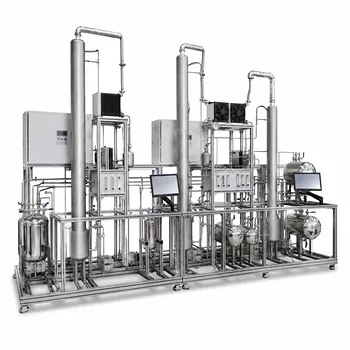
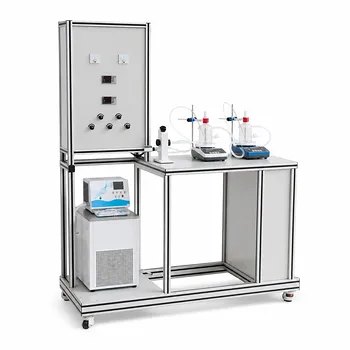
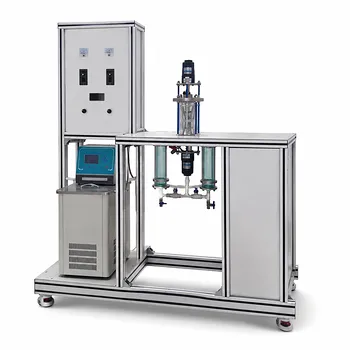
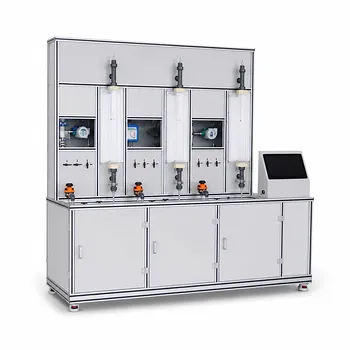
The Gibbs phase rule acts as a control map for your distillation pilot plant. It directly tells you exactly how many variables you must fix to guarantee a stable, defined equilibrium—and, crucially, which combinations are physically meaningful. For a nonreactive binary mixture in vapor–liquid equilibrium, the rule states you have only two independent intensive variables to work with. In practice, that means if you set the column’s operating pressure and, say, the reboiler temperature, the compositions of both liquid and vapor phases are completely locked in.
The Gibbs phase rule reveals that in a binary distillation pilot plant at constant pressure, you only need to control one additional variable to completely determine the equilibrium state. This principle transforms complex multi-variable operation into a manageable, predictable process—and it is the bedrock of any rigorous experimental or educational run.
Why the Gibbs Phase Rule is Your Operational Compass
The Simple Math That Defines Your Control Problem
The phase rule, (F = C + 2 - P), is not abstract theory; it’s a practical control inventory. For a binary system (C = 2) with two coexisting phases—vapor and liquid (P = 2)—the calculation gives F = 2. Those two degrees of freedom are intensive properties like pressure, temperature, or a phase mole fraction.
What “Degrees of Freedom” Really Means at the Pilot Scale
A degree of freedom is an independent knob you can turn without violating the laws of thermodynamics. Once you’ve turned two of those knobs, nature fixes everything else. In a pilot plant, this means you cannot arbitrarily target pressure, temperature, and both product compositions simultaneously—you simply run out of independent controls. Acknowledging this prevents endless loop-tuning and non-reproducible results.
From Theory to Control Strategy: Fixing One Variable, Gaining Certainty
The Power of Operating at Constant Pressure
Most pilot-scale distillation columns maintain a fixed operating pressure via a back-pressure regulator or overhead pressure controller. That decision alone consumes one degree of freedom. According to the phase rule, the system now behaves as if it has only one remaining degree of freedom. You are no longer flying blind—you just have to manage a single key variable.
How Reboiler Temperature Becomes Your Primary Control Knob
With pressure held constant, the phase rule tells you that setting the reboiler temperature (and therefore the boiling point of the liquid at that pressure) uniquely defines the equilibrium compositions on every tray. In educational settings, operators vary the heating utility temperature and watch the column’s temperature profile and top-bottom compositions shift exactly as the t-x-y diagram predicts. That direct cause-and-effect is what makes the rule so valuable for training and research.
Validating Your Operation: Checking Thermodynamic Consistency
Using the Rule to Troubleshoot Off-Spec Separation
When experimental measurements drift from expected purity, the phase rule gives you a diagnostic checklist. First, confirm that control pressure truly is constant. Second, verify the temperature sensors at the reboiler and key stages. If those two intensive variables are stable and you still see off-spec products, you may have a non-ideal mixture or a column not at full equilibrium—prompting a deeper look at activity coefficients or stage efficiency.
Linking Experiment to Theory with T-x-y Diagrams
Pilot plants are designed to make the abstract concrete. By fixing pressure and then varying the reboiler duty (which changes temperature), students can directly map the resulting vapor and liquid compositions. Those measurements are compared against calculated temperature-composition curves derived from thermodynamic models. The Gibbs-Duhem equation then allows consistency checks of this experimental VLE data, helping filter out measurement errors before the data are used for scale-up.
Understanding the Trade-offs and Limitations
The Assumption of Equilibrium: How Real Columns Differ
The phase rule is an equilibrium tool. In a real pilot plant, finite tray efficiencies, pressure drops, and heat losses mean that contact is not ideal. You may have “fixed” two variables, but the local compositions can be biased by mass transfer limitations. Relying solely on equilibrium predictions without considering kinetics can lead to overly optimistic stage counts.
The Danger of Ignoring Non-Ideality
The clean (F=2) story assumes ideal behavior or that you already incorporate activity coefficients. With azeotropic or strongly non-ideal mixtures, the degrees of freedom mathematically remain two, but the relationship between temperature and composition becomes highly nonlinear or multi-valued. The control logic—fix pressure, then pick temperature—still holds, but the composition you get may not be the one you intuitively expect. Pilot plant runs with such mixtures must be accompanied by robust (g^E) models (like Wilson or NRTL) for meaningful interpretation.
Making the Right Choice for Your Experimental Goal
After you understand the phase rule’s constraints, your operational decisions become straightforward. The best strategy depends entirely on what you intend to demonstrate or achieve.
- If your primary focus is precise separation control: Operate at a constant, well-regulated pressure and use reboiler heating duty as your sole manipulated variable to meet the top or bottom purity target.
- If your primary focus is collecting high-quality VLE data: Maintain constant pressure and systematically vary the boiler composition or temperature, letting the system reach equilibrium before sampling—then use the phase rule to confirm that only two variables were free during each steady state.
- If your primary focus is teaching thermodynamic principles: Deliberately “violate” the rule by trying to fix three independent variables and observe the control system’s struggle—this vividly proves that the phase rule is a non-negotiable boundary, not a suggestion.
The Gibbs phase rule strips away the apparent complexity of a binary distillation pilot plant, revealing a simple truth: choose your two control knobs wisely, and the system’s behavior becomes entirely predictable.
Summary Table:
| Parameter / Variable | Value / Role (Binary System) | Control Application in Pilot Plant |
|---|---|---|
| Components (C) | 2 (Binary mixture) | Defines the feed mixture complexity |
| Phases (P) | 2 (Vapor & Liquid) | Represents VLE equilibrium states |
| Degrees of Freedom (F) | 2 (F = C + 2 - P) | Total variables needed to lock the system |
| Controlled Variable 1 | Operating Pressure | Kept constant via pressure regulators |
| Controlled Variable 2 | Reboiler Temperature / Heat Duty | Manipulated to set target product compositions |
Are you looking to bridge the gap between thermodynamic theory and practical training? LABPARK provides state-of-the-art Educational and Vocational Unit Operations Pilot Plants in chemical engineering, bioprocess & biotech, and environmental & water treatment for universities, research institutes, and enterprises. Our systems empower students and researchers to master phase equilibrium, distillation control, and process scale-up with hands-on precision.
Ready to upgrade your laboratory or training facility? Contact LABPARK today to explore our customizable pilot plant solutions!
Related Products
- Binary System Vapor Liquid Equilibrium Data Determination Educational Unit Operations Pilot Plant
- Dual-Mode Rectification Pilot Plant for Practical Training Unit Operations
- Multi-Functional Special Distillation Educational Pilot Plant
- Continuous Sieve-Plate Distillation Pilot Plant for Unit Operations Laboratory Education
- Multi-Modal Distillation Unit Operations Training Pilot Plant
People Also Ask
- Why correlate VLE pilot plant data using Wilson, NRTL, and UNIQUAC? Achieve Accurate Column Scale-Up
- For VLE Experiments: Fugacity vs. Activity Coefficient Method Selection Criteria
- How do pilot plants assist in teaching & researching non-ideal VLE? Bridge Theory & Physical Validation
- How to Model VLE for Supercritical & Unstable Components? Pilot Plant Methods
- Why is accurate VLE data critical? Optimize Unit Operations & Process Scale-Up