Metals are nature’s thermal expressways, and the secret lies in their free-flowing electrons. In the free electron model, a metal’s outermost electrons are released from their parent atoms, forming a highly mobile “sea” of delocalized charges. When you heat one end, those electrons instantly gain kinetic energy and carry it through the lattice, colliding with ions and transferring energy as they go. This extremely efficient, collision-driven energy transport is what gives metals thermal conductivities 10 to 100 times higher than most non-metallic solids. In a heat transfer pilot plant, that property is far more than a textbook curiosity—it is the foundation upon which rapid, precise, and scalable experimental heat exchange is built.
The free electron model explains high thermal conductivity as the result of a vast population of mobile electrons that swiftly convey thermal energy from hot to cold regions. For pilot plants, this translates directly into maximized heat transfer coefficients, minimized conductive resistance, and the ability to faithfully replicate industrial-scale thermal processes at a smaller, safer scale.
How the Free Electron Model Powers Heat Conduction
The Sea of Electrons: A Blueprint for Rapid Energy Transport
In metallic bonding, positive metal ions are arranged in a regular lattice, while their outermost electrons are completely detached and belong to the entire crystal.
These delocalized electrons behave like a fluid that can flow through the material without being anchored to any single nucleus.
When a temperature gradient exists, electrons at the hot end gain extra kinetic energy and mobility.
Because they can travel long distances unimpeded—unlike the bound electrons in ceramics or polymers—they act as a high-speed courier service for thermal energy.
The Collision Cascade: From Ion Vibration to Bulk Conduction
Applying heat sets the local metal ions into more vigorous vibration.
The free electrons immediately absorb some of this energy through collisions, then drift toward cooler zones.
Upon reaching a colder region, they collide with the sluggish ions there, transferring their surplus energy and raising that zone’s temperature.
This perpetual, wave‑like relay of energy via electron‑ion collisions makes metals exceptionally good conductors of both heat and electricity.
Why High Thermal Conductivity Is Critical for Heat Transfer Pilot Plants
Raising the Heat Transfer Coefficient Where It Counts
In shell‑and‑tube or plate heat exchangers, the overall heat transfer coefficient ((U)) is a make‑or‑break performance indicator.
A major throttle on (U) is the conductive resistance of the tube wall itself. Selecting a metal with high thermal conductivity ((k))—often in the range 15–420 W/(m·°C)—dramatically lowers that resistance.
The result is a higher (U), meaning the exchanger can move more thermal energy per unit area, per unit time, and per degree of temperature difference.
Eliminating Conductive Bottlenecks
According to Fourier’s law, the heat flux through a solid is directly proportional to (k) and the temperature gradient.
If the tube wall’s (k) is low, it becomes a thermal bottleneck that distorts the temperature profiles the pilot plant is designed to investigate.
By using metals like copper or aluminum (with (k) values near the top of the range), the wall’s own resistance becomes almost negligible, allowing the true film and fouling resistances to dominate the experiment.
Anchoring Experimental Accuracy and Scale‑Up Fidelity
A pilot plant exists to generate data that can be reliably scaled to full‑size industrial units.
If the chosen metal’s thermal conductivity is unrepresentative or causes excessive temperature drops, the dimensionless correlations (Reynolds, Nusselt, Prandtl) will embed systematic errors.
Using high‑conductivity metals ensures that the conductive time scale is fast compared to convective processes, preserving the dynamic similarity between pilot and plant.
This means measured heat duties, outlet temperatures, and energy balances truly mirror what will happen at production scale.
The Bigger Picture: Managing Conductivity’s Partners and Pitfalls
The Temperature‑Dependence Trap
Thermal conductivity is not a fixed constant. For most solids, (k) decreases as temperature rises (water and uranium being notable exceptions).
In cylindrical pilot‑plant geometries, this is often modeled as (k = k_0(1 + \alpha T + \beta T^2)); for plane walls, a simpler (k = k_0(1 + \beta T)) is used.
Failing to account for these shifts skews energy balance calculations, especially in experiments that span wide temperature ranges.
Pilot plants can be designed to measure temperature profiles in‑situ, allowing researchers to back‑calculate (k) at each operating point and verify these thermodynamic models.
Thermal Expansion: When High Conductivity Meets Mechanical Stress
High‑conductivity metals like aluminum and copper also have relatively high thermal expansion coefficients.
In a pilot plant cycling between low and high temperatures, repeated expansion and contraction can fatigue joints, warp plates, or crack welds.
This forces a trade‑off in material selection: you may accept a slightly lower (k) in exchange for a metal that expands less and mates better with gaskets and supports.
The Insulation Counterpart
Where heat transfer is desired, high (k) metals are king.
But on external surfaces, insulation with extremely low thermal conductivity (<0.2 W/(m·°C), such as fiberglass or silica aerogel) must be applied to guarantee that heat only flows where intended.
This pairing of conductive pathways and insulating boundaries is what makes energy balance closure possible—otherwise, heat lost to the surroundings corrupts the experimental data.
Heat Capacity as a Thermal Stabilizer
High thermal conductivity alone does not guarantee temperature stability.
A reactor vessel undergoing exothermic reactions may benefit from a material with high specific heat capacity, which absorbs excess energy without a sharp temperature spike.
In such cases, the metal choice becomes a balancing act between rapid conduction away from hot spots and the ability to buffer thermal swings.
Making the Right Choice for Your Pilot Plant
Choosing a metal for heat transfer service in a pilot plant is never a one‑factor decision. Use the guiding principle below to align your selection with your primary objective.
- If your primary focus is maximizing heat transfer rates: Opt for the highest practical (k) (copper or aluminum) and design for thin walls to eliminate conductive resistance almost entirely.
- If your primary focus is accurate energy balances: Pair your high‑conductivity metal with a robust insulation system and include dedicated temperature sensors to track and correct for any variation in (k) with temperature.
- If your primary focus is high‑temperature operation: Implement the temperature‑dependent (k) models ((k = k_0(1 + \beta T)) for plane walls, (k = k_0(1 + \alpha T + \beta T^2)) for cylinders) and cross‑check thermal expansion allowances to prevent mechanical failure.
- If your primary focus is education and demonstration: Use pilot plants with interchangeable metal test sections so that students can directly observe how the free‑electron‑driven conductivity of copper outperforms that of stainless steel in real time.
Harnessing the free electron mechanism is about more than just picking a shiny metal—it’s about engineering the entire thermal pathway so that your pilot plant delivers the clear, scalable, and accurate heat transfer data your work demands.
Summary Table:
| Aspect | Mechanism/Value | Impact on Pilot Plants |
|---|---|---|
| Free Electron Model | Delocalized electron sea transferring kinetic energy | Drives rapid, collision-based energy transport |
| Conductivity ($k$) | High range: 15–420 W/(m·°C) | Maximizes heat transfer ($U$) and minimizes resistance |
| Scale-up Fidelity | Faster conduction relative to convection | Ensures dynamic similarity and accurate correlations |
| Design Challenges | Temp-dependent $k$ & thermal expansion | Requires precise material selection and expansion joints |
Optimize Your Thermal Research with LABPARK
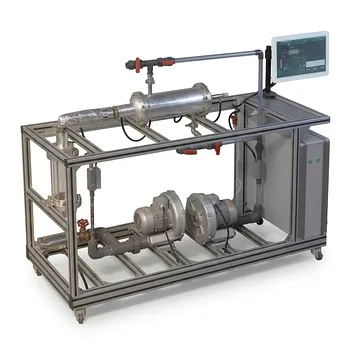
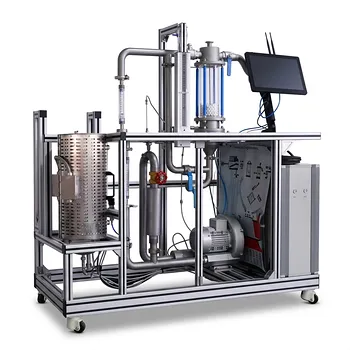
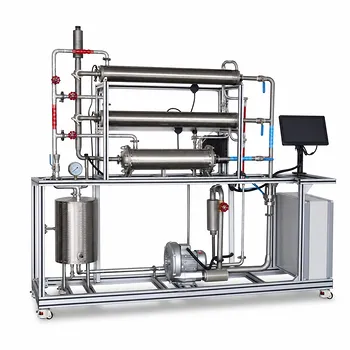
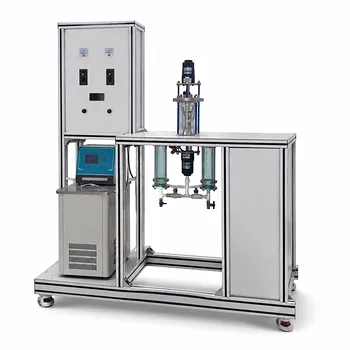
Are you looking to bridge the gap between theory and industrial application? LABPARK provides premium Educational and Vocational Unit Operations Pilot Plants in chemical engineering, bioprocess & biotech, and environmental & water treatment. Tailored for universities, research institutes, and enterprises, our systems ensure precise experimental data and reliable scale-up calculations.
Take your thermal engineering labs to the next level—contact us today!
Related Products
- Dual Mode Heat Transfer Pilot Plant for Unit Operations Training
- Three-Tube Heat Transfer Educational Pilot Plant for Unit Operations Training
- Comprehensive Multi-Modal Heat Transfer Unit Operations Pilot Plant for Engineering Training
- Shell and Tube Heat Exchanger Heat Transfer Coefficient Determination Educational Pilot Plant
- Solid Spherical Heat Transfer Coefficient Determination Educational Chemical Engineering Pilot Plant
People Also Ask
- Why is the study of thermal boundary layers and Prandtl numbers critical in heat transfer unit operations pilot plants?
- When is ε-NTU preferred over LMTD in pilot plants? Predict heat exchanger performance without iteration.
- How do unit conversions affect pilot plant calibration? Avoid errors in heat transfer data analysis
- Why is the prevention of scale formation on heat exchanger surfaces a critical learning objective? Key Lessons
- How is the thermal resistance of a thick-walled hollow cylinder calculated? Key Equations